
Ling
Hokarari, Hoka, Rari
Genypterus blacodesAlso known as Kingklip, pink ling, pink cusk-eel, ling cod
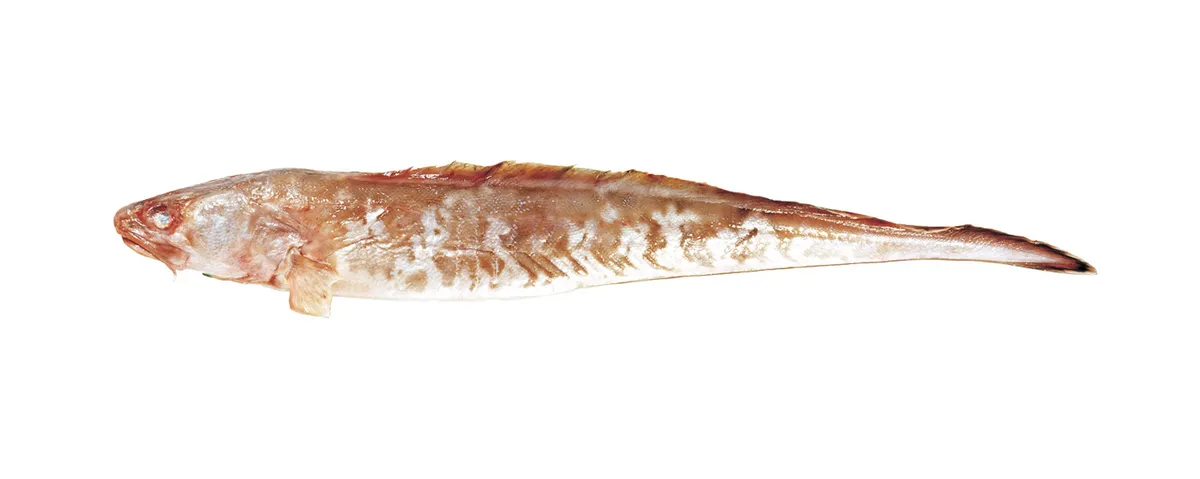
Ling (hokarari) is a long, eel-like deepwater fish found around New Zealand in 200 to 800 m, mostly south of 40°S. Look for the long, slimy, orange-pink body mottled with creamy white, and thin, feeler-like pelvic fins. Mostly caught commercially, it is prized for thick, boneless, firm white fillets.
How to identify ling
A long, eel-like fish with slimy skin. The body is orange-pink, irregularly mottled with creamy white, and white underneath. The pelvic fins are reduced to two thin, barbel-like filaments on the throat, below the eye. The mouth is large, with the jaw reaching back to the rear of the eye or just beyond. Females grow faster and larger than males. In Australia it is sold as pink ling, a name that matches its colour.
Size and daily limits
Daily limitVaries by area5 a day in Fiordland. A shared or split limit applies in Kaikōura. No species limit in Auckland and Kermadec, Central, Challenger, South-East, and Southland.Limits for each area
| Area | Min. size | Daily limit |
|---|---|---|
| Auckland and Kermadec area | None | No species limit (combined 20 a day) |
| Central area | None | No species limit (combined 20 a day) |
| Challenger area | None | No species limit (combined 20 a day) |
| Kaikōura area | None | Varies, see note Albacore tuna, bluenose, groper (hāpuku)/bass, kingfish and ling share a combined daily limit of 5 per person, with a maximum of 3 of any one species. |
| South-East area | None | No species limit (combined 30 a day) |
| Fiordland area (Fiordland Marine Area) | None | 5 Inside the Fiords: 1 per day. |
| Southland area | None | No species limit (combined 30 a day) |
Within combined finfish daily limit. Kaikōura: shares combined 5 with albacore, bluenose, hāpuku/bass and kingfish.
Checked 22 October 2026 · Source: MPI. Rules change, so check the NZ Fishing Rules app before you keep a fish.
Where it lives in New Zealand
Found throughout New Zealand's middle depths (200 to 800 m), especially south of 40°S. Main grounds are the west coast of the South Island, Cook Strait, the Chatham Rise, Bounty Plateau, Puysegur Bank, the Stewart-Snares shelf and around the Auckland Islands. Ling are mainly bottom dwellers and some live in burrows in the seafloor. They rise off the bottom to feed, for example on hoki during the hoki spawning season.
How to catch it
Ling are mostly caught commercially by trawl, bottom longline and pots. Recreational catches are small and usually come as a bycatch when bottom fishing in deep water with bait. A 1993–94 survey estimated about 10,000 fish a year taken by recreational fishers in the northern region, and later surveys found catches too low to estimate reliably.
Eating
Thick, boneless, firm white fillets with a mild flavour. Ling suits almost any method: bake, fry, barbecue, poach, steam or smoke it, or use it in curries, casseroles and chowder. It can also be served raw as sashimi. Ling is very lean and a good source of omega-3 fatty acids, selenium and vitamin B12.
Recipes
- Panko crumbed ling taco (Seafood New Zealand)
- Green fish curry (Seafood New Zealand)
Good to know
The oldest ling recorded in New Zealand was 46 years old, though few live past 30. Females grow faster and larger than males. Ling are managed under the Quota Management System as several separate stocks.
Questions
Is ling good eating?
Yes. Ling has thick, boneless, firm white fillets with a mild flavour. It is very lean and suits almost any method: bake, fry, barbecue, poach, steam or smoke it, or use it in curries and chowder. It can also be served raw as sashimi.
Is ling the same as ling cod?
No. New Zealand ling (Genypterus blacodes) is a cusk-eel, not a cod, although many people search for it as ling cod. Lingcod is an unrelated fish from the North American Pacific coast. In Australia our ling is sold as pink ling, after its colour.
Can you catch ling in New Zealand?
Yes, but rarely. Ling live on or near the bottom in 200 to 800 m, mostly south of 40°S. Recreational catches are small and usually come as bycatch when bottom fishing with bait in deep water. Most ling are caught commercially by trawl, bottom longline and pots.
What's the difference between ling and red cod?
Ling have a long, eel-like body with the dorsal and anal fins running into the tail, and pink skin mottled with cream. Red cod have a normal cod shape with a separate tail, a reddish-brown back and a small barbel under the chin. Red cod are sometimes mistakenly called ling.
Related species
 EndemicSaltwater
 Saltwater
 Saltwater
 Saltwater
More guides
All guides- ArticlesNZ fishing rigs and knots: diagrams and when to use eachClear diagrams of the main NZ fishing rigs (ledger, running sinker, strayline, surfcasting, live bait) and the knots to tie them, with which fish each catches.
- ArticlesHow to fillet a fish: snapper, gurnard, kahawai and moreStep-by-step filleting for NZ fish, with photos: the basic method, skinning and pin bones, and what is different about snapper, gurnard, kahawai and blue cod.
- ArticlesBest time to fish in New ZealandWhen to catch snapper, kingfish, kahawai, tuna, trout and salmon in New Zealand, with a month-by-month calendar and what bites in each season.