
Blue Cod
Rāwaru, Pākirikiri (also used for the spotty), Taipua, Kopukopu, Pātutuki
Parapercis coliasAlso known as New Zealand blue cod, Rock cod
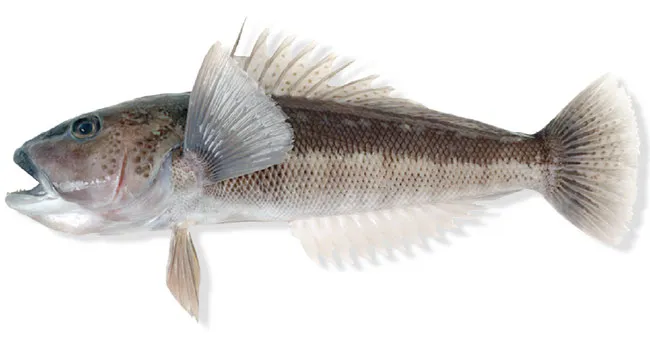
Blue cod (rāwaru) is a bottom-dwelling reef fish found only in New Zealand, and the most caught recreational fish in the South Island. Look for a round, elongated body, a smoothly sloping head with big lips, and blue to blue-green upper sides over a pale belly. It is most common south of Cook Strait.
How to identify blue cod
- A round, elongated body that is flattened underneath, built for resting on the bottom.
- A smoothly sloping, rounded head with a big mouth and thick, fleshy lips. The eyes are large.
- Adults are blue-grey to blue-green on the back and upper sides, fading to white on the belly. Smaller fish are paler and blotched brown.
- A short first dorsal fin of about five short spines, followed by a long soft dorsal fin that runs almost to the tail. The anal fin is long too.
- Pelvic fins set well forward on the throat, which the fish uses as props when it rests on the seabed.
Blue cod are stocky, round-bodied fish with a smoothly sloping head and snout, a big mouth with thick lips, and large eyes that can swivel to look almost all the way round. The belly is flat, and the pelvic fins sit far forward on the throat. They have no swim bladder, so they sink when they stop swimming, and they spend most of their time resting on the bottom, propped on those fins.
Colour changes with size and sex. Juveniles are pale with two long dark stripes along the sides, which fade to brown blotches as the fish grow. Once they pass about 25 cm, both sexes are bluish-grey on the back with a white belly. Females often have an orange tinge and tend to turn greener as they get bigger. Adult males are blue-grey with greenish sides and a golden-brown line above each eye. Males grow faster and bigger than females, so most of the biggest blue cod you see will be males.
Despite the name, blue cod are not related to true cods. They belong to the sandperch family, Pinguipedidae. Divers find them easy to approach, and curious fish will swim right up and nip at fingers.
Often confused with
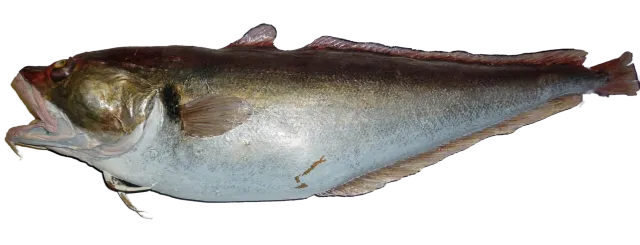
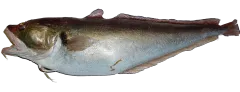 Red CodPseudophycis bachusRed cod are reddish pink, paler underneath, with a black blotch at the base of the pectoral fin and no spiny dorsal fin. Their flesh is much softer. Red cod live mostly over sand and mud, not reef.
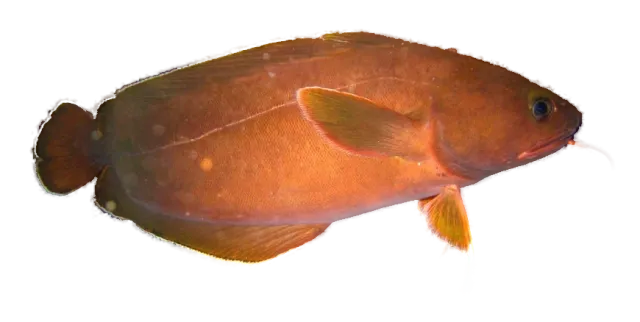
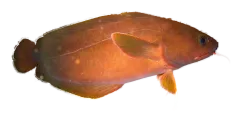 Rock CodLotella rhacinaRock cod (Lotella rhacina) are chocolate brown, with a pale chin barbel, white edges to the fins and two dorsal fins with no spines. They hide in reef caves by day. Blue cod have no barbel and are blue-grey to green. "Rock cod" is also an old name for blue cod.
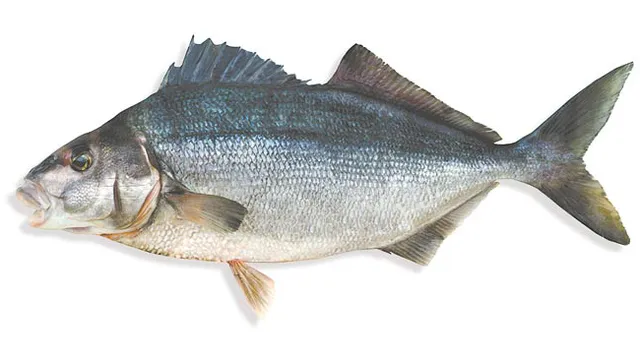
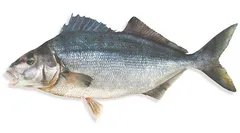 Blue MokiLatridopsis ciliarisBlue moki are deep-bodied, blue-grey and silver fish with a small mouth, often with brownish blotches below the dorsal fins. Blue cod are long and round-bodied with a big mouth.
- Sea perch
Sea perch have a large, spiny head and a long dorsal fin of sharp spines, which can give a painful, venomous jab. Blue cod have a smooth head and only a few short spines.
- Spotty
Spotties are small wrasses, under 25 cm, brownish-yellow to greenish or blue-grey with a large smudged spot on the side. Some Māori names, such as pākirikiri, are shared between the two fish.
Size and daily limits
Minimum size30–33 cmDaily limitVaries by area10 a day in Fiordland and Southland. A shared or split limit applies in Central, Challenger, Kaikōura and South-East. No species limit in Auckland and Kermadec.Limits for each area
| Area | Min. size | Daily limit |
|---|---|---|
| Auckland and Kermadec area | 30 cm | No species limit (combined 20 a day) Multi-day trips: may hold 2 daily limits if you can prove you did not exceed the daily limit on any day. |
| Central area | 33 cm | Varies, see note By area: Taranaki to Titahi Bay (FMA 8): 2 per day. Titahi Bay to Cape Runaway (FMA 2): 20 per day. Min 33 cm, landed whole or gutted only. Multi-day trips: may hold 2 daily limits with proof. |
| Challenger area | 33 cm | Varies, see note By area: Tasman (Farewell Spit to Clarence River, incl. Marlborough Sounds) 2 per day; Kahurangi (Heaphy River to Farewell Spit) 10; Westland (south bank of Haast River to Heaphy River) 15; South West (Sandhill Point to south bank of Haast River) 10; Paringa, Popotai Taumaka/Open Bay Islands, Okahu/Jacksons Bay and Tauneke/Barn Bay Mātaitai Reserves: 5 per person, vessel limit 15. Min 33 cm. Landed whole or gutted only, except Westland and the mātaitai reserves where headed-and-gutted is also allowed (headed min 24 cm, measured from base of side pectoral fin to middle ray of tail). Marlborough Sounds closed to blue cod 1 September to 10 January (inclusive) each year. May possess up to 4 in Challenger Tasman area if proven no more than 2 taken on any one day there. Multi-day trips: 2 daily limits with proof. |
| Kaikōura area | 33 cm | Varies, see note Kaikōura Marine Area (Te Whata Kai o Rakihouia i Te Tai o Marokura): 6 per day. Te Taumanu o Te Waka a Maui Taiāpure and Oaro-Haumuri Taiāpure: 2 per day. Everywhere else within Kaikōura: 10 per day. Min 33 cm, landed whole or gutted only. |
| South-East area | 33 cm | Varies, see note By management area: Kaikōura (Clarence River to Hurunui River) as per Kaikōura area; Canterbury (Hurunui River to Rakaia River) 2 per day incl. Akaroa Taiāpure, closed in Rāpaki and Lyttelton Harbour/Whakaraupō and Extension mātaitai reserves; North Otago (Rakaia River to Taiaroa Head) 10 per day, East Otago Taiāpure 2; Southern (Taiaroa Head to Sand Hill Point) 10 per day. Min 33 cm. Landed whole or gutted (Southern area also headed). Pots: rigid square mesh at least 54 mm x 54 mm. Multi-day trips: 2 daily limits with proof. |
| Fiordland area (Fiordland Marine Area) | 33 cm | 10 Inside the Fiords (incl. Internal Waters): 1 per day. Milford Sound (Piopiotahi) Internal Waters blue cod closure area: no take or possession. No accumulation beyond one day's limit anywhere in the Fiordland Marine Area. Landed whole or gutted only. No blue cod pots in the Internal Waters. Measure from tip of nose to rear end of middle ray of tail fin. |
| Southland area | 33 cm | 10 Southern (Taiaroa Head to Sand Hill Point): 10, landed whole, gutted or headed and gutted. South West (Sandhill Point to south bank of Haast River, excl. Fiordland Marine Area): 10, landed whole and gutted. Te Whaka ā Te Wera/Paterson Inlet Mātaitai: 10. Headed state min 24 cm where permitted (base of side pectoral fin to middle ray of tail). |
Within combined finfish daily limit. Blue cod limits are set by blue cod management area, which can cross MPI fishing-area boundaries; when moving between areas the lowest limit applies (stated on the Fiordland page).
Checked 22 October 2026 · Source: MPI. Rules change, so check the NZ Fishing Rules app before you keep a fish.
Check the rules for the exact spot you're fishing before you leave. Blue cod limits change a lot around the South Island, and 'I didn't know' won't help you at the boat ramp.
Where it lives in New Zealand
Blue cod are found only in New Zealand, from the shore to the edge of the continental shelf, near rocky reef and broken ground down to about 150 m. They are far more common south of Cook Strait and around the Chatham Islands. The biggest commercial fisheries are off Southland and the Chathams, with smaller ones off Otago, Canterbury, the Marlborough Sounds and Whanganui.
They like bedrock outcrops on gravel or sand, especially where there is kelp, other seaweed or sponge. Juveniles shelter in sponge gardens and shallow reef, while adults are mostly found on reef edges and in deeper water.
Blue cod don't travel far. In a Foveaux Strait tagging study, 60% of recaptured fish had moved less than 1 km, though a few went as far as 156 km. Fiordland tagging found much the same. That makes local populations easy to fish down, which is why some sounds and harbours have their own rules or closures.
Blue cod spawn over a long season in late winter and spring. Eggs drift for about five days, and the larvae for about five more, before settling on the bottom.
- Jan: good
- Feb: good
- Mar: good
- Apr: good
- May: good
- Jun: good
- Jul: good
- Aug: good
- Sep: good
- Oct: good
- Nov: good
- Dec: good
How to catch it
Bottom fishing from a boat: almost all recreational blue cod are caught on rod and line from a boat. Find rocky reef, broken ground or the edge of a reef where it meets gravel or sand, and fish your bait right on the bottom. A two-hook ledger (dropper or paternoster) rig with enough sinker to hold bottom is the standard; see the fishing rigs guide. Blue cod are not fussy: squid, pilchard and fresh fish fillets all work, and cut baits stay on the hook better than soft ones (see the bait guide). If you aren't getting bites within a few minutes, move. Blue cod stay close to home, so a spot that has been fished hard can be empty while the next patch of reef is busy.
Use bigger hooks to protect undersized fish. Blue cod have no swim bladder, so unlike snapper they don't suffer from being brought up from depth. Research for the Ministry of Fisheries found that small fish caught on large (6/0) hooks, which seldom gut-hook them, survive well if they are put back quickly. Circle hooks help for the same reason. Lip-hooked fish can be released in a few seconds.
Potting and spearfishing: in many areas you can also take blue cod in a cod pot, but pots must meet mesh rules and are banned in some places, such as the Fiordland internal waters. Divers spear blue cod over shallow reef, where the fish often come in close.
Look after the catch. Bleed and ice your fish straight away (bleed and ice guide). Blue cod must stay whole or gutted until you are back on land (some areas also allow headed and gutted), so don't fillet them at sea. Then use the filleting guide.
Eating
Blue cod is one of New Zealand's most prized eating fish. The flesh is white, delicate and flaky, with a mild flavour and low oil content. Because it is so mild, simple cooking shows it off best: fillets pan-fried in butter, battered for fish and chips, or baked whole.
It also suits poaching, marinating, chowder and soup. Smoked blue cod is a southern favourite, though as a lean fish it dries out faster than oily fish like kahawai, so smoke it for a shorter time or brine it first (see the smoking guide).
The fillets are soft and break up easily, so handle them gently once filleted, and bleed and chill the fish as soon as it is caught.
Recipes
- Panfried blue cod on buttered leeks with crisp bacon (RNZ)
- Blue cod and seaweed ceviche (Cuisine)
- Creamy blue cod pie (New World)
Good to know
Blue cod is New Zealand's third most caught recreational fish, after snapper and kahawai, and the most caught in the South Island. Recreational fishers kept an estimated 316,746 blue cod (about 170 tonnes) in the year to September 2023, and 83% of them came from the three South Island areas. It is the most important recreational finfish in Marlborough, Canterbury, Otago, Southland and the Chatham Islands. Bones in middens show it was also an important fish for Māori before Europeans arrived.
Blue cod is managed under the Quota Management System. Commercial fishers now take most of their catch in cod pots rather than on hand lines. The fish has low productivity, and stocks under heavy fishing pressure decline quickly. In 2025, Fisheries New Zealand rated overfishing as very likely to be occurring off Otago, and recreational fishers report local depletion in parts of the east coast, Southland and the top of the South Island. The rules were overhauled in 2020, and they now differ a lot from area to area.
Blue cod can live to about 32 years. When they mature depends on where they live: at about 2 years and 10–19 cm in Northland, but 4–5 years and 26–28 cm in Southland. Some fish start life as females and later change into males, while others are male from the start. Chatham Islands blue cod may be genetically distinct from mainland fish.
Questions
What are the blue cod rules?
They depend on exactly where you fish. Minimum sizes, daily limits and seasonal closures differ between areas, and some harbours, sounds and mātaitai reserves have their own rules or are closed to blue cod. The table above shows the current rules for each area and when we last checked them against MPI. You can also use the rules checker.
What is the Māori name for blue cod?
Rāwaru is the most common Māori name for blue cod. Te Aka Māori Dictionary also records pākirikiri, taipua, kopukopu and pātutuki. Pākirikiri is used for the spotty as well, a different fish.
How big do blue cod get?
Most blue cod caught are 30–40 cm long and weigh 0.8–1.5 kg, and the biggest reach about 60 cm and 3 kg. Using Fisheries New Zealand length-to-weight formulas from southern surveys, a 35 cm fish weighs about 0.6–0.8 kg, a 40 cm fish about 1–1.2 kg, a 45 cm fish about 1.4–1.7 kg and a 50 cm fish about 2–2.4 kg. Males grow bigger than females.
How do you fillet blue cod?
Keep the fish whole or gutted until you are back on land, then fillet it like most round fish. Blue cod have a big head, so angle the first cut towards the head to save flesh, and handle the soft fillets gently. Our filleting guide has a section on blue cod.
How much is blue cod per kg?
Prices vary by shop, region and season, so check with your local fishmonger. Blue cod is sold fresh and is usually one of the dearer fish on the counter, partly because supply is small. The whole commercial catch was about 1,700 tonnes in 2022–23, much of it potted off Southland and the Chatham Islands.
What's the difference between blue cod and red cod?
They are different families. Blue cod are blue-grey to green, firm-fleshed reef fish with a short spiny dorsal fin. Red cod are reddish pink with a black spot at the base of the pectoral fin, no spiny dorsal fin and much softer flesh, and live mostly over sand and mud. The national recreational survey asks fishers to always check whether a cod was red or blue.
Related species
 Saltwater
 EndemicSaltwater
 Saltwater
 Saltwater
More guides
All guides- ArticlesBest bait for fishing in NZ: a species-by-species guideWhat bait to use for snapper, kahawai, gurnard, kingfish and more in NZ: a species-by-species table, how to rig each bait, and how to use burley.
- ArticlesThe best eating fish in New ZealandThe best New Zealand fish to eat, grouped by how to cook them: snapper and blue cod for frying, kingfish for sashimi, kahawai for smoking and more.
- ToolsFish weight calculatorWork out what your fish weighs from its length, or how long a fish of a given weight is, for snapper, kingfish, kahawai and 25 more NZ species, from Fisheries NZ data.