Squid
Ngū
Sepioteuthis australis, Nototodarus sloanii, Nototodarus gouldiAlso known as Southern calamari, Broad squid, Southern reef squid, Arrow squid, Calamari
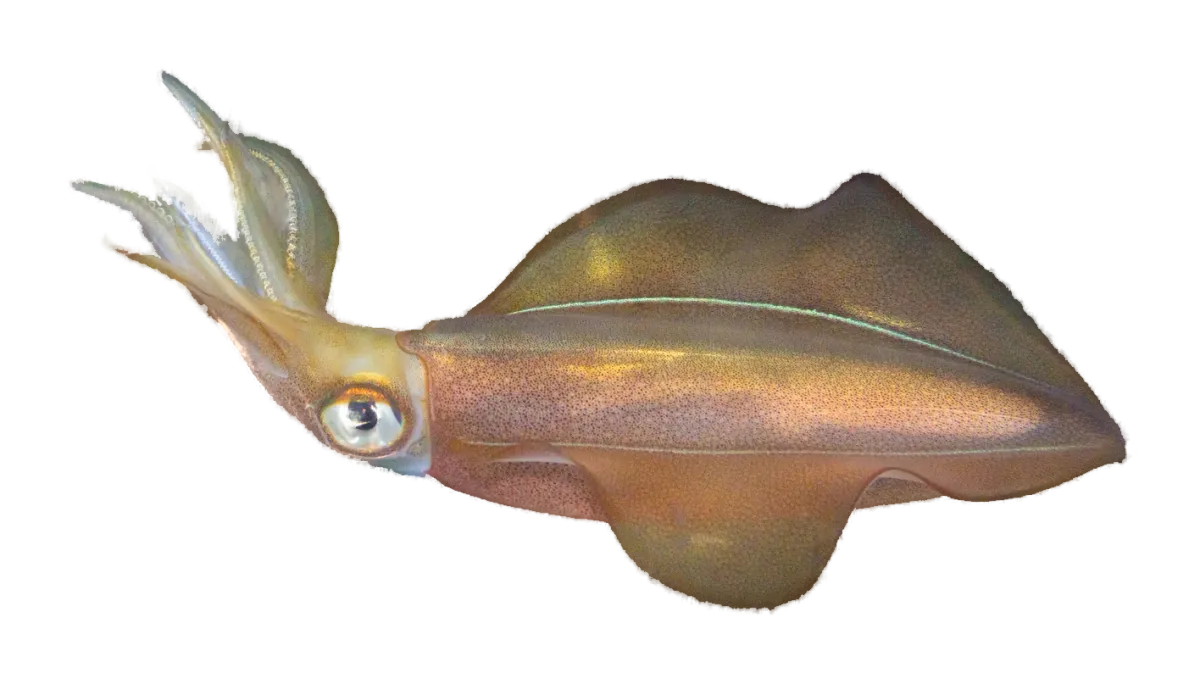
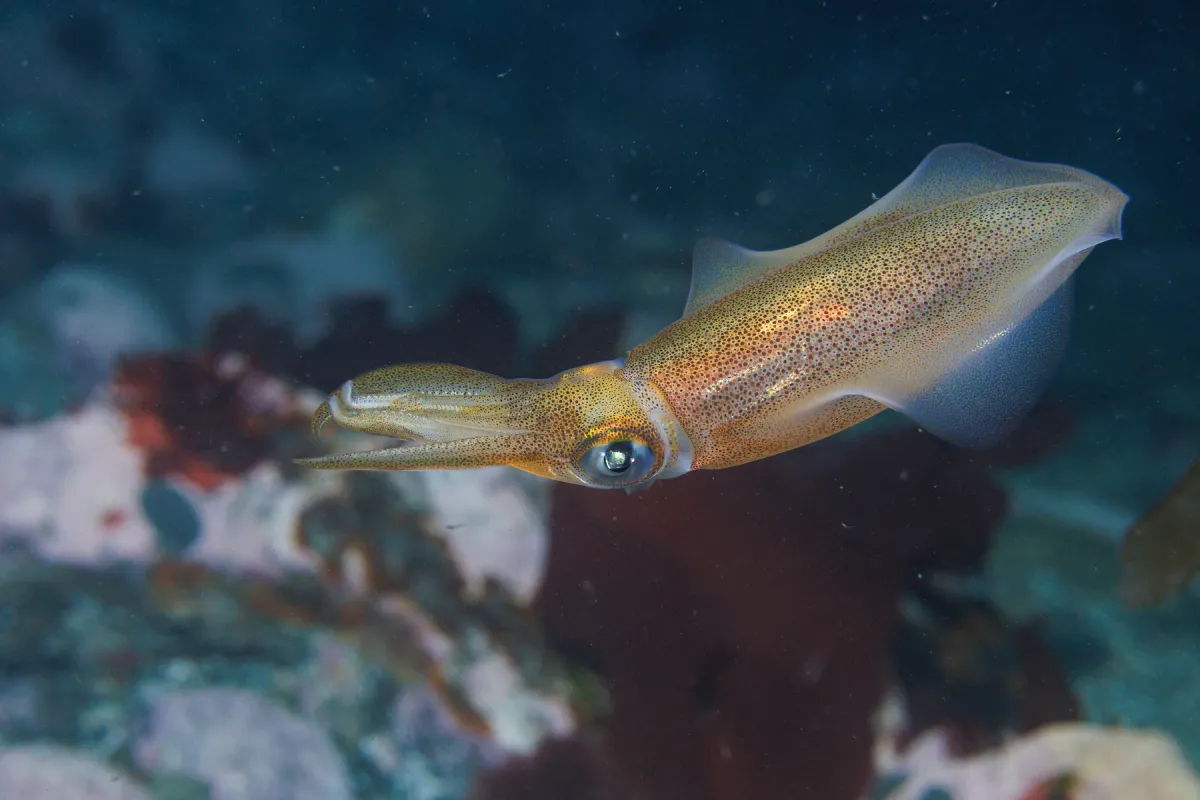
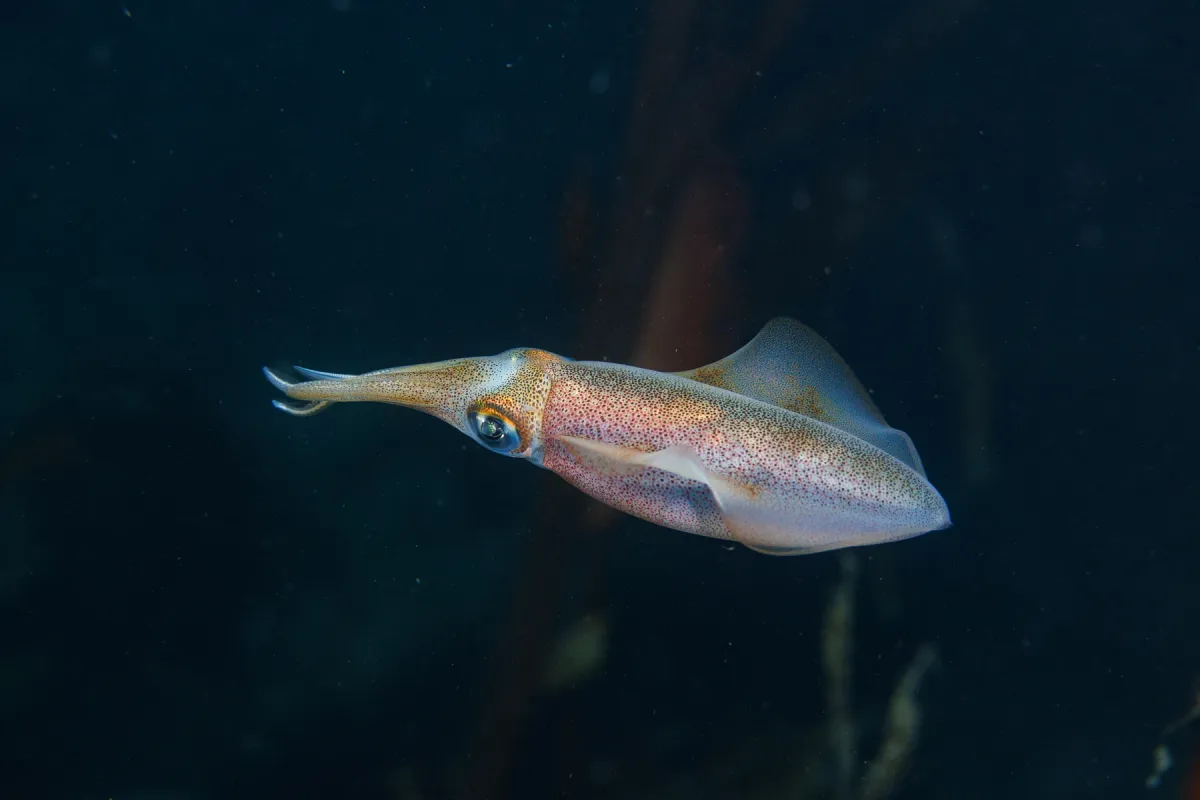
Squid (ngū) in New Zealand means two groups. Southern calamari, or broad squid, is the one caught on jigs from northern wharves, rocks and boats, mostly at night and from June to October. Arrow squid live out on the continental shelf, are fished commercially in the south, and are the squid sold as bait and rings. Both live about a year.
How to identify squid
- Southern calamari have diamond-shaped fins that run the full length of the body.
- Arrow squid have a slim, torpedo-shaped tube with a short arrowhead fin at the tail only.
- Ten arms in all, eight arms and two long feeding tentacles, which tells any squid from an octopus.
- Colour changes fast, from orange-brown to banded to almost see-through, and they squirt black ink when caught.
Two kinds of squid matter to New Zealand anglers, and the fins tell them apart. The southern calamari or broad squid (Sepioteuthis australis) has fins that run the whole length of its body and are widest in the middle, which gives it a rounded, almost cuttlefish-like outline. The arrow squids (Nototodarus sloanii and N. gouldi) have a slim, heavily muscled tube that tapers to a point, with a short arrowhead-shaped fin at the tail end, about 42 to 48% of the mantle length.
The two arrow squid look almost identical. Scientists tell them apart by counting suckers under magnification, so in practice they're told apart by where they live: Gould's or red arrow squid north of the Subtropical Convergence, and N. sloanii in and south of it.
All squid have ten arms: eight arms plus two longer feeding tentacles. Inside is a clear, flexible quill (the pen), not a bone. Calamari change colour constantly, from an even orange-brown to white with dark bands to almost transparent, and when threatened they squirt ink as a decoy and jet away. Black ink stains on a wharf are a good sign squid have been caught there.
Often confused with
- Arrow squid
A slim tube with a short arrowhead fin at the tail. Calamari fins run the full length of the body. Arrow squid are caught inshore less often, though anglers do take them off some wharves.
- Octopus
Octopus have eight arms and no long feeding tentacles. Squid have eight arms plus two longer tentacles.
Size and daily limits
Daily limitVaries by areaLimits for each area
| Area | Min. size | Daily limit |
|---|---|---|
| Auckland and Kermadec | None | 10DetailsFrom 1 November 2026: 10 squid (all species) per person per day in the Auckland Coromandel area, both inside the new intertidal closure (mean high-water mark to 2 m depth), where squid stays open, and outside it. Before 1 November, and in the rest of the Auckland/Kermadec area, squid is not named and falls under 'All others (combined)' shellfish, 50 per day. The Ōmaha Bay, Kawau Bay and Whangaparāoa Peninsula closure (from 12 Mar 2026, 2 years, rock pools out to 200 m) prohibits taking squid. The Auckland area rules page (reviewed 10.09.26) does not show the new limit yet. |
| Central | None | Not listedDetailsNot named. Falls under 'All others (combined)' shellfish, 50 per day. |
| Challenger | None | Not listedDetailsNot named. Falls under 'All others (combined)' shellfish, 50 per day. |
| Kaikōura | None | Not listedDetailsNot named. Falls under 'All others (combined)' shellfish, 30 per day. |
| South-East | None | Not listedDetailsNot named. Falls under 'All others (combined)' shellfish, 50 per day. |
| Fiordland | None | Not listedDetailsNot named. Falls under 'All others (combined)' shellfish, 20 per day. |
| Southland | None | Not listedDetailsNot named. Falls under 'All others (combined)' shellfish, 50 per day. |
MPI counts squid as shellfish, not finfish, so squid does not count toward the combined finfish limit. Where it has no individual limit it falls under the area's 'All others (combined)' shellfish limit. MPI's 'squid (all species)' covers arrow squid and any other squid. No minimum size anywhere.
Before you gather
- Check the MPI shellfish biotoxin alerts for the beach you're going to. Toxins can't be cooked out.
- Check for rāhui, mātaitai and other customary management areas, which can have their own limits or closures.
- Check you're not in a marine reserve. Taking anything from one is illegal.
- Seen someone taking too much or undersize shellfish? Call MPI on 0800 4 POACHER (0800 47 62 24). Calls are confidential.
Checked 23 October 2026 · Source: MPI. Rules and closures change, so check the NZ Fishing Rules app before you gather.
Where it lives in New Zealand
Southern calamari live in shallow coastal water around the North Island, over reef, sand and seagrass, from the surface down to about 10 m. They're most active in the evening and at night, when they feed on small fish and prawns, and they're drawn to the baitfish that gather under wharf lights. Shallow, weedy spots with some current and clear water are best: lit wharves and jetties, rocky points and boat ramps.
Arrow squid live out on the continental shelf, down to about 500 m and mostly shallower than 300 m. Gould's arrow squid is found around the mainland north of the Subtropical Convergence, and N. sloanii mainly in southern shelf waters. Big arrow squid are sometimes caught offshore at night, for example by anglers drifting for broadbill.
Anglers also catch squid from wharves around Wellington and the top of the South Island. The sources we found place southern calamari only around the North Island, so squid caught further south may be arrow squid.
Squid can be caught all year, but the main inshore run is June to October. They're big enough to keep from about late May, and bigger squid turn up more from about August. Each squid lives only about a year, so every season is a new crop.
- Jan: quieter
- Feb: quieter
- Mar: quieter
- Apr: quieter
- May: quieter
- Jun: good
- Jul: good
- Aug: good
- Sep: good
- Oct: good
- Nov: quieter
- Dec: quieter
How to catch it
In snaggy spots, hang your jig about a metre under a float and let the swell work it. You'll lose far fewer jigs, and it's an easy way to get kids catching squid.
Most squid are caught on squid jigs (egi): barbless, shrimp-shaped lures with rows of fine spikes at the tail. Jigs are sized in inches by length, not weight. A 2.5 is the best size to start with. Go smaller (1.8 to 2.5) for the small squid early in the season, up to 3.0 for bigger squid later on, and 3.0 to 3.5 in daylight or strong current, when you need the jig to sink faster to the bottom. The pack shows the sink rate in seconds per metre, so you can count the jig down to the depth you want.
Colour is worth changing. At night, pink and orange are the most consistent, with red and green as back-ups, though natural colours can do better under bright wharf lights. By day in clear, calm water, natural baitfish patterns work better, and dark colours suit low light. If squid follow the jig without grabbing it, change the size, colour or brand.
Cast, let the jig sink, give it two or three sharp lifts of the rod, then pause and let it sink again while you slowly wind in the slack. The pause matters most: squid usually grab the jig as it sinks, often about a foot off the bottom. Don't strike. Wind down gently and keep a bend in the rod, because the jig has no barbs and a slack line lets the squid go. Keep the drag light so the spikes don't tear out.
Fish lit wharves, bridges and boat ramps at night, and the dawn and dusk changeovers. Squid usually sit at the edge of the light rather than in the middle of it, so cast to where the light fades. Keep your headlamp off the water. The tide with the least flow is easiest, and many anglers like the end of the incoming tide, especially when it lines up with dusk. From a boat, squid come up to deck lights at anchor, or you can drift one or two jigs on droppers over weed beds.
A light spinning rod of 8 to 9 ft with a 2000 to 2500 size reel, light braid and 2 to 3 m of fluorocarbon trace is the usual setup. Use a heavier trace around weed. When you lift a squid out, point it away from you and let it squirt its ink first.
Squid is also one of the best baits there is. Snapper find it hard to resist, it stays on the hook better than pilchard, and a live squid bridled through the tip of the tube is a top bait for kingfish. Freeze what you don't eat for bait.
Eating
Kill squid quickly with a spike or a sharp chop just above the eyes, then ice them. To clean one, pull the head and tentacles away from the tube, which draws out the insides. Keep the ink sac whole if you want the ink. Cut the tentacles off just below the eyes so they stay in one piece, and squeeze out the hard beak from the centre. Pull out the clear quill, peel the skin off the tube and fins, and rinse the tube clean.
Squid needs either very quick, very hot cooking or long, slow cooking. Anything in between makes it rubbery. Cut the tube into rings, or open it out and score the inside in a crosshatch, then fry, grill or barbecue it for a minute or two. Crumbed and fried calamari is the Kiwi classic. Large squid are better braised slowly in a stew or sauce. The ink colours and flavours pasta and risotto.
Good to know
Arrow squid are one of New Zealand's biggest commercial fisheries. They entered the Quota Management System in 1986, and the catch limits now total about 82,000 tonnes a year across the main stocks (SQU 1J for jigging, SQU 1T and SQU 6T for trawling). Japanese jigging boats began fishing squid here in 1969, and jig landings peaked at about 54,000 tonnes in 1988–89. There has been no jig fishery since 2016–17, when every vessel fishing in the EEZ had to be New Zealand-flagged. The catch is now almost all taken by trawlers on the Stewart-Snares shelf and around the Auckland Islands, and landings were about 15,600 tonnes in 2023–24. Most of it is frozen and exported.
Squid grow fast and live only about a year. Arrow squid spawn once and die. Southern calamari lay clumps of finger-like egg strings, each holding a few eggs, at the base of weed and seagrass, and in northern New Zealand early spawning is around May and June, with tiny squid appearing from late December.
Questions
How do you catch squid in NZ?
Use a squid jig (egi) in size 2.5 or 3.0 on light braid with a fluorocarbon trace. Cast, let it sink, give it two or three sharp lifts, then pause. Most squid grab the jig as it sinks, so wind down gently rather than striking, because the jig has no barbs. Night under wharf lights, dawn and dusk are best.
Where can I catch squid in Auckland?
Shallow, weedy spots with some current and clear water: lit wharves and jetties, rocky points and boat ramps. Squid usually sit at the edge of the light, so cast to where it fades. Check the limits first, because Auckland and the Coromandel have their own squid limit.
When is squid season in NZ?
Squid are caught all year, but the main inshore run is June to October. They're big enough to keep from about late May, and bigger squid turn up more from about August. Each squid lives about a year, so every season is a new crop.
What's the best squid jig in NZ?
Size matters more than brand. Start with a 2.5 and go up to a 3.0 later in the season, or a 3.5 in strong current. At night, pink and orange are the most consistent colours; by day in clear water, use natural baitfish patterns. Carry a few and change if squid follow without grabbing.
What's the difference between calamari and arrow squid?
Calamari (broad squid) have fins along the whole body and live in shallow, weedy water, which is why they're the squid caught from wharves. Arrow squid have a short arrowhead fin at the tail, live out on the shelf, and are the squid sold as bait and frozen rings.