Kina
Pūrau, Ateate (kina roe)
Evechinus chloroticusAlso known as Sea urchin, Sea egg, New Zealand sea urchin
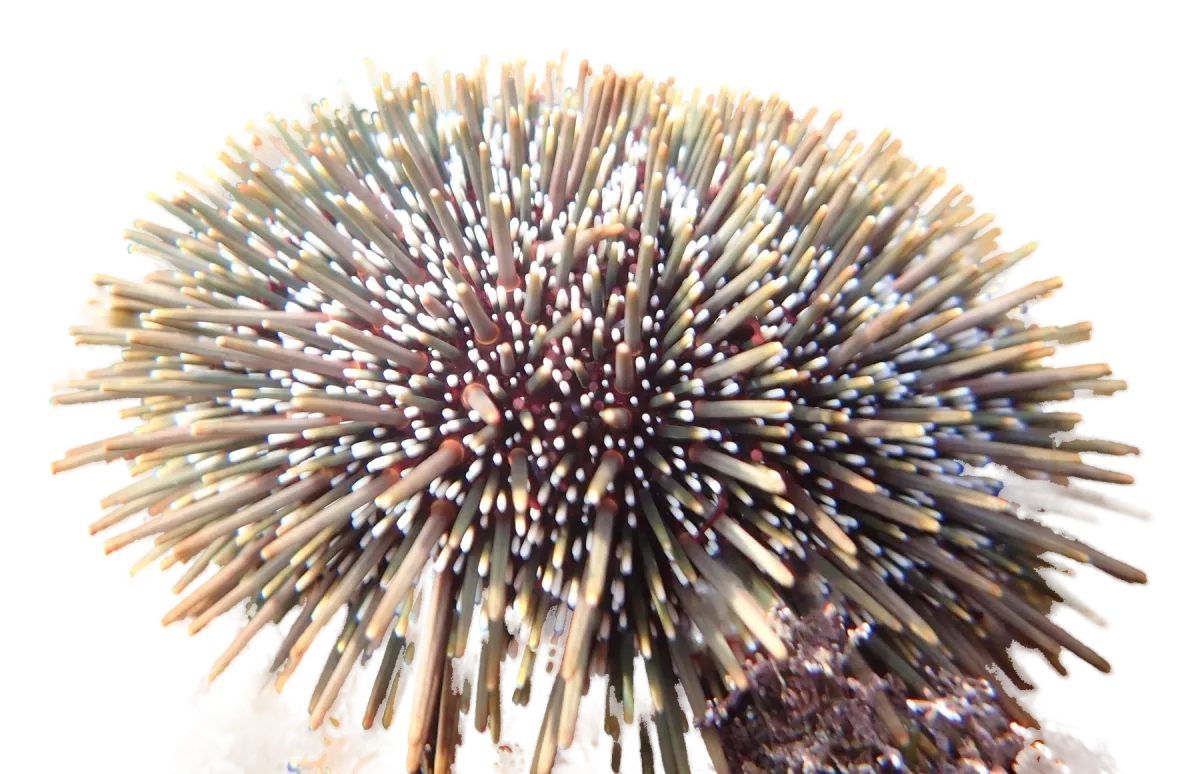
Kina (Evechinus chloroticus) is a sea urchin found only in New Zealand. Its round, greenish shell is covered in sharp, movable spines, and it grazes kelp on shallow rocky reefs. It is the most gathered kaimoana in the country, prized for its roe, and too many kina can strip a reef bare, creating a kina barren.
How to identify kina
- A round, slightly flattened shell (the test) covered in short, stiff, sharp spines, usually dark green to brown.
- The mouth is in the middle of the underside, with five hard teeth (Aristotle's lantern).
- Rows of small tube feet between the spines, which it uses to grip, move and pass food to its mouth.
- A dead kina loses its spines and leaves a green, globe-shaped shell patterned with neat rows of small bumps where the spines were attached.
Kina is New Zealand's common sea urchin, and the only one most people will ever gather. It is an echinoderm, related to starfish and sea cucumbers. New Zealand has about 110 kinds of sea urchin, but kina is by far the most common in shallow coastal water.
Adults are usually between about 8 and 15 cm across the shell, not counting the spines, and the biggest reach about 19 cm. That makes kina one of the largest edible sea urchins in the world. The spines are short, stiff and sharp, and the animal can regrow them if they break.
Males and females look the same from outside. Inside, NIWA notes that male roe is often paler than female roe and can have a milky look, although colour also depends on food, season and place.
Several other animals carry kina in their te reo name. Te Aka lists the heart urchin (kina pākira) and the snapper biscuit or sand dollar (kina papa), which live buried in sand or mud and look nothing like kina. Te Aka also records kina ariki, a variety with very long spines.
Often confused with
- Long-spined sea urchin (Centrostephanus rodgersii)
Much longer, thinner spines than kina. A subtropical urchin from Australia that has spread down the north-east coast of the North Island as the sea has warmed. NIWA notes it competes with kina.
- Heart urchin (kina pākira)
Heart-shaped and covered in fine, curved, greenish-grey spines. It lives buried in soft mud below the low-tide mark, not on rock.
- Snapper biscuit or sand dollar (kina papa)
A flat, hard disc with very short spines, found in sand near harbour entrances.
Size and daily limits
| Area | Min. size | Daily limit |
|---|---|---|
| Auckland and Kermadec area | None | 50 50 per day is the table's general figure. Since 1 Aug 2024 the limit is 150 per day in FMA 1 (east coast from North Cape to Cape Runaway, incl. Hauraki Gulf, Coromandel and Bay of Plenty); the 'Auckland Coromandel area' column also shows 150. Kina means Evechinus chloroticus and Centrostephanus rodgersii. Kina are excluded from the Ōmaha Bay, Kawau Bay and Whangaparāoa closure. Maunganui Bay (Deep Water Cove): no taking of any species except kina. |
| Central area | None | 50 No minimum size. |
| Challenger area | None | 50 No minimum size. Makaawhio mātaitai: 50 per day where allowed; no take at Okuru/Mussel Point, Mahitahi/Bruce Bay, Manakaiaua/Hunts Beach and Okarito Lagoon. |
| Kaikōura area | None | 20 No minimum size. Oaro-Haumuri Taiāpure is closed to shellfish except scampi, rock lobster, octopus and kina. |
| South-East area | None | 50 No minimum size. Akaroa Taiāpure, Tuhawaiki and Te Ahi Tarakihi mātaitai: 20 per day. East Otago Taiāpure: 10 per day. Lyttelton Harbour/Whakaraupō and Extension mātaitai: kina are not on the permitted list, so taking them is prohibited; Rāpaki: no shellfish. |
| Fiordland area (Fiordland Marine Area) | None | 30 No minimum size. The page gives one figure, with no separate Fiords figure. No accumulation beyond one day's limit. |
| Southland area | None | 50 No minimum size. |
Separate shellfish limit; does not count toward the finfish limit.
Checked 22 October 2026 · Source: MPI. Rules change, so check the NZ Fishing Rules app before you keep a fish.
Where it lives in New Zealand
Kina live on rocky reefs all round New Zealand, including the Chatham Islands and the subantarctic islands. They are found from about the low-tide mark down to at least 20 m, and most of the commercial harvest comes from water less than 10 m deep. They favour kelp forest and reef covered in pink coralline algae, with some current and wave action.
Young kina hide under rocks and in crevices until they are about 4 cm across, then move out into the open. Adults don't move far, and usually stay close to a home crevice when predators are about. They feed mostly around dusk and dawn.
Kina mainly eat brown seaweed and coralline algae, and will eat sponges and sea squirts when food is short. Their predators include snapper, blue cod, crayfish and starfish.
Kina barrens are areas of reef where kina have grazed away the kelp, leaving bare rock. Without kelp, the reef loses shelter for young fish and crustaceans and food for pāua. In northern New Zealand, fishing down kina predators such as crayfish and snapper is thought to have let kina numbers rise and strip the kelp. In other places, such as Queen Charlotte Sound, water quality, temperature and sediment are thought to be the main cause. Once a barren forms, it can be kept bare by fairly few kina, which are usually small and poorly fed, with little roe.
Research at the Leigh (Goat Island) marine reserve linked the increase in snapper and crayfish there to a long-term fall in kina numbers. Gathering of any kind is not allowed in a marine reserve.
How to gather it
Kina are gathered by hand, mostly by diving. In the 2022–23 National Panel Survey, more than nine in ten kina kept by recreational fishers were gathered by diving, and the rest from the shore at low tide. Kina can be taken by snorkelling or with scuba; the scuba ban that applies to pāua does not apply to kina.
Wear thick gloves: the spines are sharp and break off in skin. Use a blunt knife or a kina tool to ease each kina off the rock, and put it straight into your catch bag. A kina counts toward your limit as soon as it is in the bag.
There is no minimum size for kina, but the daily limit varies a lot by area. Some mātaitai reserves and taiāpure have lower limits or are closed to kina, and some temporary closures include kina; see the limits and closures by area above. Tangata whenua may also place a rāhui on an area. Respect it whether or not it is backed by a legal closure.
Roe quality varies a great deal between reefs and through the year. Divers often crack a test kina underwater to check the roe before gathering more. Kina opened this way and left behind die, so keep testing to a minimum. Kina from barrens and heavily grazed reef usually have little roe.
Kina can be affected by marine biotoxins, and MPI's shellfish biotoxin warnings usually say kina should not be eaten from a warning area. Check MPI's current shellfish biotoxin alerts (linked in the sources) before you gather.
Eating
The part you eat is the roe (the gonads): five soft, orange to yellow strips that line the inside of the shell. It is rich, soft and tastes of the sea. Colour ranges from dark brown to bright golden yellow, and the flavour and texture change with the kina's diet and the season.
To open a kina, hold it mouth side up in a gloved hand or a cloth. Push a knife or the handle of a spoon through the soft skin around the mouth, then cut or crack around it and lift out the mouth and teeth. Tip out the liquid and the dark gut. Scoop the roe out with a teaspoon and rinse it gently in seawater.
Kina roe is most often eaten raw, straight from the shell or on bread. It can also be stirred through scrambled eggs, pasta or sauces, or made into fritters. Eat it as fresh as you can.
Recipes
Good to know
Kina was the most gathered kaimoana in New Zealand in 2022–23. The National Panel Survey estimated recreational fishers kept 556,942 kina that year, more than twice as many as pāua. The most were gathered on the east coast of the North Island south of East Cape (FMA 2), followed by the north-east of the North Island (FMA 1).
Kina are broadcast spawners. Once a year, adults release eggs and sperm into the water, and the larvae drift in the plankton for about three to four weeks before settling on reef. Kina grow about 8–10 mm in their first year, start breeding at three or four years old, take eight or nine years to reach 10 cm across, and can live for more than 20 years.
Kina have been managed under the Quota Management System since 2002 in the South Island and 2003 in the North Island. The commercial fishery is by breath-hold diving only, and almost all the roe is sold in New Zealand.
In 2024 the Minister for Oceans and Fisheries raised the recreational daily limit for kina on the north-east coast of the North Island and introduced a special permit that lets people harvest, cull or move kina to help restore reefs or prevent barrens.
Kina are a taonga species for many Māori communities and central to the idea of kaimoana. NIWA's Te Kūwaha centre works with whānau, hapū and iwi on kina science, and notes that local names vary: check with local hapū for the name used in your area.
Questions
What is kina?
Kina is a sea urchin, Evechinus chloroticus, found only in New Zealand. It is a spiny, round shellfish that lives on shallow rocky reefs and grazes seaweed. Its roe is a traditional kaimoana and is usually eaten raw.
How many kina can I take?
It depends on where you are gathering. Daily limits for kina differ a lot between areas, and some reserves have their own lower limits or no taking. There is no minimum size. Check the table above for the current limit in each area and the date we last checked it against MPI.
How do you open and eat kina?
Wear gloves. Turn the kina mouth side up, cut or crack around the mouth and lift it out, tip out the liquid and gut, then scoop out the five strips of orange roe with a spoon. Most people eat the roe raw.
What is a kina barren?
A kina barren is an area of rocky reef where kina have eaten the kelp, leaving bare rock with little shelter or food for other species. Barrens have been linked to fishing down kina predators such as crayfish and snapper, and in some places to sediment, water quality and warming seas.
When are kina in season?
Kina can be gathered all year, but the roe is usually best in the months before they spawn, which is between about November and March. In many places the flowering of kōwhai was the traditional sign that kina were ready.
Can I use scuba to gather kina?
Yes. Unlike pāua, kina can be gathered using scuba as well as by snorkelling or from the shore. Most kina are gathered by divers.