
Butterfish
Mararī, Rarī, Marare, Matohe, Tarao, Kōeaea
Odax pullus formerly Coridodax pullus, Odax vittatus (juveniles)Also known as Greenbone, Greenbone butterfish, Kelp fish, butter fish
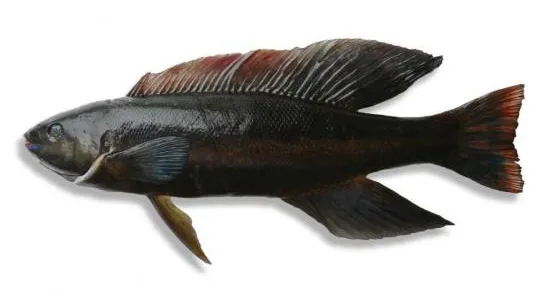
Butterfish (mararī, Odax pullus), also called greenbone, is a long, cylindrical, kelp-eating reef fish found only in New Zealand and most common from Cook Strait south. Look for very long dorsal and anal fins, a brown, green or blue-black body and blue-green bones. Most are speared, and the flesh is clean and delicate.
How to identify butterfish
- A long, slim, cylindrical body, not deep or flattened like most reef fish.
- Very long, broad dorsal and anal fins that sweep along most of the length of the body.
- Colour changes with age and sex. Small fish are golden yellow with a pale stripe, females brown to green, and big males dark greenish to blue-black.
- Blue markings on the fins, and blue chin markings in the breeding season.
- Blue-green bones, and blue-green stained flesh next to them, when you fillet it.
Butterfish are long, slim fish, round in cross-section, with very long dorsal and anal fins that sweep along most of the body. They live among kelp, and their colours match it.
The colour depends on age and sex. Young fish start reddish brown with a pale stripe along the middle of the body, then turn golden yellow, still with the stripe. These small yellow fish were once described as a separate species, Odax vittatus. At about 30 cm they become deeper-bodied, brownish or greenish females, and when they mature the pale stripe breaks into a row of pale blotches. About half the mature females later change into males, which are dark greenish to black above and paler olive green on the sides and belly, with brighter fin markings. Both sexes develop blue chin markings in the breeding season.
The surest check is inside. The bones, and the flesh touching them, are stained a bright blue-green, which is where the name greenbone comes from. The old name kelp fish describes where they live.
Often confused with
- Blue-finned butterfish
A smaller relative, Odax cyanoallix, also found only in New Zealand, with a different colour pattern. It lives at the Three Kings Islands, where common butterfish are absent, and at a few headlands and islands in East Northland.
- Marblefish
Another seaweed-eating reef fish, 40–60 cm long, but green or brown with fine, mottled white lines that give a marbled look. It rests in crevices by day and is active at dusk, and it eats smaller, finer seaweeds than butterfish do.
- Warehou (sold overseas as butterfish)
Warehou are unrelated open-water fish that are also called butterfish in Japan and other markets. New Zealand butterfish is a kelp-reef fish with green bones; check the scientific name, Odax pullus, before comparing recipes or prices.
Size and daily limits
Minimum size35 cmDaily limit4–15 a dayNo species limit in Auckland and Kermadec, and Central.Limits for each area
| Area | Min. size | Daily limit |
|---|---|---|
| Auckland and Kermadec area | 35 cm | No species limit (combined 20 a day) |
| Central area | 35 cm | No species limit (combined 20 a day) |
| Challenger area | 35 cm | 5 5 per day from 1 Nov 2026 (no butterfish-specific limit before, only the combined finfish limit). |
| Kaikōura area | 35 cm | 10 |
| South-East area | 35 cm | 15 Closed (no take) in Lyttelton Harbour/Whakaraupō mātaitai. Akaroa Taiāpure: 3 per day. |
| Fiordland area (Fiordland Marine Area) | 35 cm | 4 Inside the Fiords: 2 per day. |
| Southland area | 35 cm | 15 |
Within combined finfish daily limit.
Checked 22 October 2026 · Source: MPI. Rules change, so check the NZ Fishing Rules app before you keep a fish.
Where it lives in New Zealand
Butterfish are found only in New Zealand, from North Cape to the Snares Islands, and also around the Chatham, Bounty and Antipodes Islands. They are more common from Cook Strait south. The main commercial fishery is centred on Cook Strait, between Tasman Bay, Castlepoint and Kaikōura, with a smaller one around Stewart Island.
They live along rocky coasts in moderately turbulent water, among dense beds of large brown seaweeds such as Ecklonia and Carpophyllum. The usual depth range is from just below the low-tide mark to about 20 m. They stay shallower in the north (to about 10 m) than in Cook Strait (to about 20 m), and in southern waters they can be found as deep as 40 m.
Where you find them depends on size and sex. Juveniles under about 30 cm keep to the shallow weed beds, in less than 15 m. Outside the breeding season, males live deeper than females, so females often outnumber males on shallow reefs. In the breeding season males become territorial and move into the females' shallower range.
Butterfish do not seem to travel far. The only movements recorded are small ones within the weed beds where they feed, so each reef's population is probably quite local. That is one reason the stock is prone to being fished down in one place.
- Jan: good
- Feb: good
- Mar: good
- Apr: good
- May: good
- Jun: good
- Jul: good
- Aug: good
- Sep: good
- Oct: good
- Nov: good
- Dec: good
How to catch it
Spearfishing: this is how most butterfish are taken. In the 2022–23 National Panel Survey, about 9 in 10 butterfish kept by recreational fishers were speared, and about a third came from fishers working off land rather than from boats. Look over shallow, kelp-covered rocky reef with some wave surge, from a few metres down to about 20 m, and deeper in the south. Females and smaller fish are mostly in the shallows, and bigger males tend to sit deeper outside the breeding season. Butterfish move through the kelp and are easy to lose sight of, so a slow, quiet approach and waiting in the weed for fish to come back usually works better than chasing them. Make sure a fish is over the minimum size before you shoot, because you cannot keep or hold an undersized fish, even a dead one. MPI suggests putting a measure on your speargun. Spearfishing is banned in marine reserves. Spike and gut the fish soon after landing and put it on ice.
Set net: setting a net among the kelp is the traditional way to catch butterfish and the main commercial method. Recreational set netting comes with strict rules. Nets are banned in marine reserves and across large areas closed to protect Hector's and Māui dolphins, including much of the west coast of the North Island, and a minimum mesh size applies to butterfish nets. At the top of the South Island's east coast, a special exemption allows recreational set netting for butterfish for part of the year only, and only if you stay with your net. Everywhere, MPI limits you to one set net, which must not be baited, must have marked floats at each end and must not strand fish on a falling tide. Check the rules for your area before you set a net, and check the net often so bycatch can be released alive.
Rod and line: butterfish eat seaweed, so they rarely take a bait, and only about 3% of the recreational catch is taken on a line. A small hook on a light, simple rig, baited with a small crustacean, such as a crab, or a marine worm, sometimes works over weedy reef. See the bait guide for crabs and other reef baits.
Eating
Butterfish is one of the better eating fish from the reef, and the name comes from the texture. The flesh is translucent, delicately flavoured and flakes well, and it stays tender and moist when cooked. In 1872 James Hector called it "very good food", short in the grain and well flavoured without being rich, and noted that it was the fish most commonly sold in Wellington in winter.
The green bones and the blue-green tinge on the flesh next to them are natural and do not affect the taste. The dark, slimy skin put some buyers off in the past, but it does not mean anything is wrong with the fish. Bake, grill, pan-fry, poach, smoke or marinate it. Some restaurants also serve freshly speared butterfish raw, as crudo.
Commercial spearfishers spike and gut each fish on the boat and put it straight on ice, and the same works for a recreational catch: bleed and ice it as soon as you can. See the filleting guide for the knife work, and the clean, mild flesh takes a hot smoke well.
Butterfish live on seaweed and seldom take a bait, which is why nearly all of them are speared. When you fillet one, don't worry about the blue-green bones. That's why they're called greenbone.
Recipes
Good to know
Butterfish are almost entirely vegetarian. They graze the larger seaweeds, especially giant kelp and Ecklonia, and what they eat in each place depends on the local weed beds. Most other seaweed-eating fish, such as marblefish and parore, prefer smaller, finer weeds. Butterfish feed hardest early in the day, and more in summer than winter.
They start life as females, and about half of the mature females later change into males, at around 37–45 cm long. Water temperature shapes their lives. Fish in the warm north grow fast, mature early and change sex at about 2.5 years old in the Hauraki Gulf, while fish at Stewart Island change at about 7. Southern fish grow more slowly but live longer and reach a bigger average size: the oldest aged so far were 11 years in the Hauraki Gulf and 19 years at Stewart Island. Spawning runs from July to November in the north, peaking in August, and from July to March in Cook Strait.
Butterfish entered the Quota Management System on 1 October 2002, and are managed as several stocks around the country. There is not enough information to estimate the status of any of them. Commercial landings have averaged about 105 tonnes a year since then, mostly from the Central East, Southland and Challenger stocks, and have stayed under the commercial catch limit almost every year.
Recreational fishers kept an estimated 47,101 butterfish, weighing about 51 tonnes, in the year to September 2023. That puts butterfish ninth among recreationally kept finfish by number, ahead of kingfish. The average fish kept weighed about 1.1 kg. The catch was about 30% lower than in 2017–18, and most of it came from the east coast of the South Island and the lower North Island.
Butterfish have been eaten in New Zealand for a long time. Their bones turn up in coastal Māori middens in central and southern New Zealand, and in Cook Strait Māori once caught them in long, bag-shaped nets with a hoop at the mouth, tied between kelp at high tide so the falling tide carried fish in.
Questions
Why is butterfish called greenbone?
Because its bones, and the flesh touching them, are stained a bright blue-green. The name butterfish comes from the flesh, which stays tender and moist when cooked. Butterfish and greenbone are the same fish, Odax pullus.
What is the Māori name for butterfish?
Te Aka Māori Dictionary gives mararī, rarī, marare, matohe, tarao and kōeaea for butterfish. Fisheries New Zealand uses mararī in its butterfish stock reports.
Is butterfish good eating?
Yes. Butterfish has translucent flesh with a very clean, delicate flavour that flakes well and stays moist when cooked. The green tinge near the bones is natural. Bake, grill, pan-fry, poach or smoke it, and spike, gut and ice the fish soon after catching.
How do you catch butterfish?
Most are speared by divers over shallow, kelp-covered reef, which accounted for about 9 in 10 butterfish kept by recreational fishers in 2022–23. Set nets also catch them where netting is allowed. They eat seaweed, so they rarely take a baited hook, though a small hook with a crab or worm sometimes works.
What is the size limit for butterfish, and can you set net for them?
Butterfish have a minimum size in every area, and some areas also set a butterfish daily limit. The table above shows the current limits for each area and when we last checked them. Set netting is banned in many places, including large areas closed to protect Hector's and Māui dolphins, so check the rules for your area before you set a net.
Is New Zealand butterfish the same as butterfish overseas?
No. New Zealand butterfish is Odax pullus, a kelp-eating reef fish found only here. Overseas, the name butterfish is used for other, unrelated fish, including warehou in Japan, so check the species before comparing recipes, prices or advice.
Related species
 Saltwater
 Saltwater
 Saltwater
 EndemicSaltwater
More guides
All guides- ArticlesNZ fishing rigs and knots: diagrams and when to use eachClear diagrams of the main NZ fishing rigs (ledger, running sinker, strayline, surfcasting, live bait) and the knots to tie them, with which fish each catches.
- ArticlesHow to fillet a fish: snapper, gurnard, kahawai and moreStep-by-step filleting for NZ fish, with photos: the basic method, skinning and pin bones, and what is different about snapper, gurnard, kahawai and blue cod.
- ArticlesBest time to fish in New ZealandWhen to catch snapper, kingfish, kahawai, tuna, trout and salmon in New Zealand, with a month-by-month calendar and what bites in each season.