
Land-based fishing spots in Auckland: wharves, rocks and beaches
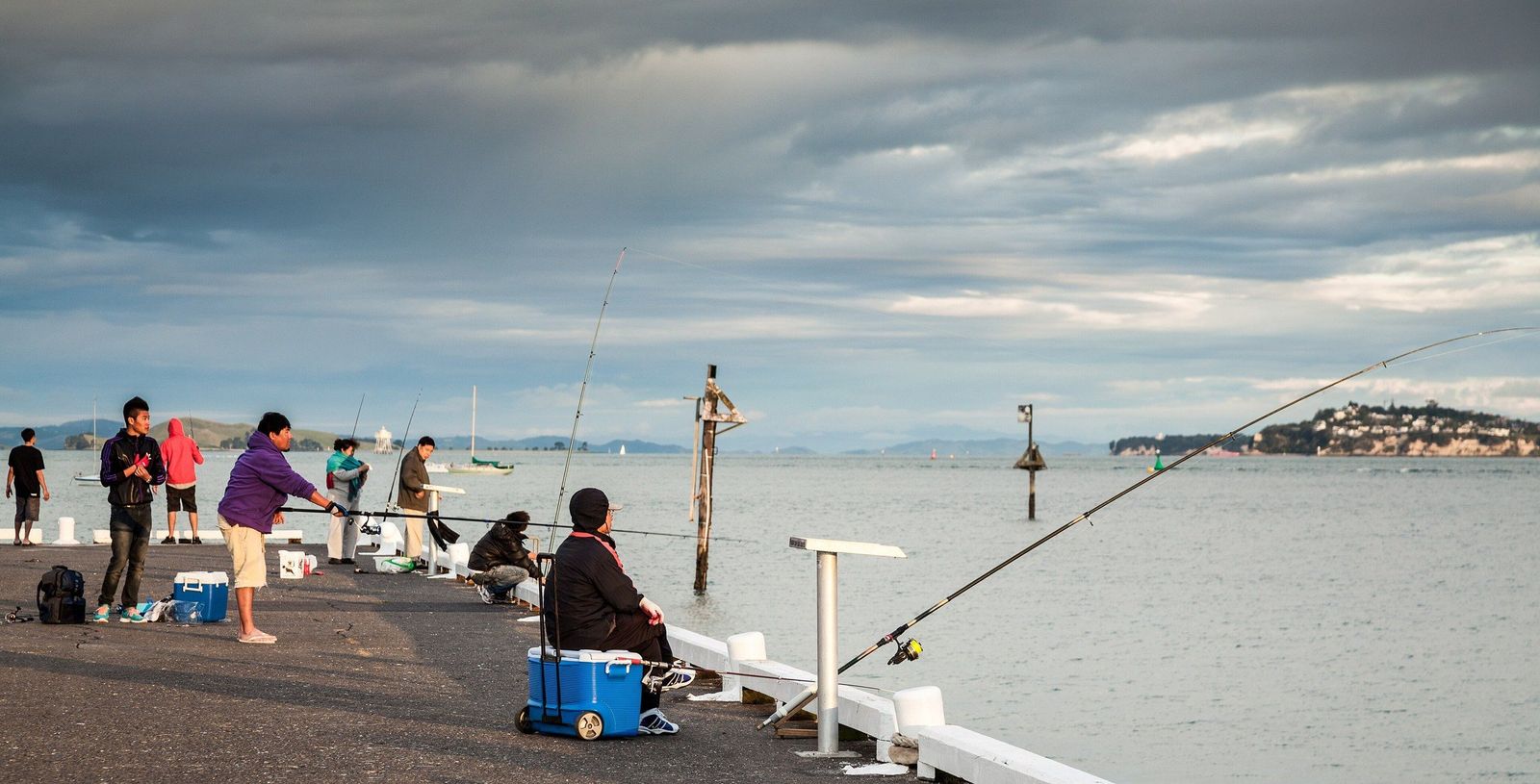
The easiest places to fish in Auckland without a boat are the public wharves: Ōrākei on Tāmaki Drive, Devonport, Murrays Bay, Maraetai and Cornwallis, plus the fishing bays on Ngā Hau Māngere bridge. Expect kahawai, small snapper, jack mackerel and piper all year, with bigger snapper and kingfish from spring to autumn. The west coast rocks hold better fish but are among the most dangerous places to fish in the country, so wear a lifejacket there.
| Area | Best-known spots | What you’ll catch |
|---|---|---|
| Central and Tāmaki Drive | Ōrākei (Okahu Bay) wharf, Harbour Bridge seawall, Point Chevalier | Snapper, kahawai, trevally, piper, squid at night |
| North Shore | Devonport, Murrays Bay and Birkenhead wharves, Takapuna to Milford rocks, North Head | Snapper, kahawai, John dory, kingfish in summer |
| Hibiscus Coast and north | Army Bay, Ōrewa estuary, Wenderholm, Mahurangi West | Snapper, kahawai, kingfish on the reefs |
| East Auckland | Maraetai wharf, Bucklands Beach and Musick Point, Waitawa wharf, Tāmaki estuary | Snapper, kahawai, squid, flounder in the estuary |
| Manukau Harbour | Cornwallis wharf, Ngā Hau Māngere bridge, Huia | Kahawai, snapper, gurnard, kingfish in summer |
| West coast | Muriwai, Piha, Te Henga, Whatipū, Kariotahi | Kahawai, snapper, gurnard, rig and school shark; kingfish off the rocks |
Last checked: 23 October 2026. Wharves close for repairs, and access changes, so check signs when you arrive and tell us if something here is out of date.
Rules that catch people out
Auckland is in the Auckland and Kermadec fishing area, but the snapper rules change from one coast to the other:
- East coast (the Waitematā, Tāmaki Drive, the North Shore, the Hibiscus Coast, East Auckland and Waiheke): 7 snapper a day, minimum 30 cm.
- West coast and the Manukau Harbour: 10 snapper a day, minimum 27 cm.
- Snapper count toward a combined limit of 20 finfish a day on both coasts.
Most snapper caught from inner-harbour wharves are under 30 cm. Fisheries officers checked 514 fishers on Auckland’s coasts over one weekend in October 2026, and nine of the 15 people caught breaking the rules had undersized snapper. Measure every fish.
Where you can’t fish
- Marine reserves: no fishing or collecting of anything.
- Long Bay–Okura, along the whole coast of Long Bay Regional Park.
- Motu Manawa–Pollen Island, beside the North-western Motorway between Point Chevalier and Rosebank.
- Te Matuku, on the south-east of Waiheke.
- Goat Island (Cape Rodney–Okakari Point), which was greatly extended offshore in October 2025.
- Tāwharanui, along the northern coast of the regional park. The south coast is open.
- Hauraki Gulf high protection areas: since 25 October 2025, no recreational fishing or gathering, including from the shore. The ones you can reach on foot are:
- Scandrett Regional Park, and the northern east coast of Mahurangi East down past Martins Bay. Snells Beach and Algies Bay are outside the high protection area, and line fishing is allowed there.
- The north-east shore of Rangitoto and the west shore of Motutapu, north of the causeway.
- The south side of Tiritiri Matangi.
- Check the boundaries on the DOC maps before you go.
Shellfish and bait from the rocks
From 1 November 2026, most shellfish and other invertebrates can’t be taken from the shore between the high-tide mark and 2 m deep. The ban covers the east coast from Cape Rodney to the Coromandel, the west coast from Muriwai to Port Waikato, and Waiheke. That includes mussels, so you can no longer gather mussels for bait on the rocks. Crabs are limited to 10 a day and squid to 10 a day.
The Whangaparāoa Peninsula, Kawau Bay and Ōmaha Bay have a stricter closure until March 2028: nothing but kina can be taken from the rock pools or out to 200 m. None of these closures stop you fishing for finfish with a rod and line.
Central Auckland and Tāmaki Drive
Ōrākei Wharf (Okahu Bay)
The most popular wharf in the city, on Tāmaki Drive opposite Kelly Tarlton’s. Ōrākei Wharf and Okahu Bay Wharf are the same structure: a long, narrow walkway out to a platform. You can catch snapper, kahawai, trevally, gurnard, piper and jack mackerel, and squid after dark.
Most snapper here are undersized. Regulars do best with berley and lightly weighted or unweighted baits, especially fresh piper, in the first couple of hours of the outgoing tide. In summer the end of the wharf fills up with anglers in the evening, and people jump off it.
There are no railings along the walkway or the platform, so keep a close eye on young children.
Under the Harbour Bridge
The seawall and rock wall at Curran Street, on the city side of the bridge, is the inner-city spot local anglers recommend most. It holds snapper, kahawai, gurnard and trevally, and squid at night on the western side of the bridge. Fish dawn or dusk from late November to April, when snapper are thick in the harbour. A dropper rig with a 3 to 4 oz breakout sinker and chunks of squid or pilchard is the usual approach. It can get windy.
Keep to the public promenade around Westhaven. The marina pontoons are for berth holders.
Point Chevalier
The rock ledge at the end of the point, reached by the track from Coyle Park, is where plenty of Auckland kids caught their first fish. Expect piper, kahawai, yellow-eyed mullet and small trevally, with the best fishing at full tide and some berley. Motu Manawa–Pollen Island Marine Reserve is just to the west. If you fish the Waterview side, check the DOC boundary.
Downtown wharves
Queens Wharf used to be a regular spot for John dory, kahawai and the odd decent snapper, but anglers reported new “no fishing” signs there in August 2026. The fenced port areas and Princes Wharf are off limits too. For a city spot with no restrictions, go under the Harbour Bridge instead.
North Shore
Devonport Wharf
The best-known wharf on the North Shore. It’s an easy ferry ride from downtown, and it holds snapper, kahawai, trevally, John dory, squid and baitfish, with kingfish from about November to April. The tide runs hard, so use a running rig with a breakout sinker, and keep your lines well clear of the ferries.
Auckland Transport is rebuilding ferry Piers 1 and 2 over about three years from December 2026. Parts of the wharf will be fenced off while the work is under way.
Murrays Bay Wharf
Rebuilt by the council in 2016, Murrays Bay has a good reputation for snapper. It’s one of the few wharves where a longer cast pays off, because there’s foul ground out in front. Squid come into the bay at night, attracted by the street lights. In summer it’s packed with swimmers and wharf jumpers, so fish early morning or late evening. The end of the wharf has been signed as a jumping zone with no fishing. Respect it.
Birkenhead, Northcote Point and the upper harbour
Birkenhead ferry wharf on Hinemoa Street is a good place for kids to catch small fish and parore with plenty of berley. The current runs strongly off the end, so fish the downstream side. Northcote Point is lit and good at night for snapper and kahawai. Island Bay and Beach Haven wharves are quiet family spots for sprats, piper and the odd snapper, best over the top of the tide.
Takapuna to Milford rocks
The rock platforms north of Takapuna Beach, around Takapuna Head, Black Rocks and the end of Tiri Road at Milford, hold bigger snapper as well as kahawai, John dory and gurnard. The Takapuna cliffs are one of the best places to catch live bait. Fish the change of light with running rigs and strip baits, or big floating baits over the foul at dusk. The tide comes right up to the cliffs under Fort Cautley, so watch your way out.
North Head and Cheltenham
The ledges at North Head get kingfish in summer, and the shore from Narrow Neck to St Leonards produces big snapper on evening tides. Fish very early, before the boat traffic, on a low incoming tide. At Cheltenham you can wade the flats at low tide to reach the edge of the Rangitoto Channel, but the tide pushes you back within a couple of hours. Shellfish gathering is banned at Cheltenham Beach.
Closed or restricted
- Torpedo Bay Wharf closed on 9 October 2026 after an inspection found failing piles. There’s no reopening date.
- Bayswater Marina breakwater is open in daylight, but the marina has restricted fishing there before and applied in October 2026 for exclusive occupation of the area. Check the signs.
Hibiscus Coast and the north
- Shakespear Regional Park and Army Bay: the council says you can surfcast off Army Bay at high tide. Snapper and kahawai, with surface kahawai schools when pilchards are running. No set nets from 20 December to 31 March.
- Ōrewa estuary: kahawai run up the channel past the rock training wall on the incoming tide, and fish under the bridge lights at night. Squid baits last longer than soft baits against the crabs.
- Wenderholm and the Pūhoi River mouth: the council names it as a spot for kahawai and snapper. The river mouth has very strong tidal currents. Don’t walk out to Sugar Loaf Island; you can be cut off quickly.
- Mahurangi West Regional Park: kahawai and snapper from the rocky outcrops. You can fish Pudding Island over low tide, but the council warns to take great care as the tide comes in. Mahurangi East, across the harbour, is inside the Kawau Bay high protection area.
East Auckland
- Maraetai Wharf: a family wharf in the middle of the beach, with sprats, jack mackerel and snapper, and squid after dark.
- Bucklands Beach and Musick Point: kahawai, snapper and the odd trevally on the incoming tide. The beach suits kids; the ledges at Musick Point are better with heavier gear.
- Half Moon Bay: the marina is off limits, but anglers fish the rocky points and breakwaters around it for snapper and kahawai early and late.
- Waitawa Regional Park wharf, Kawakawa Bay: the old explosives works wharf, now part of the regional park. The council describes deep water and fishing at all tides, and local parents rate it for kids with a sabiki rig for baitfish. The deck is high above the water and the current is strong, so don’t jump off.
- Kawakawa Bay, Ōrere Point and Tawhitokino: snapper, kahawai, and kingfish patrolling the rock edges in summer. Tawhitokino is reached on foot at low tide only.
- Tāmaki estuary: flounder on the mudflats around Point England, and snapper, kahawai and trevally on moving tides near Panmure. The mud is very soft in places, so go in daylight. Set nets are banned in the Tāmaki River and Panmure Basin.
There are cockle and shellfish closures at Umupuia, Cockle Bay and Eastern Beach.
Manukau Harbour
Cornwallis Wharf
A 200 m wharf in the Waitākere Ranges Regional Park with a big grassy reserve, and the pick of the Manukau for a family day out. You can catch kahawai, gurnard and snapper, and kingfish and John dory in summer. Baitfish are plentiful for livebaiting. Cast into the channel at the change of light, and watch for workups coming in from Huia on the turn of the tide.
It gets very busy on summer weekends. If you can cast from the shore, Kaitarakihi beach, just along the road, is a quieter option. The council says jumping off the wharf is unsafe because of the strong current. The community trust asks anglers not to cut bait on the handrails, which has damaged them.
Ngā Hau Māngere bridge
The new walking and cycling bridge between Onehunga and Māngere Bridge opened in 2022. It has two fishing bays with rod holders and lighting, and rails with a lip to stop rubbish going into the harbour. The rails make it one of the safest spots in Auckland for young kids. Kahawai and snapper (mostly small) are the main catch, and rays and sharks are common. The bridge is high and the current is strong, so use a heavy sinker. Check Safeswim after heavy rain. Wastewater overflows led to warnings against fishing here in 2023.
Huia and the harbour edge
At Little Huia, people fish from the roadside when the tide is in. Anglers report kingfish along the northern edge of the Manukau west of Huia. On the Āwhitu side, Grahams Beach, Te Toro and Wattle Bay give gurnard, small snapper, kahawai and rays.
The north-east Manukau, off the airport shoreline, is a no-take area. No fish may be taken there.
West coast
The west coast holds bigger fish than the harbours, but it’s where most of Auckland’s rock fishing deaths happen. Read the safety section before you go.
- Muriwai: surfcasting for kahawai, gurnard, rig and school shark, with long casts into the gutters and rips. Fresh mullet or tuatua work well. In June 2026 a fisher without a lifejacket drowned off the rocks near the gannet colony. There’s no lifejacket hub at Muriwai, so bring your own. No set nets.
- Piha: kahawai, snapper in winter, and rig in summer from the deeper gutters near Lion Rock. Fish the outgoing tide. The free lifejacket library is at the south end of the beach.
- Te Henga (Bethells) and O’Neill Bay: kahawai from the surf and limited rock space. Heavy sinkers (around 6 oz) are needed to hold in the rip. A free lifejacket hub is at the base of the dunes before O’Neill Bay.
- Whatipū (Ninepin Rock and Paratutae): for experienced rock anglers only. Kingfish on live kahawai or poppers, snapper and trevally with berley, and school shark off the beach. Ninepin can only be reached for about two hours either side of low tide, and Paratutae is cut off at high tide. Lifejacket wear here is the lowest on the coast, at 16%. There’s a free lifejacket hub at the end of the track from the car park.
- Kariotahi and Hamiltons Gap: kahawai, snapper, gurnard, trevally and school shark from the beach, best over low tide in a swell under about 1 m.
Waiheke
Walk off the ferry at Matiatia and follow the coastal track to the ledges on either side of the bay. Anglers report snapper (berley hard, early in summer), trevally in spring, kahawai in autumn, squid, and plenty of piper. Kingfish are caught from the shore around the island too. Waiheke is on the east coast, so 7 snapper at 30 cm applies.
Te Matuku Marine Reserve covers the south-east of the island. If you fish near Orapiu, check the DOC boundary first. Mussels, pāua and packhorse crayfish are closed within 1 nautical mile of Waiheke until August 2028.
West coast rock fishing safety
Ten land-based fishers drowned in New Zealand in 2025, against a 10-year average of six. All seven who drowned in 2024 were men, and none wore a lifejacket. Lifejacket wear on the Auckland west coast rocks rose to 51% in 2026, from 29% the year before, but it’s still as low as 16% at Whatipū Ninepin and 38% at Muriwai Flat Rock.
A lifejacket isn’t a guarantee: a fisher who was wearing one died at The Gap, Piha, in January 2025. But in February 2026 another fisher was washed off the same rocks while landing a fish. He was wearing a lifejacket, his friends threw him a ring, and he was picked up unharmed.
What the safety organisations ask:
- Wear a lifejacket, even close to shore. Free loan lifejackets are at Whatipū, Karekare, Piha and Te Henga.
- Never fish alone.
- Check the swell, weather and tide before you choose a spot. If it looks dangerous, fish another day.
- Plan an escape route so the incoming tide can’t cut you off.
- Keep your eyes on the sea. Don’t climb down to free snagged gear.
- Wear light, warm clothes and grippy shoes, not gumboots.
- Tell someone where you’re going, carry a phone, and call 111 in an emergency.
- If someone falls in, throw them a life ring or anything that floats, and call 111.
Water quality
- Check Safeswim before fishing an inner-harbour spot after rain. Treat a red or black flag as a reason not to gather shellfish there.
- Don’t collect shellfish for at least 48 hours after heavy rain, or near stormwater and wastewater outlets, marinas or busy wharves.
- Auckland Council advises against eating any shellfish from Mahurangi Harbour.
- Check MPI’s shellfish biotoxin alerts before gathering anywhere.
Wharf etiquette
- Keep clear of ferries. The Navigation Bylaw makes it an offence to leave fishing gear where it can endanger boats or people. Wind in when a ferry is berthing.
- Share with swimmers. Jumpers have priority where a zone is signed, and hooks, sinkers and swimmers don’t mix.
- Take your rubbish and fish frames home. Wharf mess has led to complaints and fishing restrictions at Murrays Bay and Ōkahu Bay. Use a bait board, not the handrails. Auckland’s food scrap bins take fish frames.
- Release small fish quickly, with wet hands.
Questions
Where can I fish in Auckland without a boat?
The public wharves are the easiest start. Ōrākei (Okahu Bay) on Tāmaki Drive, Devonport, Birkenhead, Murrays Bay, Maraetai and Cornwallis are all popular, and Ngā Hau Māngere bridge has two fishing bays with rod holders. For bigger fish, anglers fish the rocks between Takapuna and Milford, the Whangaparāoa and Hibiscus Coast, and the west coast beaches and rocks.
What is the best wharf in Auckland for snapper?
There's no single best wharf. Murrays Bay and Devonport have the best reputation for snapper on the North Shore, and Cornwallis is the pick on the Manukau. On every inner-harbour wharf most snapper are undersized, so expect to release plenty, and fish at dawn, dusk or after dark around the top of the tide.
Is it safe to rock fish on Auckland's west coast?
It is dangerous. Ten land-based fishers drowned in New Zealand in 2025, against an average of six, and the west coast has had deaths at Muriwai, Piha and Anawhata in the last three years. Wear a lifejacket, never fish alone, check the swell and tide first, and never turn your back on the sea. Free loan lifejackets are at Whatipū, Karekare, Piha and Te Henga.
Can you fish at Long Bay?
No. The whole coastline of Long Bay Regional Park is inside the Long Bay–Okura Marine Reserve, where all fishing and collecting is banned. Some websites still recommend surfcasting there; they are wrong.
How many snapper can I keep in Auckland?
It depends which coast you are on. On the east coast, including the Waitematā, the Hauraki Gulf and Waiheke, the limit is 7 snapper a day at a minimum of 30 cm. On the west coast and in the Manukau Harbour it is 10 a day at 27 cm. Both count toward a combined limit of 20 finfish a day.
Do I need a licence to fish in the sea in Auckland?
No. You don't need a licence for recreational sea fishing in New Zealand, but you must follow the size limits, daily limits and closed areas.
Sources (17)
- Auckland Council, Fishing at regional parks
- MPI, Auckland and Kermadec fishing rules
- MPI, Review of measures for shore-based shellfish harvesting in the Auckland Coromandel area (decision, 8 October 2026)
- DOC, What you can and can't do in the Hauraki Gulf/Tīkapa Moana marine protected areas
- DOC, Long Bay–Okura Marine Reserve
- Water Safety New Zealand, Drowning Prevention Report 2025 (19 February 2026)
- Drowning Prevention Auckland, West Coast Rock-based Fishing Observation Research Report YE26 (September 2026)
- Drowning Prevention Auckland, Lifejacket hubs
- Surf Life Saving NZ, Rock fishing incidents highlight continued need for safety education (22 June 2026)
- Auckland Transport, Major upgrade coming for Devonport Ferry Wharf and Terminal (August 2026)
- Auckland Transport, Navigation Bylaw 2021
- Devonport Flagstaff, Shock over Torpedo Bay wharf's sudden closure (22 October 2026)
- Devonport Flagstaff, Marina seeks 'exclusive occupation' at Bayswater (22 October 2026)
- Cornwallis community, The Wharf
- About Māngere Bridge, Ngā Hau Māngere, the new Māngere Bridge (September 2022)
- Reddit, r/auckland, r/NZFishing and r/FishingNZ land-based fishing threads (2023 to 2026)
- fishing.net.nz forum, land-based Auckland threads (2020 to 2025)