
Yellow-eyed Mullet
Aua, Makawhiti, Kātaha, Kātaka, Mokohiti
Aldrichetta forsteriAlso known as Yelloweye mullet, herring
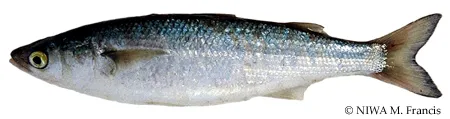
Yellow-eyed mullet (aua) is a small, slender, silvery fish with a bright yellow eye, found from North Cape to Stewart Island in harbours, estuaries, river mouths and along beaches. It is one of the easiest fish to catch off a wharf and a common first catch for children. Most are used as bait for kahawai and snapper.
How to identify yellow-eyed mullet
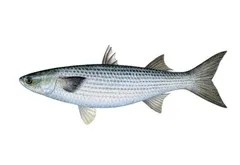
A slender, silvery fish with a greenish to bluish or olive-grey back, a pale underside and a pointed head and snout. The bright yellow eye is the easiest way to identify it. There are two dorsal fins, the first tall with four obvious spines, and the tail is weakly forked. The large scales come off easily. Small yellow-eyed mullet can be confused with grey mullet or smelt; grey mullet have a thick fleshy eyelid and no yellow eye.
Size and daily limits
Daily limit50 a dayLimits for each area
| Area | Min. size | Daily limit |
|---|---|---|
| Auckland and Kermadec area | None | 50 Baitfish limit: 50 a day of any mix of baitfish, on top of the combined finfish limit. |
| Central area | None | 50 Baitfish limit: 50 a day of any mix of baitfish, on top of the combined finfish limit. |
| Challenger area | None | 50 Baitfish limit: 50 a day of any mix of baitfish, on top of the combined finfish limit. |
| Kaikōura area | None | 50 Baitfish limit: 50 a day of any mix of baitfish, on top of the combined finfish limit. |
| South-East area | None | 50 Baitfish limit: 50 a day of any mix of baitfish, on top of the combined finfish limit. |
| Fiordland area (Fiordland Marine Area) | None | 50 Baitfish limit: 50 a day of any mix of baitfish, on top of the combined finfish limit. |
| Southland area | None | 50 Baitfish limit: 50 a day of any mix of baitfish, on top of the combined finfish limit. |
Baitfish: 50 per day across all listed baitfish species, additional to the combined finfish limit.
Checked 22 October 2026 · Source: MPI. Rules change, so check the NZ Fishing Rules app before you keep a fish.
Where it lives in New Zealand
Yellow-eyed mullet are found from North Cape to Stewart Island, and also in southern Australia and Norfolk Island. They are rarely far from the coast, schooling in sheltered harbours, estuaries, river mouths and along beaches over sand and mud. They can move several kilometres up rivers and live year-round in Lake Ellesmere. Older fish prefer deeper, saltier water, while juveniles sometimes enter fresh water. They leave estuaries to spawn at sea, mainly from late December to mid-March.
How to catch it
Yellow-eyed mullet are one of the easiest fish to catch off wharves and in harbours, and are a common first catch for children. Small hooks baited with bread, flour dough or small pieces of bait work well on light line. Commercially they are mostly taken by set net, and much of the catch is used as bait.
Eating
Yellow-eyed mullet are small but edible, with firm flesh. Most are used as bait, and they are a good live or cut bait for larger species such as kahawai and snapper. They can be fried whole once scaled and gutted, or smoked.
Good to know
Managed under the Quota Management System since 1998. They mature at 2 to 3 years and about 22 to 23 cm, and the maximum recorded age is 7 years. Yellow-eyed mullet eat algae, small crustaceans, molluscs, worms and detritus. They are often wrongly called herring in New Zealand.
Questions
Is yellow-eyed mullet the same as herring?
No. Yellow-eyed mullet are often wrongly called herring in New Zealand, but they are a mullet (family Mugilidae), not a true herring. Look for the bright yellow eye, pointed snout and slender silvery body with large, loose scales.
What is the best bait for yellow-eyed mullet?
Bread or flour dough on small hooks works well, as do small pieces of bait on light line. Yellow-eyed mullet feed on algae, small crustaceans, molluscs and worms, so keep baits tiny. Wharves and sheltered harbours are the easiest places to find them.
Can you eat yellow-eyed mullet?
Yes. They are small but edible, with firm flesh. Scale and gut them, then fry them whole or smoke them. Most anglers use them as bait instead, as live or cut bait for larger species such as kahawai and snapper.
Related species
 Saltwater
 Saltwater
 Saltwater
 EndemicSaltwater
More guides
All guides- ArticlesHow to fillet a fish: snapper, gurnard, kahawai and moreStep-by-step filleting for NZ fish, with photos: the basic method, skinning and pin bones, and what is different about snapper, gurnard, kahawai and blue cod.
- ArticlesBest time to fish in New ZealandWhen to catch snapper, kingfish, kahawai, tuna, trout and salmon in New Zealand, with a month-by-month calendar and what bites in each season.