Crayfish
Kōura, Kōura papatea, Kōura matapara
Jasus edwardsiiAlso known as Rock lobster, Spiny rock lobster, Red rock lobster, Southern rock lobster, cray
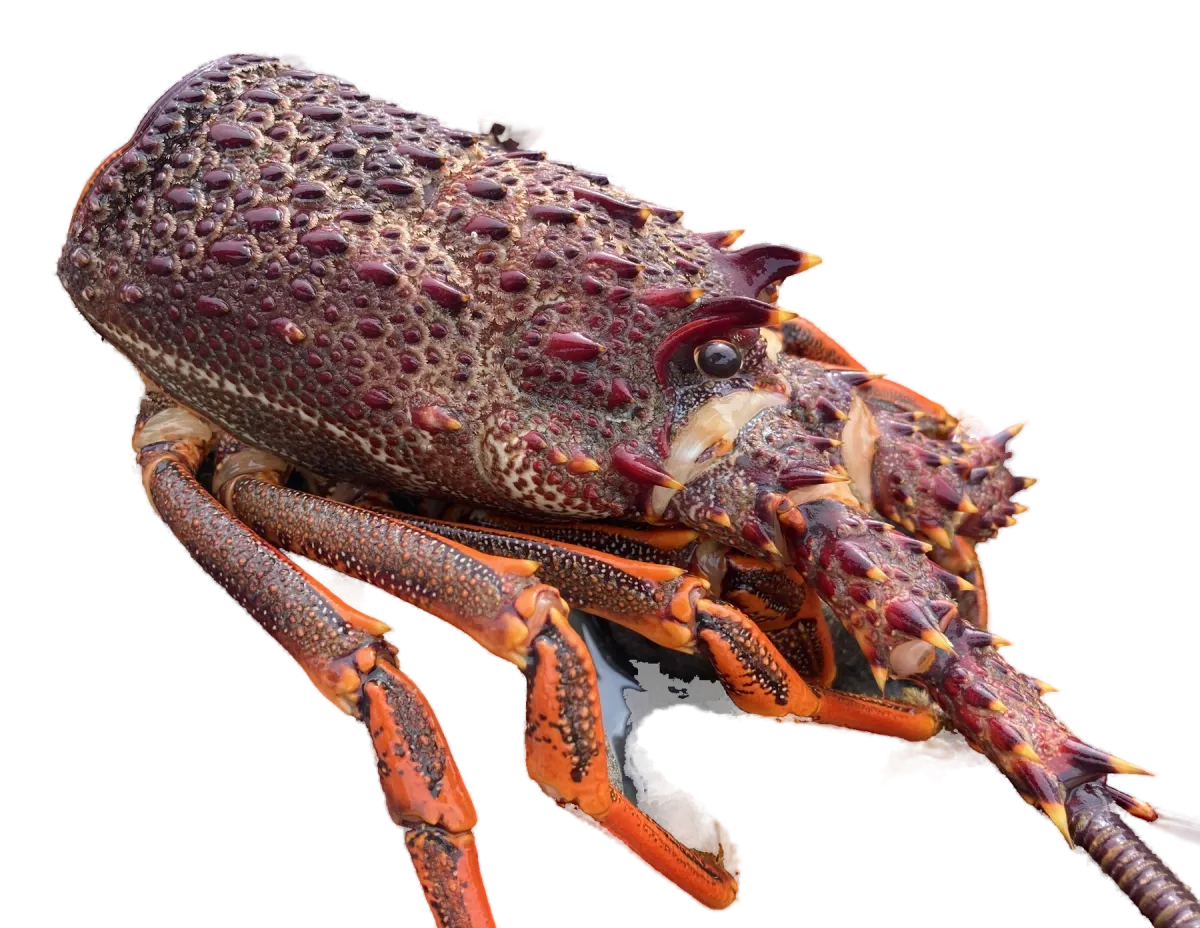
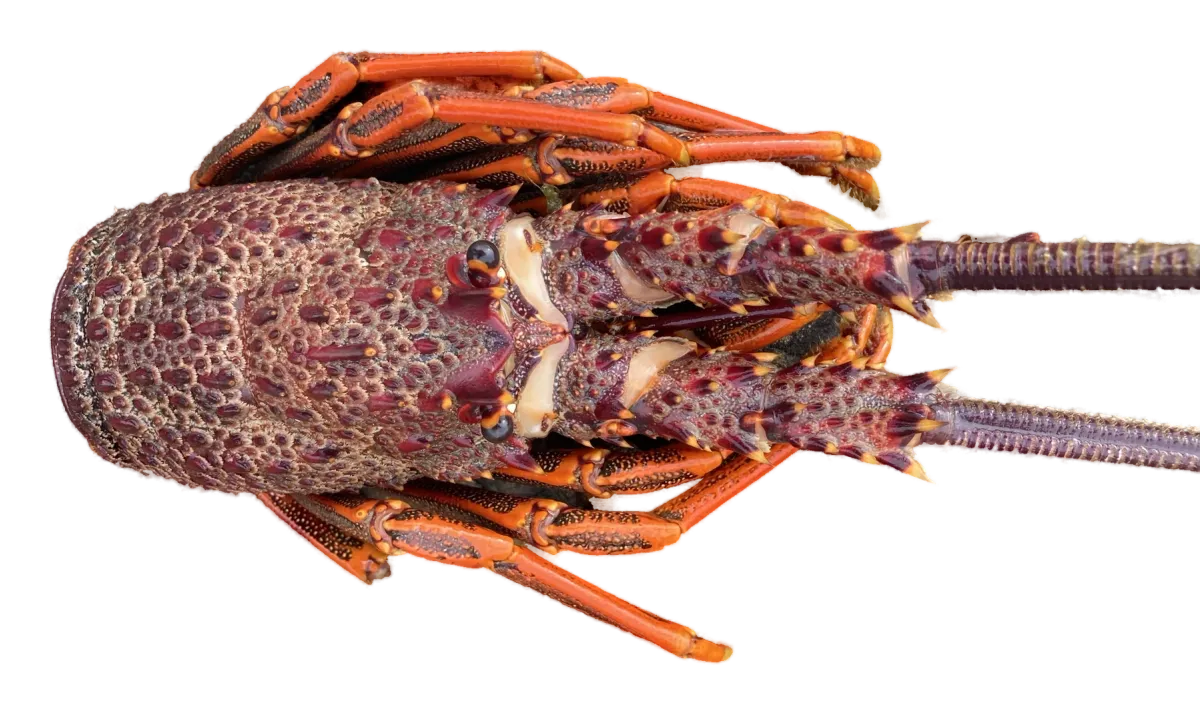
Crayfish, or kōura, is New Zealand's spiny (red) rock lobster, Jasus edwardsii. It has no big claws, a spiny reddish-orange shell and long antennae, and lives on rocky reefs all round the coast. Most are taken by diving or with cray pots. Size is measured by tail width, and berried females must go back.
How to identify crayfish
- No large pincer claws. The first pair of antennae are long, thick and spiny, and are longer than the body.
- A spiny, rough-textured shell, reddish orange in shallow water and darker red to purple in deeper water.
- A rough, sculptured tail (abdomen) with six segments, ending in a fan made of the central telson and the outer uropods.
- Females have a small claw at the tip of each back walking leg and two sets of swimmerets (pleopods) per tail segment; males have one set.
Crayfish is the everyday New Zealand name for the spiny rock lobster, also called the red rock lobster. Unlike the lobsters of the Northern Hemisphere it has no big pincers. It defends itself with its spiny shell, its long, spiked antennae and a powerful flick of the tail.
Colour depends on depth. NIWA describes kōura papatea as reddish orange in shallow water and more reddish purple in deeper water, and a crayfish that has just moulted can look pale or washed out. The upper surface of the tail is rough and spiny to the touch.
New Zealand has two rock lobsters that people gather. Almost all of the catch is the spiny (red) rock lobster. The packhorse rock lobster, pawharu, is much bigger, green to brown, and smooth tailed, and it is found mainly in the north of the North Island. The two have different minimum sizes and, in some areas, separate daily limits, so identify your crayfish before you measure it.
Sex matters too, because males and females have different minimum sizes. Turn the crayfish over: a female has two sets of swimmerets on each tail segment, which she uses to carry her eggs, and a small claw on the last pair of walking legs. A male has single swimmerets. If you can't tell, MPI says to use the female size.
In te reo Māori, kōura covers both the marine rock lobster and the freshwater crayfish (Paranephrops). The two are not closely related. NIWA notes that rock lobsters are closer to slipper lobsters than to freshwater kōura.
Often confused with
- Packhorse rock lobster (pawharu, Sagmariasus verreauxi)
Olive green to dull brown-green rather than red or orange, with a much smoother tail surface. It grows far bigger (around 60 cm and 15 kg). Mainly found from East Cape north. It has a larger minimum size and its own limits, and must never be telson clipped.
- Spanish (slipper) lobster
A flat-bodied lobster with broad, flat plate-like antennae instead of the long, whip-like spiny antennae of a crayfish. The species divers see in northern New Zealand is the Spanish lobster (Arctides antipodarum), mottled red and yellow, on shallow rocky reefs.
- Freshwater kōura (Paranephrops)
Shares the te reo name kōura but lives in streams and lakes, is much smaller, and has a pair of pincer claws.
Size and daily limits
Minimum tail width (male spiny)54 mmLimits for each area
| Area | Min. size | Daily limit |
|---|---|---|
| Auckland and Kermadec | 54 mm | Varies by sub-areaDetailsDaily limits from 1 April 2026 (separate per species): CRA 1 (Kaipara Harbour North Head around North Cape to Te Ārai Point) spiny 2, packhorse 3; CRA 2 (Te Ārai Point to East Cape) spiny 3, packhorse 3; west coast south of Kaipara Harbour spiny and packhorse combined 6 (max 3 packhorse). Spiny rock lobster closed (take or possess) from Pārengarenga Harbour to Cape Rodney (from 1 April 2026) and Cape Rodney to Port Jackson (from 1 April 2025); packhorse still open there except where other closures apply. Telson clipping required for all spiny rock lobster taken from Te Ārai Point to Cape Runaway (do not clip packhorse). Minimum size is tail width (straight line between the tips of the 2 large primary spines on the second tail segment): spiny/red rock lobster (Jasus edwardsii) male 54 mm, female 60 mm; packhorse (Sagmariasus verreauxi) male 84 mm, female 90 mm; if unsure of sex use the female size. Must return: undersize, females in berry (external eggs), soft-shell, and unmeasurable lobsters (exemption for damaged tails: spiny 600 g+ or carapace 110 mm+; packhorse 2 kg+ or tail length 216 mm+). No spears, no spring-loaded loops, no baited nets, do not remove eggs; max 3 pots per fisher, 6 per vessel with 2+ fishers. All areas: total rock lobster max 6 per day (RMC Notice cl 5.2), so CRA 1 tops out at 5 (2 spiny + 3 packhorse). Kermadec Islands: marine reserve out to 12 nm, no take (landing by DOC permit only). |
| Central | 54 mm | Varies by sub-areaDetailsCape Runaway to East Cape (CRA 2) and East Cape to Wairoa River (CRA 3): spiny 3, packhorse 3 per day, total max 6. South of the Wairoa River: spiny and packhorse combined 6 (max 3 packhorse). Telson clipping required for spiny rock lobster from Cape Runaway to East Cape Lighthouse. Minimum size is tail width (straight line between the tips of the 2 large primary spines on the second tail segment): spiny/red rock lobster (Jasus edwardsii) male 54 mm, female 60 mm; packhorse (Sagmariasus verreauxi) male 84 mm, female 90 mm; if unsure of sex use the female size. Must return: undersize, females in berry (external eggs), soft-shell, and unmeasurable lobsters (exemption for damaged tails: spiny 600 g+ or carapace 110 mm+; packhorse 2 kg+ or tail length 216 mm+). No spears, no spring-loaded loops, no baited nets, do not remove eggs; max 3 pots per fisher, 6 per vessel with 2+ fishers. Tangoiro/Waihirere and Motuoroi temporary closures include rock lobster (to 25 Jul 2027); Western Taranaki closure excludes rock lobster. |
| Challenger | 54 mm | 6DetailsSpiny and packhorse combined 6 per day (max 3 packhorse). Accumulation on multi-day trips: max 18 spiny (3 daily limits) in possession anywhere including at home, with bag-and-tag (one day's catch per labelled bag: name, date, number). Telson clipping required for spiny from Bush End Point (Farewell Spit) to Clarence Point. Makaawhio mātaitai: no take at Ōkārito, Manakaiaua/Hunts Beach, Mahitahi/Bruce Bay, Tauparikaka and Okuru; at Paringa, Popotai Taumaka/Open Bay Islands, Okāhu/Jackson Bay and Tauneke/Barn Bay spiny over 70 mm tail width prohibited (slot 54/60 to 70 mm), 6 per person, vessel limit 18. Minimum size is tail width (straight line between the tips of the 2 large primary spines on the second tail segment): spiny/red rock lobster (Jasus edwardsii) male 54 mm, female 60 mm; packhorse (Sagmariasus verreauxi) male 84 mm, female 90 mm; if unsure of sex use the female size. Must return: undersize, females in berry (external eggs), soft-shell, and unmeasurable lobsters (exemption for damaged tails: spiny 600 g+ or carapace 110 mm+; packhorse 2 kg+ or tail length 216 mm+). No spears, no spring-loaded loops, no baited nets, do not remove eggs; max 3 pots per fisher, 6 per vessel with 2+ fishers. |
| Kaikōura | 54 mm | 6DetailsSpiny and packhorse combined 6 per day (max 3 packhorse). Minimum size is tail width (straight line between the tips of the 2 large primary spines on the second tail segment): spiny/red rock lobster (Jasus edwardsii) male 54 mm, female 60 mm; packhorse (Sagmariasus verreauxi) male 84 mm, female 90 mm; if unsure of sex use the female size. Must return: undersize, females in berry (external eggs), soft-shell, and unmeasurable lobsters (exemption for damaged tails: spiny 600 g+ or carapace 110 mm+; packhorse 2 kg+ or tail length 216 mm+). No spears, no spring-loaded loops, no baited nets, do not remove eggs; max 3 pots per fisher, 6 per vessel with 2+ fishers. Kaikōura Marine Area temporary rock lobster closure (s186B) ran 1 July to 30 September 2026; the page still lists it under restricted areas (see flags). Accumulation/bag-and-tag and telson clipping (Clarence Point to Waitaki River) are on the South-East page, not the Kaikōura page. |
| South-East | 54 mm | 6DetailsSpiny and packhorse combined 6 per day (max 3 packhorse). Telson clipping required for spiny from Clarence Point to the Waitaki River. Accumulation on multi-day trips: max 18 spiny (3 daily limits) in possession anywhere including at home, with bag-and-tag labelling. Minimum size is tail width (straight line between the tips of the 2 large primary spines on the second tail segment): spiny/red rock lobster (Jasus edwardsii) male 54 mm, female 60 mm; packhorse (Sagmariasus verreauxi) male 84 mm, female 90 mm; if unsure of sex use the female size. Must return: undersize, females in berry (external eggs), soft-shell, and unmeasurable lobsters (exemption for damaged tails: spiny 600 g+ or carapace 110 mm+; packhorse 2 kg+ or tail length 216 mm+). No spears, no spring-loaded loops, no baited nets, do not remove eggs; max 3 pots per fisher, 6 per vessel with 2+ fishers. |
| Fiordland | 54 mm | 6DetailsBoth species combined 6 per day (max 3 packhorse), inside and outside the Fiords; Milford Sound (Piopiotahi) Internal Waters 3 per day both species combined, no accumulation. Accumulation over 3+ days: max 15, conditional on daily catch separation and labelling (and holding-pot records). Pots: max 3 catching pots per person; vessel max 3 rock lobster catching pots within a 6-pot vessel limit, plus up to 2 holding pots (1 per person); pots and floats marked with name. No potting in Pendulo Reach (Doubtful Sound/Patea Internal Waters). Minimum size is tail width (straight line between the tips of the 2 large primary spines on the second tail segment): spiny/red rock lobster (Jasus edwardsii) male 54 mm, female 60 mm; packhorse (Sagmariasus verreauxi) male 84 mm, female 90 mm; if unsure of sex use the female size. Must return: undersize, females in berry (external eggs), soft-shell, and unmeasurable lobsters (exemption for damaged tails: spiny 600 g+ or carapace 110 mm+; packhorse 2 kg+ or tail length 216 mm+). No spears, no spring-loaded loops, no baited nets, do not remove eggs; max 3 pots per fisher, 6 per vessel with 2+ fishers. |
| Southland | 54 mm | 6DetailsSpiny and packhorse combined 6 per day (max 3 packhorse). Minimum size is tail width (straight line between the tips of the 2 large primary spines on the second tail segment): spiny/red rock lobster (Jasus edwardsii) male 54 mm, female 60 mm; packhorse (Sagmariasus verreauxi) male 84 mm, female 90 mm; if unsure of sex use the female size. Must return: undersize, females in berry (external eggs), soft-shell, and unmeasurable lobsters (exemption for damaged tails: spiny 600 g+ or carapace 110 mm+; packhorse 2 kg+ or tail length 216 mm+). No spears, no spring-loaded loops, no baited nets, do not remove eggs; max 3 pots per fisher, 6 per vessel with 2+ fishers. No accumulation limit stated on the Southland page. |
Separate rock lobster limit, not part of finfish or "all others" shellfish limits. Where a combined 6 applies, max 3 may be packhorse.
Closures in force (16)
Auckland and Kermadec5 closures
- Until 6 August 2028
Waiheke Island, within 1 nm (excludes Te Matuku Marine Reserve): mussels, pāua and packhorse rock lobster. Scallops and spiny rock lobster already closed there. From 7 Aug 2026.
- Until 28 June 2028
Marsden Bank and Mair Bank, Whangārei Harbour entrance: all shellfish, including kina, sea cucumbers and packhorse rock lobster (the notice defines shellfish as all echinoderms, molluscs and crustaceans). Pipi, scallop and spiny rock lobster are closed by other measures. From 29 Jun 2026.
- No end date
Spiny/red rock lobster closed to take and possession from 1 Apr 2026: Pārengarenga Harbour (Ohao Point) to Te Ārai Point out to the 12 nm territorial sea limit, and Te Ārai Point to Cape Rodney (inshore, about 2 nm offshore). Packhorse not affected. Spiny rock lobster beyond 12 nm is not closed.
- No end date
Cape Rodney to Port Jackson (CRA 2, Hauraki Gulf): spiny/red rock lobster closed to take and possession from 1 Apr 2025. Packhorse not affected.
- Until 25 June 2028
Rehuotane Ki Tai (Tutukaka Harbour, Ngunguru Bay, Ngunguru and Horahora Rivers): no taking cockle, crab, garfish, mussel, octopus, pāua, pipi, packhorse rock lobster, rock oyster, sea cucumber, sea horse, sea snail, starfish, tuatua; nets prohibited in harbour/rivers. From 26 Jun 2026.
Central6 closures
- Until 25 July 2027
Tangoiro/Waihirere (Tairāwhiti, near Māwhai Point): all shellfish (incl. rock lobster) and finfish. From 26 Jul 2025.
- Until 25 July 2027
Motuoroi (Anaura Bay, Tairāwhiti): all shellfish (incl. rock lobster) and finfish. From 26 Jul 2025.
- Until 7 August 2027
Te Ohooho o Parapara rāhui: small box approx. 6 km north-east of the Port of Napier; any fish, aquatic life or seaweed. From 8 Aug 2025.
- No end date
Toka Tāmure mātaitai reserve (Māhia Peninsula) bylaws (MPI 599, 2016): no taking of pāua, mussels, pipi, tuatua, cockles, surf clams, deepwater clams, packhorse rock lobster, sea cucumber, karengo or beach-cast seaweed. Kina closed 1 Mar to 31 Jul; 25 per day 1 Aug to end of Feb. Spiny rock lobster 3 per day; no loops for rock lobster. No UBA for taking fish, shellfish or seaweed.
- No end date
Horokaka mātaitai reserve (Māhia Peninsula) bylaws (MPI 919, 2018): no taking of pāua, mussels, pipi, tuatua, cockles, surf clams, deepwater clams, packhorse rock lobster, sea cucumber, karengo or beach-cast seaweed. Spiny rock lobster closed 1 May to 30 Sep, 3 per day 1 Oct to 30 Apr; no loops. Kina closed 1 Apr to 30 Sep, 25 per day 1 Oct to 31 Mar. No UBA for taking fish, shellfish or seaweed.
- No end date
Te Hoe mātaitai reserve (Māhia Peninsula), Waikokopu to Opoutama section only: no taking of kina, rock lobster (kōura), mussels (kuku) or pāua (MPI 1413, in force 17 Dec 2021).
Challenger1 closure
- No end date
Makaawhio (West Coast) mātaitai reserves bylaws: pāua no take at Okāhu, Okuru, Popotai Taumaka, Mahitahi and Ōkārito; rock lobster no take at Ōkārito, Manakaiaua, Mahitahi, Tauparikaka and Okuru, max tail width 70 mm and vessel limit 18 elsewhere; mussels no take at Ōkārito; reduced limits (20) or no take for mussels, cockles, pipi and tuatua; any shellfish not listed prohibited.
Southland3 closures
- No end date
Pikomamaku (Womens Island) mātaitai reserve, North Tītī Islands: all fishing prohibited (fish, aquatic life, seaweed).
- No end date
Horomamae mātaitai reserve (waters north and north-east of Horomamae/Owen Island, east Stewart Island): all fish, aquatic life and seaweed closed 1 Jun to 31 Mar (open 1 Apr to 31 May only) (MPI 35, 2012).
- No end date
Kaihuka mātaitai reserve (waters around Kaihuka Island, Breaksea Islands group, east Stewart Island): all fish, aquatic life and seaweed closed 1 Jun to 31 Mar (open 1 Apr to 31 May only) (MPI 37, 2012).
South-East1 closure
- No end date
Tuhawaiki (south of Timaru) and Te Ahi Tarakihi (north of Timaru) mātaitai reserves: all shellfish other than pāua, kina and kūtai (mussels) prohibited. Limits: pāua 3 (black-foot and yellow-foot), kina 20, kūtai 50 per person per day (MPI 973, in force 24 Jun 2019). Rock lobster treated as shellfish under the Fisheries Act definition (inferred, medium-high confidence). Waitarakao mātaitai (same notice) has no shellfish bylaws.
Marine reserves and protected areas: no take57 areas
Poor Knights Islands Marine Reserve (Poor Knights Islands, about 22 km off the east coast of Northland (boats launch from Tutukaka); covers the sea 800 m out from all islands, islets, rocks and stacks). Marine reserve, no take: No fishing of any kind, from a boat or from shore; no taking or disturbing any marine life, including shellfish and seaweeds; no taking any part of the sea floor, including rocks and shells; no feeding fish.
Whangārei Harbour Marine Reserve (Two sites in Whangārei Harbour, Northland: Motukaroro (Passage) Island at Reotahi, and the Waikaraka mudflats and mangroves off Whangārei Heads Road). Marine reserve, no take: Don't take, disturb, kill or damage anything within the reserve.
Cape Rodney-Okakari Point Marine Reserve (Goat Island) (Cape Rodney to Okakari Point near Leigh, north of Warkworth, Auckland; waters 800 m from shore including Te Hāwere-a-Maki/Goat Island (pre-extension description)). Marine reserve, no take: Don't take, disturb, kill or damage anything within the reserve. Extended (Cape Rodney–Okakari Point Extension Marine Reserve) under the Hauraki Gulf / Tīkapa Moana Marine Protection Act 2025 from 25 Oct 2025; the old 800 m boundary no longer marks the edge, check the DOC map.
Tāwharanui Marine Reserve (Northern coast of the Tāwharanui Peninsula (Tāwharanui Regional Park), Rodney, about 90 km north of Auckland). Marine reserve, no take: Don't take, disturb, kill or damage anything within the reserve; no fishing; taking fossils prohibited.
Long Bay-Okura Marine Reserve (Long Bay to the Okura estuary, North Shore, about 20 km north of Auckland CBD). Marine reserve, no take: Don't take, disturb, kill or damage anything within the reserve.
Te Matuku Marine Reserve (Te Matuku Bay, far south-east corner of Waiheke Island, Hauraki Gulf, extending into Tāmaki Strait). Marine reserve, no take: Fishing, collecting, or disturbing marine organisms and resources are prohibited. Don't take, disturb, kill or damage anything within the reserve.
Mōtū Manawa-Pollen Island Marine Reserve (Inner Waitematā Harbour around Pollen and Traherne Islands, between Rosebank Peninsula and Waterview/Pt Chevalier, Auckland). Marine reserve, no take: Do not take or kill fish, crustaceans, shellfish, seaweed, shells, rocks or any other marine life; don't take, disturb, kill or damage anything within the reserve.
Te Whanganui-o-Hei/Cathedral Cove Marine Reserve (Cathedral Cove to Hahei, Mercury Bay, Coromandel). Marine reserve, no take: No fishing of any kind, from a boat or from shore; no taking or disturbing any marine life, including shellfish and seaweeds; no taking any part of the sea floor, including rocks and shells; no feeding fish. No discharge of waste/ballast/sewage. Extended (Te Whanganui-o-Hei / Cathedral Cove Extension Marine Reserve, Areas A and B) under the Hauraki Gulf / Tīkapa Moana Marine Protection Act 2025 from 25 Oct 2025; check the DOC map.
Tūhua (Mayor Island) Marine Reserve (Northern coast of Tūhua/Mayor Island, Bay of Plenty, from high-tide mark to 1 nm offshore between Turanginui Point and Tumutu Point). Marine reserve, no take: Don't take, disturb, kill or damage anything within the reserve. Reserve covers the northern coast only; elsewhere around the island normal rules apply, with set nets and long lines banned within 1 nm.
Te Paepae o Aotea (Volkner Rocks) Marine Reserve (Volkner Rocks, 5 km north-west of Whakaari/White Island and 55 km north of Whakatāne, Bay of Plenty). Marine reserve, no take: Fishing is not permitted. Don't take, disturb, kill or damage anything within the reserve.
Te Tapuwae o Rongokako Marine Reserve (Pouawa coast, about 16 km north of Gisborne, East Coast (access from SH35 at Pouawa)). Marine reserve, no take: Don't take, disturb, kill or damage anything within the reserve.
Te Angiangi Marine Reserve (Central Hawke's Bay coast between Aramoana and Blackhead, about 30 min from Waipukurau/Waipawa). Marine reserve, no take: No fishing, seaweed or shellfish gathering. All plant and animal life, alive or dead, totally protected; reefs and sea floor protected, nothing may be removed. Illegal to discharge firearms or harmful substances, or release non-native species; also an offence to pollute, litter, or erect a structure.
Parininihi Marine Reserve (North Taranaki coast at the Whitecliffs/Parininihi, north of Urenui (road access via Pukearuhe Road), including Pariokariwa reef). Marine reserve, no take: Illegal to take anything, including fish, shellfish, lobster, rocks, shells, driftwood or any other natural feature, plant or animal; don't take, disturb, kill or damage anything. Areas either side were left out of the reserve so customary and recreational fishing continue there.
Tapuae Marine Reserve (Taranaki coast just south-west of New Plymouth, adjoining Ngā Motu/Sugar Loaf Islands Marine Protected Area). Marine reserve, no take: No-take: no fishing of any kind, no shellfish gathering, no removal of rocks, shells, driftwood or plants; don't take, disturb, kill or damage anything. Adjoins the Ngā Motu/Sugar Loaf Islands Marine Protected Area, where some fishing is allowed (not a marine reserve).
Kapiti Marine Reserve (Between Kapiti Island and Paraparaumu/Waikanae beaches, Kapiti Coast, about 30 km from Wellington (two areas: inner/eastern and outer/western of the island)). Marine reserve, no take: Fishing within the marine reserve is not permitted. Don't take, disturb, kill or damage anything within the reserve.
Taputeranga Marine Reserve (Wellington south coast around Island Bay and Owhiro Bay, about 6 km from the city centre). Marine reserve, no take: Fishing and the removal or disturbance of any living or non-living marine resource is prohibited (except permitted monitoring/research).
Westhaven (Te Tai Tapu) Marine Reserve (Tidal sandflats and channels at the southern end of Whanganui Inlet, western Golden Bay; inlet entrance 19 km SW of Farewell Spit). Marine reserve, no take: Fishing and shooting are not permitted in the marine reserve. Don't take, disturb, kill or damage anything within the reserve.
Kahurangi Marine Reserve (Far NW South Island (West Coast region), 16 km of coast from Wekakura Point to Crayfish Point, about 5 km offshore; southern half reachable from the Heaphy Track). Marine reserve, no take: Don't take, disturb, kill or damage anything within the reserve - it's illegal.
Tonga Island Marine Reserve (Abel Tasman National Park coast, Nelson/Tasman, surrounding Tonga Island). Marine reserve, no take: Don't take, disturb, kill or damage anything within the reserve.
Horoirangi Marine Reserve (North of Nelson on the eastern side of Tasman Bay/Te Tai-o-Aorere, Glenduan to near Cable Bay (Ataata Point)). Marine reserve, no take: Don't take, disturb, kill or damage anything within the reserve - it's illegal. Fishing is not permitted within the reserve.
Long Island - Kokomohua Marine Reserve (Entrance to Queen Charlotte Sound, Marlborough Sounds, about 35 km from Picton; boat access only). Marine reserve, no take: Taking, disturbing, killing or damaging anything within the reserve is illegal.
Punakaiki Marine Reserve (West Coast, edge of Paparoa National Park, around Dolomite Point (Pancake Rocks), Perpendicular Point to near Maher Swamp, out to 2 nautical miles). Marine reserve, no take: Don't take, disturb, kill or damage anything within the reserve - it's illegal. Exception: eeling, whitebaiting and recreational fishing at river mouths allowed in two defined areas (not shellfish gathering on the reef).
Waiau Glacier Coast Marine Reserve (South Westland, about 11 km from Kohuamarua Bluff (near Ōkārito) south to Omoeroa Bluff, about 4 km offshore, incl. a short way up the Waiho River). Marine reserve, no take: Don't take, disturb, kill or damage anything within the reserve - it's illegal.
Tauparikākā Marine Reserve (Ship Creek visitor site, about 20 min drive north of Haast, South Westland). Marine reserve, no take: Don't take, disturb, kill or damage anything within the reserve.
Hautai Marine Reserve (Remote South Westland coast, from just south of Longridge Point about 6 km south to the Hacket River mouth, >1 km offshore; halfway between Jackson Bay and Milford Sound, 60 km from any road). Marine reserve, no take: Don't take, disturb, kill or damage anything within the reserve.
Hikurangi Marine Reserve (About 10 km south of Kaikōura near Goose Bay, extending offshore over the Kaikōura Canyon). Marine reserve, no take: No-take area: you may not remove or disturb any marine life, or take any other material, including shells from the beach, water or seabed.
Pōhatu Marine Reserve (Flea Bay, south-east (outer) coast of Banks Peninsula, Canterbury; 4WD-only land access). Marine reserve, no take: It is not permitted to take any animal or natural item from the reserve (fish, shellfish, shells, seaweed, rocks, driftwood).
Akaroa Marine Reserve (Mouth of Akaroa Harbour, Banks Peninsula, Canterbury; boat or kayak access). Marine reserve, no take: You are not permitted to take any animals or natural items from the reserve (fish, shellfish, shells, seaweed, rocks, driftwood).
Waitaki Marine Reserve (North Otago coast south of the Waitaki River; foreshore access limited (much via private land)). Marine reserve, no take: 'No take' area: all fishing (commercial, recreational, customary), taking or killing marine life, removing or disturbing marine life or materials, feeding fish, discarding fish waste. In force 1 Jul 2026 (Te Au Roa o Te Rakihouia network). Only exception is Ngāi Tahu Whānui wānaka (incl. wānaka hī ika with limited take); fish caught outside may be carried through.
Papanui Marine Reserve (Entirely offshore off the Otago Peninsula/Dunedin coast; boat access only). Marine reserve, no take: 'No take' area: all fishing (commercial, recreational, customary), taking or killing marine life, removing or disturbing marine life or materials, feeding fish, discarding fish waste. In force 1 Jul 2026 (Te Au Roa o Te Rakihouia network). Only exception is Ngāi Tahu Whānui wānaka (incl. wānaka hī ika with limited take); fish caught outside may be carried through.
Ōrau Marine Reserve (Dunedin coast, Harakeke Point to St Clair; accessible from Otago Peninsula beaches (Sandfly Bay to St Clair)). Marine reserve, no take: 'No take' area: all fishing (commercial, recreational, customary), taking or killing marine life, removing or disturbing marine life or materials, feeding fish, discarding fish waste. In force 1 Jul 2026 (Te Au Roa o Te Rakihouia network). Only exception is Ngāi Tahu Whānui wānaka (incl. wānaka hī ika with limited take); fish caught outside may be carried through.
Ōkaihae Marine Reserve (Around Ōkaihae/Green Island, offshore island (nature reserve) on the Otago coast south of Dunedin; boat access only). Marine reserve, no take: 'No take' area: all fishing (commercial, recreational, customary), taking or killing marine life, removing or disturbing marine life or materials, feeding fish, discarding fish waste. Landing on Ōkaihae (Green Island) without DOC permission prohibited. In force 1 Jul 2026 (Te Au Roa o Te Rakihouia network). Only exception is Ngāi Tahu Whānui wānaka (incl. wānaka hī ika with limited take); fish caught outside may be carried through.
Hākinikini Marine Reserve (Remote southern Otago coast; limited road access, walk in via Akatore Creek at low tide). Marine reserve, no take: 'No take' area: all fishing (commercial, recreational, customary), taking or killing marine life, removing or disturbing marine life or materials, feeding fish, discarding fish waste. In force 1 Jul 2026 (Te Au Roa o Te Rakihouia network). Only exception is Ngāi Tahu Whānui wānaka (incl. wānaka hī ika with limited take); fish caught outside may be carried through.
Ulva Island-Te Wharawhara Marine Reserve (Outer Paterson Inlet/Whaka ā Te Wera, east coast of Stewart Island/Rakiura, around Ulva Island). Marine reserve, no take: Fishing, or taking or disturbing anything that occurs naturally in the reserve; feeding fish; discharging pollutants or ballast water; introducing living organisms. Surrounded by Te Whaka a Te Wera (Paterson Inlet) mātaitai reserve, which has its own bylaws.
Piopiotahi (Milford Sound) Marine Reserve (Northern side of Milford Sound/Piopiotahi from the head of the sound to Dale Point). Marine reserve, no take: All marine life is totally protected. No fishing, netting, taking, or killing of marine life. No polluting, disturbance or damage. No removal of any natural thing from the marine reserve.
Te Hapua (Sutherland Sound) Marine Reserve (Sutherland Sound, northern Fiordland (shallow-sill entrance)). Marine reserve, no take: All marine life is totally protected. No fishing, netting, taking, or killing of marine life. No polluting, disturbance or damage. No removal of any natural thing from the marine reserve.
Hawea (Clio Rocks) Marine Reserve (Inner Bligh Sound/Hāwea, northern Fiordland). Marine reserve, no take: All marine life is totally protected. No fishing, netting, taking, or killing of marine life. No polluting, disturbance or damage. No removal of any natural thing from the marine reserve.
Kahukura (Gold Arm) Marine Reserve (Gold Arm, Charles Sound/Taiporoporo). Marine reserve, no take: All marine life is totally protected. No fishing, netting, taking, or killing of marine life. No polluting, disturbance or damage. No removal of any natural thing from the marine reserve.
Kutu Parera (Gaer Arm) Marine Reserve (Gaer Arm, Bradshaw Sound (Doubtful Sound complex), incl. Camelot River entrance estuary). Marine reserve, no take: All marine life is totally protected. No fishing, netting, taking, or killing of marine life. No polluting, disturbance or damage. No removal of any natural thing from the marine reserve.
Te Awaatu Channel (The Gut) Marine Reserve (The Gut channel, Doubtful Sound/Patea, near Secretary Island). Marine reserve, no take: All marine life is totally protected. No fishing, netting, taking, or killing of marine life. No polluting, disturbance or damage. No removal of any natural thing from the marine reserve.
Taipari Roa (Elizabeth Island) Marine Reserve (Around Elizabeth Island, inner Doubtful Sound/Patea). Marine reserve, no take: All marine life is totally protected. No fishing, netting, taking, or killing of marine life. No polluting, disturbance or damage. No removal of any natural thing from the marine reserve.
Moana Uta (Wet Jacket Arm) Marine Reserve (Entire length of Wet Jacket Arm, Dusky Sound/Tamatea complex). Marine reserve, no take: All marine life is totally protected. No fishing, netting, taking, or killing of marine life. No polluting, disturbance or damage. No removal of any natural thing from the marine reserve.
Taumoana (Five Fingers Peninsula) Marine Reserve (Beside Five Fingers Peninsula at the entrance to Tamatea/Dusky Sound (wave-exposed coast)). Marine reserve, no take: All marine life is totally protected. No fishing, netting, taking, or killing of marine life. No polluting, disturbance or damage. No removal of any natural thing from the marine reserve.
Te Tapuwae o Hua (Long Sound) Marine Reserve (Long Sound, Preservation Inlet, southern Fiordland). Marine reserve, no take: All marine life is totally protected. No fishing, netting, taking, or killing of marine life. No polluting, disturbance or damage. No removal of any natural thing from the marine reserve.
Aldermen Islands / Te Ruamahua (north) High Protection Area (waters around the northern Aldermen Islands, off Tairua, east Coromandel; boundary per SO plan in the Act, see DOC map). Hauraki Gulf / Tīkapa Moana Marine Protection Act 2025, in force 25 Oct 2025: no recreational or commercial fishing, including rock lobster and all other shellfish. Customary fishing allowed only with written authorisation from a tangata kaitiaki for a customary purpose (e.g. hui, tangi).
Aldermen Islands / Te Ruamahua (south) High Protection Area (waters around the southern Aldermen Islands, off Tairua, east Coromandel; boundary per SO plan in the Act, see DOC map). Hauraki Gulf / Tīkapa Moana Marine Protection Act 2025, in force 25 Oct 2025: no recreational or commercial fishing, including rock lobster and all other shellfish. Customary fishing allowed only with written authorisation from a tangata kaitiaki for a customary purpose (e.g. hui, tangi).
Cape Colville High Protection Area (off Cape Colville, northern tip of the Coromandel Peninsula (inside the Cape Colville SPA); boundary per SO plan in the Act, see DOC map). Hauraki Gulf / Tīkapa Moana Marine Protection Act 2025, in force 25 Oct 2025: no recreational or commercial fishing, including rock lobster and all other shellfish. Customary fishing allowed only with written authorisation from a tangata kaitiaki for a customary purpose (e.g. hui, tangi).
Kawau Bay High Protection Area (Kawau Bay, north of Auckland (inside the Kawau Bay SPA); boundary per SO plan in the Act, see DOC map). Hauraki Gulf / Tīkapa Moana Marine Protection Act 2025, in force 25 Oct 2025: no recreational or commercial fishing, including rock lobster and all other shellfish. Customary fishing allowed only with written authorisation from a tangata kaitiaki for a customary purpose (e.g. hui, tangi). Limited commercial ring-netting (kahawai, grey mullet, trevally, 1 Mar to 31 Aug, authorised existing operators only) is the only fishing exception; it does not apply to recreational fishers.
Mokohīnau Islands High Protection Area (around the Mokohīnau Islands, outer Hauraki Gulf; boundary per SO plan in the Act, see DOC map). Hauraki Gulf / Tīkapa Moana Marine Protection Act 2025, in force 25 Oct 2025: no recreational or commercial fishing, including rock lobster and all other shellfish. Customary fishing allowed only with written authorisation from a tangata kaitiaki for a customary purpose (e.g. hui, tangi).
Motukawao Islands High Protection Area (around the Motukawao Islands, western Coromandel coast; boundary per SO plan in the Act, see DOC map). Hauraki Gulf / Tīkapa Moana Marine Protection Act 2025, in force 25 Oct 2025: no recreational or commercial fishing, including rock lobster and all other shellfish. Customary fishing allowed only with written authorisation from a tangata kaitiaki for a customary purpose (e.g. hui, tangi).
Pakatoa and Tarahiki / Shag Island High Protection Area (around Pakatoa and Tarahiki/Shag Islands, east of Waiheke Island; boundary per SO plan in the Act, see DOC map). Hauraki Gulf / Tīkapa Moana Marine Protection Act 2025, in force 25 Oct 2025: no recreational or commercial fishing, including rock lobster and all other shellfish. Customary fishing allowed only with written authorisation from a tangata kaitiaki for a customary purpose (e.g. hui, tangi).
Rangitoto and Motutapu High Protection Area (around Rangitoto and Motutapu Islands, inner Hauraki Gulf; boundary per SO plan in the Act, see DOC map). Hauraki Gulf / Tīkapa Moana Marine Protection Act 2025, in force 25 Oct 2025: no recreational or commercial fishing, including rock lobster and all other shellfish. Customary fishing allowed only with written authorisation from a tangata kaitiaki for a customary purpose (e.g. hui, tangi). Limited commercial ring-netting (kahawai, grey mullet, trevally, 1 Mar to 31 Aug, authorised existing operators only) is the only fishing exception; it does not apply to recreational fishers.
Slipper Island / Whakahau High Protection Area (around Slipper Island/Whakahau, off Tairua-Pāuanui, east Coromandel; boundary per SO plan in the Act, see DOC map). Hauraki Gulf / Tīkapa Moana Marine Protection Act 2025, in force 25 Oct 2025: no recreational or commercial fishing, including rock lobster and all other shellfish. Customary fishing allowed only with written authorisation from a tangata kaitiaki for a customary purpose (e.g. hui, tangi).
Te Hauturu-o-Toi / Little Barrier Island High Protection Area (around Te Hauturu-o-Toi/Little Barrier Island, outer Hauraki Gulf; boundary per SO plan in the Act, see DOC map). Hauraki Gulf / Tīkapa Moana Marine Protection Act 2025, in force 25 Oct 2025: no recreational or commercial fishing, including rock lobster and all other shellfish. Customary fishing allowed only with written authorisation from a tangata kaitiaki for a customary purpose (e.g. hui, tangi).
The Noises High Protection Area (around The Noises islands, north-east of Rangitoto/Motutapu; boundary per SO plan in the Act, see DOC map). Hauraki Gulf / Tīkapa Moana Marine Protection Act 2025, in force 25 Oct 2025: no recreational or commercial fishing, including rock lobster and all other shellfish. Customary fishing allowed only with written authorisation from a tangata kaitiaki for a customary purpose (e.g. hui, tangi).
Tiritiri Matangi High Protection Area (around Tiritiri Matangi Island, off Whangaparāoa Peninsula (inside the Tiritiri Matangi SPA); boundary per SO plan in the Act, see DOC map). Hauraki Gulf / Tīkapa Moana Marine Protection Act 2025, in force 25 Oct 2025: no recreational or commercial fishing, including rock lobster and all other shellfish. Customary fishing allowed only with written authorisation from a tangata kaitiaki for a customary purpose (e.g. hui, tangi).
Kermadec Islands Marine Reserve (Rangitāhua): all waters around the islands and rocks out to 12 nautical miles. Marine reserve, no take of any marine life. Visits need a DOC permit.
Before you gather
- Check the MPI shellfish biotoxin alerts for the beach you're going to. Toxins can't be cooked out.
- Check for rāhui, mātaitai and other customary management areas, which can have their own limits or closures.
Checked 23 October 2026 · Source: MPI. Rules and closures change, so check the NZ Fishing Rules app before you gather.
Where it lives in New Zealand
Spiny rock lobster live around the North Island, South Island, Stewart Island, the Chatham Islands and the subantarctic Auckland Islands, from about 1 m deep to around 250 m. They are also found in southern Australia. They shelter by day in holes, crevices and ledges on rocky reef, and come out at night to forage across the reef and the sand and gravel beside it.
Crayfish eat slow-moving prey: shellfish, kina, starfish and worms, crushing thick shells such as cockles with strong jaws. Along with snapper they are one of the main predators of kina, which is why fishing them down has been linked to kina barrens on northern reefs.
Most adults spend their lives within a 3–5 km stretch of coast, moving inshore to moult and mate and offshore to feed. Some juveniles make long journeys: in the south, many swim against the current from the east and south coasts of the South Island towards Stewart Island and Fiordland.
The packhorse rock lobster lives mainly from East Cape to the far north, on rocky reefs and nearby sand, from 1 m to over 100 m deep.
How to gather it
Most crayfish are gathered by hand while diving, and the rest are caught in pots. In the 2022–23 National Panel Survey, about two-thirds of the spiny rock lobster kept by recreational fishers were taken by divers and about a third by potting. Lobsters can be caught by hand or with a hand-operated loop. Spears, spring-loaded loops and baited nets are not allowed.
Cray pots are baited and usually set from a boat close to reef. There is a limit on the number of pots per person and per boat, and Fiordland has its own pot rules; see the details by area above.
Measure every crayfish as soon as you catch it, and put any that are undersize back straight away. The minimum size is a tail width, not a body length: measure in a straight line between the tips of the two large spines on the second segment of the tail. A crayfish gauge set to the right size for your area, species and sex is the easiest way to check. Lobsters that can't be measured because the tail is damaged must go back, with a few exceptions for big animals listed in the details by area.
Return any female carrying eggs under her tail (in berry), and never remove the eggs. Also return soft-shelled crayfish, which have just moulted. Spiny rock lobster females carry eggs for much of the year, from about March to October.
In parts of the country you must clip the telson of every spiny rock lobster you keep: cut off a third of the centre piece of the tail fan so it is clearly shorter than the rest. The clip marks it as recreationally caught, which helps stop illegal sale. Never clip packhorse. Which coasts require it is listed in the details by area.
Some areas are closed to spiny rock lobster, or to all shellfish, and marine reserves are closed to all taking. The closures in force are listed under the rules above. Much of the coast also includes mātaitai reserves and taiāpure, which can have their own bylaws, and tangata whenua may place a rāhui on an area. Some rāhui are backed by a temporary closure under the Fisheries Act. Respect a rāhui whether or not it is legally enforced. MPI's customary fisheries pages have maps of these areas.
Eating
Crayfish meat is firm, sweet and rich. Most of it is in the tail, with more in the legs and the base of the antennae. Cook it gently: overcooked crayfish turns tough.
Rock lobster are animals under the Animal Welfare Act 1999, which makes it an offence to kill one in a way that causes unreasonable or unnecessary pain or distress. Make sure it is insensible before you kill and cook it. MPI's guidance is to chill it to 4°C, in a chiller (usually more than 20 minutes) or in a salted ice slurry (up to 20 minutes for a big one), without letting its legs freeze. When it no longer reacts to being touched or turned on its side, kill it quickly by splitting it lengthwise with a heavy knife.
Whole crayfish are usually boiled or steamed, then split and served with butter, lemon or mayonnaise. For the barbecue or grill, split the tail lengthways and cook it flesh side down until the meat turns from translucent to opaque. Time depends on size, so check the flesh rather than the clock. A full cooking guide, including cooking from frozen, is planned.
If MPI has issued a shellfish biotoxin warning for the area, it usually advises that crayfish can still be eaten only if the gut is completely removed before cooking. Check MPI's shellfish biotoxin alerts (linked in the sources) before eating crayfish from a warning area.
Recipes
- Rock lobster and avocado salsa (Seafood New Zealand)
- Crayfish tails with crispy capers, butter and fresh lemon (RNZ)
- Crayfish mornay (RNZ)
Good to know
Crayfish have one of the longest life cycles of any kaimoana. Mating follows the autumn moult, and the female carries the fertilised eggs under her tail for three to five months. They hatch in spring, and the larvae drift up to 1,000 km out to sea, where they live as flat, see-through phyllosoma larvae for one to two years, moulting up to 17 times. The last larval stage turns into a puerulus, a small, clear, non-feeding version of the adult that swims back to the coast and settles in holes in shallow reef.
Juveniles moult every month or two at first, then less often. Females mature at a tail width of about 34–77 mm depending on the region, which takes around four to five years. Crayfish can live for more than 30 years.
Rock lobster have been managed under the Quota Management System since 1990. Recreational fishers kept an estimated 149,749 spiny rock lobster in 2022–23, down from 209,446 in 2017–18, plus about 10,000 packhorse and Spanish lobster.
Tail fan necrosis, a bacterial infection that blisters and blackens the tail fan, has been found in New Zealand rock lobster since 2000.
Questions
How many crayfish can I take per day?
It depends on where you are. Daily limits differ between MPI areas, and in some northern areas spiny and packhorse have separate limits while elsewhere they share one. Check the table above for the current limit in each area and the date we last checked it against MPI.
How do you measure a crayfish?
Measure the tail width, not the length. Lay the gauge or calipers across the second segment of the tail and measure in a straight line between the tips of the two large spines. Males and females have different minimum sizes, and packhorse are bigger again. If you're not sure of the sex, use the female size.
What does berried mean?
A berried crayfish is a female carrying eggs under her tail. It is illegal to keep one or to remove the eggs. Put her back where you found her.
What's the difference between a spiny and a packhorse crayfish?
Spiny (red) rock lobster are reddish orange to purple with a rough, spiny tail. Packhorse are olive green to brown with a smoother tail, and grow much bigger. Packhorse live mainly in the north of the North Island. They have different minimum sizes and are never telson clipped.
What is telson clipping?
Cutting off a third of the centre piece of the tail fan (the telson) on a spiny rock lobster you keep. It marks the crayfish as recreationally caught and is required in several areas. Never clip a packhorse.
Can I sell crayfish I caught?
No. Recreationally caught fish and shellfish can't be sold or traded. If you want to buy crayfish, buy from a licensed seller.
How long do you boil a crayfish?
It depends on the size of the crayfish. Bring well-salted water to the boil, add the crayfish once it is insensible, and cook until the shell is bright red and the tail meat is opaque all the way through. Seafood New Zealand says a 600 to 800 g crayfish takes about 10 minutes boiled, or 15 to 18 minutes steamed. Bigger ones need longer.
Is there a limit on Spanish lobster?
It has no limit of its own. The regulations define rock lobster as the spiny and packhorse species only, so a Spanish lobster is not a rock lobster. It is a crustacean, which the Fisheries Act counts as shellfish, so it comes under the combined limit for other shellfish in each area. Check that limit for your area on MPI's rules page.