
Mahi Mahi
Coryphaena hippurusAlso known as Dolphinfish, Dorado, Mahimahi, Common dolphinfish
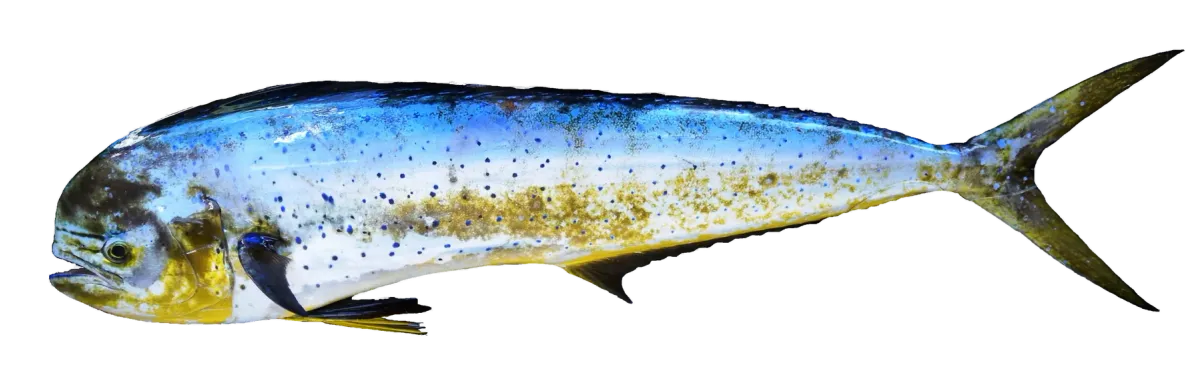
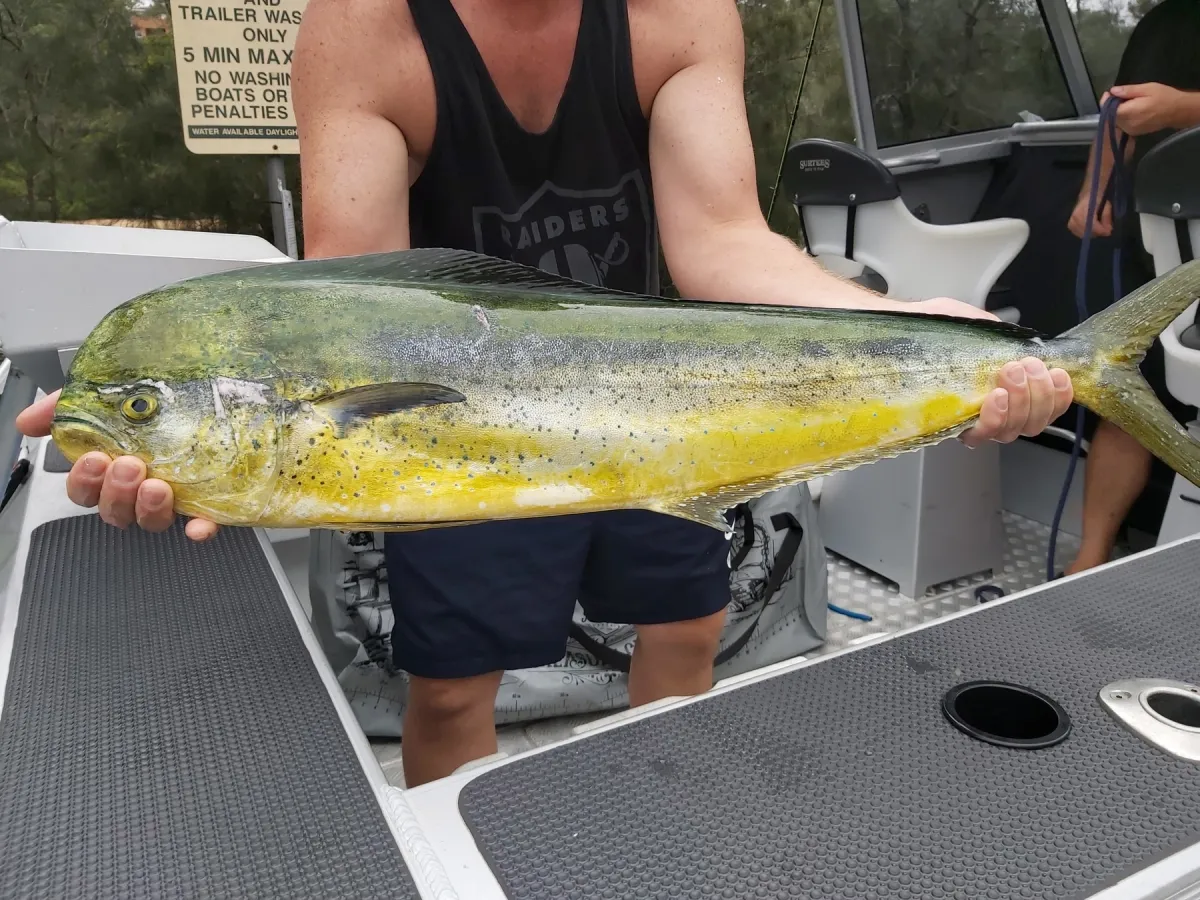
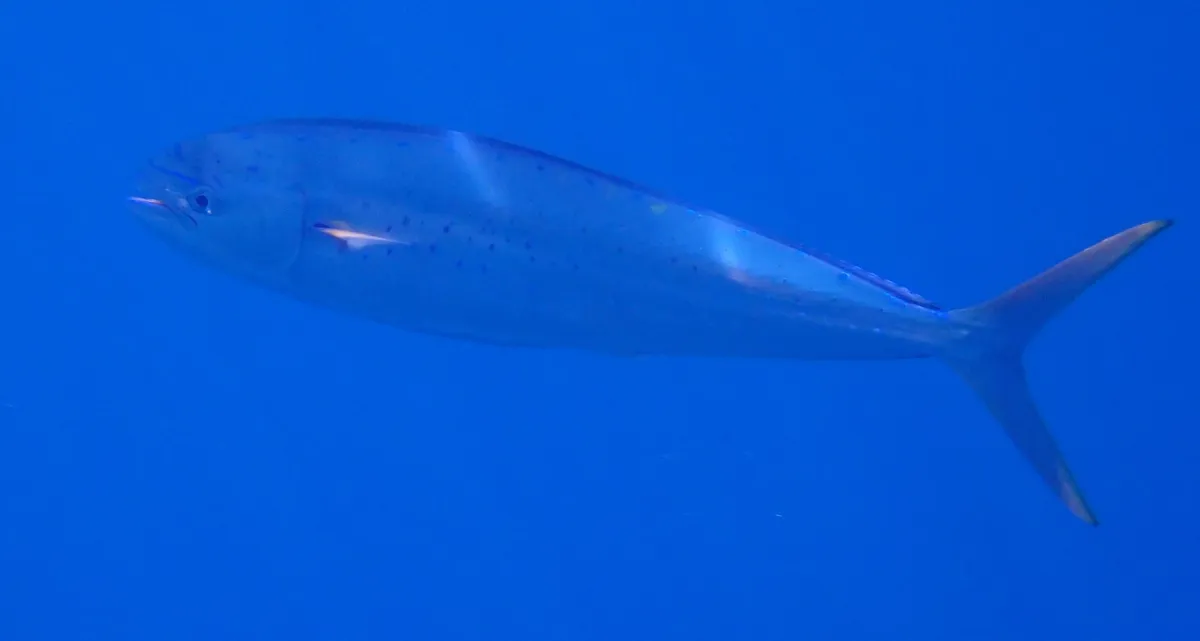
Mahi mahi (dolphinfish, dorado) is a fast, brilliantly coloured ocean fish that reaches northern New Zealand with warm water in summer and autumn. It has a long body, a dorsal fin running from the head almost to the tail, and electric blue-green and gold colours that fade within minutes of death. Bulls have a steep, square forehead. Anglers find them around floating debris and weed lines, and the firm white flesh is excellent eating.
How to identify mahi mahi
- A long, flattened body that tapers to a deeply forked tail.
- One long dorsal fin that runs from above the eye almost to the tail.
- Electric blue-green back and gold or silver sides with dark spots while alive. The colours fade to silvery grey soon after death.
- Adult males (bulls) have a high, near-vertical forehead; females (cows) have a rounded head.
Mahi mahi have a long, flattened body, a deeply forked tail and a single dorsal fin that starts above the eye and runs almost to the tail. Alive, they are electric blue-green on the back and gold or silver on the sides, scattered with dark spots, and the colours flash and change as the fish moves. Once landed, the colours fade fast, and a dead fish turns a dull silvery grey.
Adult males, called bulls, grow a bony crest that gives them a steep, almost vertical forehead. Females, called cows, keep a rounded forehead and are a little smaller. Schools often mix bulls and cows of different sizes.
The name has nothing to do with dolphins. "Dolphinfish" is an old English name, and mahi mahi is Hawaiian.
Often confused with
- Pompano dolphinfish
The only close relative (Coryphaena equiselis). It has been reported off north-eastern New Zealand, but NIWA's field guide lists no confirmed New Zealand records. It is smaller and deeper-bodied, with a shorter pectoral fin, and rarely passes 50 cm. The sure check is the tooth patch on the tongue, which is square in pompano dolphinfish and small and oval in mahi mahi.
Size and daily limits
Daily limitNo species limitCounts towards the combined finfish limit (20–30 a day). A shared limit applies in Fiordland.Limits for each area
| Area | Min. size | Daily limit |
|---|---|---|
| Auckland and Kermadec area | None | No species limit (combined 20 a day) |
| Central area | None | No species limit (combined 20 a day) |
| Challenger area | None | No species limit (combined 20 a day) |
| Kaikōura area | None | No species limit (combined 30 a day) |
| South-East area | None | No species limit (combined 30 a day) |
| Fiordland area (Fiordland Marine Area) | None | Varies, see note No species limit: counts towards Fiordland's 'any other finfish' limit of 10 a day, or 4 inside the Fiords. |
| Southland area | None | No species limit (combined 30 a day) |
Not named on any regional page; combined finfish limit only.
Checked 22 October 2026 · Source: MPI. Rules change, so check the NZ Fishing Rules app before you keep a fish.
Where it lives in New Zealand
Mahi mahi live near the surface of tropical and subtropical oceans worldwide, in water of about 21–30 °C. They are a summer visitor to New Zealand, seen mainly in northern waters when the sea warms. New Zealand record fish have come from Cape Karikari, the Bay of Islands, Tutukaka, Mercury Bay, Tauranga, Whakaari/White Island and round to Waihau Bay, and on the west coast from Raglan and New Plymouth.
They gather around anything floating in the open sea: logs, weed lines, buoys and other debris, which shelter the small fish they feed on. Young fish travel in schools, and big fish are more often alone or in pairs. Most are found in the top 10 m of the water.
- Jan: good
- Feb: good
- Mar: good
- Apr: good
- May: good
- Jun: quieter
- Jul: quieter
- Aug: quieter
- Sep: quieter
- Oct: quieter
- Nov: quieter
- Dec: good
How to catch it
A hot start to the marlin season doesn't mean the mahi mahi are here yet. They often turn up later in the summer, and off the west coast as well as the north-east.
Most New Zealand mahi mahi are caught by anglers trolling lures for marlin and tuna, or by spotting floating debris offshore and casting around it. If you see a log, a buoy, a pot float or a line of weed in warm blue water, slow down and fish it.
When they are feeding, mahi mahi will hit almost any lure or bait. Small skirted lures, bibbed and bibless minnows and cast metals all work, and live baits are taken head first. Cubing with skipjack tuna can hold a school near the boat. Single hooks make the fish easier to unhook and release.
They run hard and jump repeatedly, which makes them a great light-tackle and fly target. A green mahi mahi thrashing on deck with a multi-hook lure in its mouth is dangerous, so put it straight into the fish bin.
Eating
Mahi mahi has firm, white, mild-tasting flesh that is excellent fresh or frozen, grilled, pan-fried, barbecued or in fish tacos. Trim away the darker meat for a milder flavour. Like tuna, it can cause histamine (scombroid) poisoning if it is left to warm up, so bleed it and get it on ice straight away.
Recipes
- Mahimahi recipes (NOAA Fisheries)
Good to know
Mahi mahi grow fast and live short lives. They can mature at 4–5 months old and live for up to about 5 years, and females spawn every few days through a long season. New Zealand fish are generally small, about 2 to 10 kg, and most are caught as a bycatch when trolling for marlin in warm seasons. The New Zealand all-tackle record is 21.36 kg, from Mercury Bay in 2015.
Mahi mahi is listed as a highly migratory species under the Fisheries Act 1996, but it is not in the Quota Management System. The commercial catch around Australia and New Zealand is small, mostly bycatch on tuna and billfish longlines. The Kermadec Islands Marine Reserve, where mahi mahi are also recorded, is closed to all fishing.
Questions
Are there mahi mahi in New Zealand?
Yes. Mahi mahi visit northern New Zealand when the water warms, from about December to May, and most are caught from January to April. They are caught from Northland to the Bay of Plenty and East Cape, and occasionally off the upper west coast.
Is mahi mahi a dolphin?
No. Mahi mahi is a fish, also called dolphinfish or dorado. It is not related to dolphins, which are mammals.
How do you tell a bull mahi mahi from a cow?
Look at the forehead. Adult males (bulls) have a high, near-vertical forehead formed by a bony crest. Females (cows) have a rounded forehead and are usually smaller.
Why do mahi mahi lose their colour?
A live mahi mahi can change its colours as it moves and feeds. Once it dies the bright blue, green and gold fade within minutes, leaving a dull silvery grey fish.
Is mahi mahi good to eat?
Yes. The flesh is firm, white and mild, and it suits grilling, pan-frying and fish tacos. Bleed and ice it straight away, because mahi mahi left in the sun can build up histamine and cause scombroid poisoning.
What is the biggest mahi mahi caught in New Zealand?
The New Zealand all-tackle record is 21.36 kg, caught in Mercury Bay in March 2015. The world record is about 39 kg.
Related species
 Saltwater
 Saltwater
 EndemicSaltwater
 Saltwater
More guides
All guides- ArticlesHow to fillet a fish: snapper, gurnard, kahawai and moreStep-by-step filleting for NZ fish, with photos: the basic method, skinning and pin bones, and what is different about snapper, gurnard, kahawai and blue cod.
- ArticlesBest time to fish in New ZealandWhen to catch snapper, kingfish, kahawai, tuna, trout and salmon in New Zealand, with a month-by-month calendar and what bites in each season.