
Hāpuku
Hāpuka, Whāpuku, Kawerei, Moeone (bass), Ngutoro (bass)
Polyprion oxygeneios, Polyprion americanusAlso known as Hapuka, Hapuku, Groper, Grouper, Bass groper (for bass), Wreckfish, puka
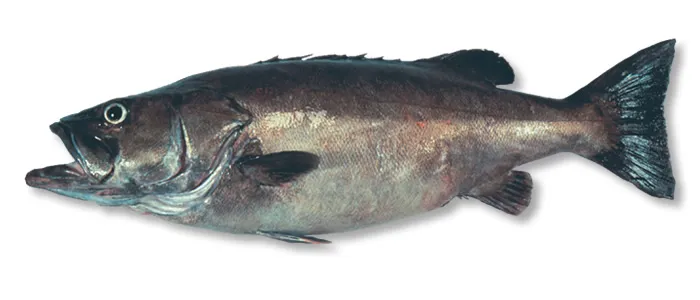
Hāpuku (hapuka or groper) is a big, heavy-bodied fish found right around New Zealand, mostly over rough ground from about 100 m down. Look for the big head, protruding lower jaw and a dark back that turns abruptly pale halfway down the side. Its close cousin, bass, is deeper bodied and evenly dark. Both are prized eating.
How to identify hāpuku
- A big, heavy body with a large, pointed head, a wide mouth and a lower jaw that sticks out past the upper.
- Hāpuku: blue-grey to brown on the back, changing abruptly about halfway down the side to dirty white, and pale white on the belly.
- A rough, bony ridge across the upper part of the gill cover.
- One long dorsal fin, with a low notch between the spiny front section and the soft rear section.
- Bass: a much deeper, bulkier body for the same length, evenly dark brown to slate grey on the sides, with white corners on the tail.
Hāpuku are large, heavy-bodied fish with a big head (about a third of the body length), a pointed snout, small eyes and a wide, oblique mouth with the lower jaw sticking out past the upper. The back is blue-grey to brown and changes sharply about halfway down the side to a dirty white, becoming pale white on the belly, and the fins are darker on their outer edges. A rough, bony ridge crosses the upper part of the gill cover, and there is one long dorsal fin with a low notch before the soft rear section.
Bass (Polyprion americanus) look much the same at a glance, and commercial fishers were allowed to report the two together for decades because they are hard to tell apart. The clearest difference is body depth. A hāpuku's body depth is less than 30% of its length to the base of the tail, so it looks long and fairly slim for its size. A bass is 35–43%, so it looks deep and chunky, and it is much heavier than a hāpuku of the same length. Adult bass are an even dark brown to slate grey on the sides, without the hāpuku's sharp change to a pale lower half, and the corners of the tail are white.
Young fish of both species look different again. Small hāpuku are mottled and live near the surface, often around drifting weed, and NIWA describes young juveniles as yellow. Young bass have dark blotches on the head and body, and up to about 60 cm long they live in open water around floating debris.
Often confused with
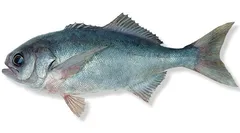
- Bass
Bass have a much deeper, bulkier body (35–43% of their length, against less than 30% for hāpuku), are an even dark brown to slate grey on the sides rather than dark above and abruptly pale below, and have white corners on the tail. They also range deeper.
Size and daily limits
Daily limit2–3 a dayA shared or split limit applies in Kaikōura, South-East and Southland.Limits for each area
| Area | Min. size | Daily limit |
|---|---|---|
| Auckland and Kermadec area | None | 2 Accumulation limit of no more than 3 per fisher over more than one day (Auckland East and West). Kermadecs: Combined daily limit of 5 groper (hāpuku)/bass and kingfish, with no more than 3 kingfish. |
| Central area | None | 2 Accumulation limit of no more than 3 per fisher over more than one day. |
| Challenger area | None | 2 Accumulation limit of no more than 3 per fisher over more than one day. Paringa, Popotai Taumaka/Open Bay Islands, Okahu/Jacksons Bay and Tauneke/Barn Bay Mātaitai Reserves: 1 per day. |
| Kaikōura area | None | Varies, see note Albacore tuna, bluenose, groper (hāpuku)/bass, kingfish and ling share a combined daily limit of 5 per person, with a maximum of 3 of any one species. |
| South-East area | None | Varies, see note Combined daily limit of 5 groper (hāpuku)/bass and kingfish, with no more than 3 kingfish. |
| Fiordland area (Fiordland Marine Area) | None | 3 Inside the Fiords (excluding Internal Waters): 1 per day. Internal Waters: closed to groper (hāpuku)/bass, no take; no setlines in Internal Waters. |
| Southland area | None | Varies, see note Combined daily limit of 5 groper (hāpuku)/bass and kingfish, with no more than 3 kingfish. |
Groper (hāpuku) and bass are one combined limit everywhere. Combined with kingfish in Kermadecs, South-East and Southland (5, max 3 kingfish). Kaikōura: combined 5 with albacore, bluenose, kingfish and ling.
Checked 22 October 2026 · Source: MPI. Rules change, so check the NZ Fishing Rules app before you keep a fish.
Where it lives in New Zealand
Hāpuku and bass live right around New Zealand and its offshore islands, from the Kermadec Islands to the Auckland Islands, including the Chatham Islands and Chatham Rise. Both live mostly over rough ground, reefs, pinnacles and ledges from the middle of the continental shelf (about 100 m) to the shelf edge and down the upper slope. Hāpuku extend to at least 300 m and bass to about 500 m, so the deeper you drop, the more likely a bass becomes. Some hāpuku live on reefs only a few metres deep, and where stocks are plentiful, as around the Chatham Islands, they also come into shallow water. Trawlers sometimes catch both species on open, flat seafloor, and fisheries scientists don't know whether they live there or are just moving between reefs.
Hāpuku rarely swim alone and are sometimes found in schools of 30 or more. They are long-term residents of their patch of reef. Tagging in Cook Strait found most fish stayed put, though about 1 in 20 moved up to 160 km. Good grounds, especially pinnacles, reefs and ledges, can be fished out quickly and take time to recover. Hāpuku spawn in winter, probably after a migration, and running-ripe fish are rarely caught, so their spawning grounds are unknown. The offshore shelves of the Chatham Rise and Stewart-Snares Shelf hold many juvenile hāpuku and may be important nurseries.
- Jan: good
- Feb: good
- Mar: good
- Apr: good
- May: good
- Jun: good
- Jul: good
- Aug: good
- Sep: good
- Oct: good
- Nov: good
- Dec: good
How to catch it
Deep dropping over reefs and pinnacles: almost all hāpuku and bass kept by recreational fishers are caught on rod and line from powered boats, usually in 100 m or more. Use the sounder to find pinnacles, ledges and hard, broken ground, and drop on the up-current side so the rig drifts onto the structure. Braid gives the feel you need at depth, with a heavy mono or fluorocarbon trace. A dropper rig with two big circle or recurve hooks is standard, with a sinker heavy enough to hold the bottom in the current. Tie the sinker on with a short link of lighter line (a "rotten bottom") so you lose only the sinker if it snags. An electric reel makes repeated deep drops much easier.
Bait: hāpuku eat fish and squid, including red cod, tarakihi, blue cod, hoki and barracouta, so big, fresh, oily baits work. Whole or half jack mackerel, kahawai or barracouta fillets, and squid are all used. See the bait guide for what to buy and how to rig it.
Releasing fish from depth: be realistic about it. A fish pulled up quickly from deep water suffers barotrauma, as gas in the swim bladder and other organs expands with the falling pressure. Signs include a swollen belly, bulging eyes and the stomach pushed out of the mouth, and the damage gets worse the deeper the fish came from. A hāpuku hauled up from 150 m often can't swim back down by itself. If you do release one, do it fast and send it back down on a release weight: a heavy sinker with a barbless hook, on about 30 m of strong line, hooked through the top jaw and let go head first. Venting with a needle isn't recommended. The better answer is to stop fishing a spot once you have what you need.
Eating
Hāpuku is highly rated eating. The flesh is firm and white with few bones, has a delicate flavour, stays moist and falls into large flakes when cooked. It is good as thick steaks or fillets, and it smokes well. Bake, steam, pan-fry, poach or barbecue it, and keep sauces simple so the fish stands out. Hāpuku is a good source of omega-3 fatty acids, selenium, iodine, niacin and vitamin B12.
A big hāpuku is a lot of fish to handle. Bleed it and put it on ice as soon as it lands, and use a long, firm knife to fillet it or cut it into steaks. The firm flesh also smokes well.
I've had my best hāpuku days jigging. The flesh is white and tender, right up there with any fish I've eaten. Don't stop at the fillets either: the wings and cheeks are some of the best eating on the fish.
Recipes
- Baked hapuku (Seafood New Zealand)
- Chilled poached hapuku with summer tomatoes (Al Brown) (NIWA)
- Green fish curry (Seafood New Zealand)
Good to know
Hāpuku and bass are managed together under the Quota Management System as one combined stock, groper (HPB), because for decades commercial fishers could report them under a single code. Since 1 December 2021, fishers have had to report hāpuku (HAP) and bass (BAS) separately. Fisheries New Zealand treats groper as a "low knowledge" stock: there are no reliable estimates of how many fish there are, and it isn't known whether current catches are sustainable. Commercial catches have fallen in some areas, and the total allowable catch was cut for HPB 1 (the upper North Island) and HPB 2 (the east coast of the lower North Island) from October 2021, and for HPB 7 (the top and west coast of the South Island) and HPB 8 (the west coast of the lower North Island) from October 2022.
Recreational fishers kept an estimated 11,989 hāpuku and bass in the year to September 2023, weighing about 77 tonnes. Of those, 10,323 were hāpuku, so bass are a much smaller part of the catch. The fish kept averaged about 6.4 kg. Almost all were caught on rod and line from powered boats, and nearly 7 in 10 catches where groper were kept were a single fish. The east coast of the South Island, the east coast of the lower North Island and the upper North Island each produced roughly a quarter of the harvest. The estimate is down from about 38,000 fish in 2017–18, though most species' estimates fell between those two surveys.
Hāpuku grow slowly and live a long time. Ageing of their ear bones has been validated, and they are known to live to 60 years. They mature at 10 to 13 years. In Cook Strait, half the males are mature by 80–85 cm and half the females by 85–90 cm. Using the Fisheries New Zealand length-to-weight formula for northern hāpuku, a fish of 80 cm (fork length) weighs about 7 kg, 100 cm about 14 kg and 120 cm about 25 kg. Bass are slightly longer on average and much heavier for their length. The New Zealand all-tackle record for bass is 86.2 kg, caught at Ranfurly Bank, off East Cape, in 2010.
Māori fished groper long before Europeans arrived, when hāpuku were more plentiful in shallower water, and traditional groper grounds are known in several regions. In Cook Strait, sperm whales eat hāpuku and bass. NIWA has bred hāpuku in tanks at its Northland Aquaculture Centre, the only place they are farmed, and closed the life cycle in 2013 when captive-bred fish spawned.
Questions
Is hāpuku the same as groper?
Yes. Groper, grouper and hapuka are other names for hāpuku. Fisheries New Zealand also uses groper for hāpuku and bass together, because the two are managed as one combined stock (HPB), so a fish sold or reported as groper may be either species.
What's the difference between hāpuku and bass?
Body shape and colour. Bass are much deeper and bulkier than a hāpuku of the same length and much heavier. Hāpuku have a blue-grey to brown back that changes sharply to dirty white about halfway down the side, while bass are an even dark brown to slate grey with white corners on the tail. Bass also tend to live deeper.
Is hāpuku good eating?
Yes, it is highly rated. The firm white flesh has few bones, stays moist and falls into large flakes when cooked. Cut it into steaks or fillets, smoke it, or bake, steam, pan-fry or barbecue it, and keep sauces simple.
How big do hāpuku get?
Most hāpuku caught are 70–100 cm long, and the fish kept by recreational fishers in 2022–23 averaged about 6.4 kg. The largest reach about 1.8 m and 100 kg. Bass grow bigger and heavier: the New Zealand record is 86.2 kg. Hāpuku grow slowly, mature at 10 to 13 years and live to 60 years.
Can you release a hāpuku caught from deep water?
You can try, but many don't survive. Fish brought up from depth suffer barotrauma: gas expands inside them, so they float with a swollen belly and bulging eyes. Release them quickly on a release weight that takes them back down, rather than venting them. The surest way to protect hāpuku is to move on once you have what you need.
How many hāpuku can I keep?
It depends where you fish, and in some areas hāpuku and bass share a combined daily limit with other species. See the size and daily limits table on this page for the current rules in your area. Hāpuku grow slowly and good spots are easily fished out, so take only what you need.
Related species
 Saltwater
 Saltwater
 Saltwater
 EndemicSaltwater
More guides
All guides- ArticlesThe best eating fish in New ZealandThe best New Zealand fish to eat, grouped by how to cook them: snapper and blue cod for frying, kingfish for sashimi, kahawai for smoking and more.
- GearFish finders NZ: what to buy for a kayak, tinny or trailer boatWhich fish finder suits your kayak, tinny, trailer boat or launch: CHIRP, side imaging, live sonar, transducers and NZ charts explained, with current NZ prices.
- ArticlesBest bait for fishing in NZ: a species-by-species guideWhat bait to use for snapper, kahawai, gurnard, kingfish and more in NZ: a species-by-species table, how to rig each bait, and how to use burley.