
Grey Mullet
Kanae, Hopuhopu, Kanae raukura
Mugil cephalusAlso known as Mullet, flathead mullet, sea mullet, striped mullet
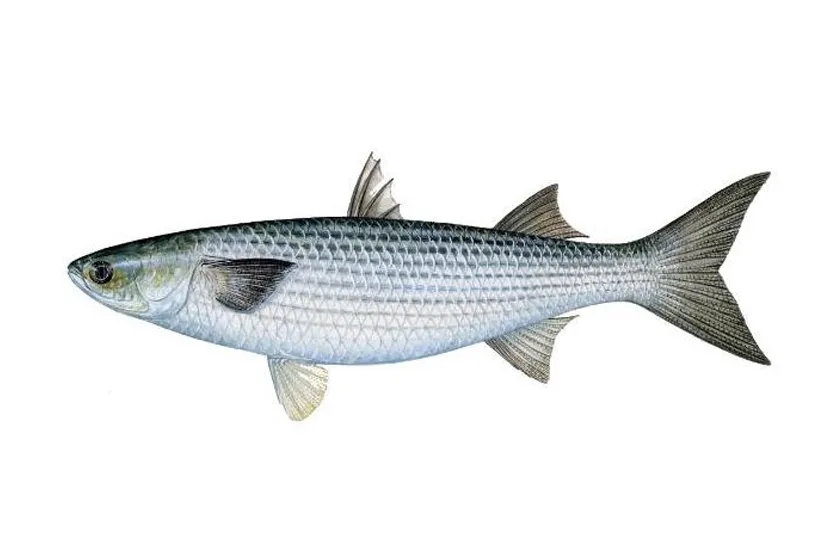
Grey mullet (kanae) is a thick, torpedo-shaped schooling fish of shallow North Island harbours, estuaries and mangroves, especially from Northland to the Bay of Plenty. The key feature is a thick, fleshy eyelid covering most of the eye. Mostly netted rather than caught on a line, it has oily flesh that is especially good smoked.
How to identify grey mullet
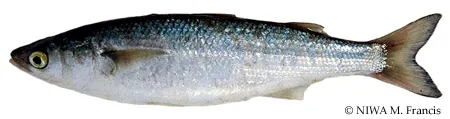
A thick, torpedo-shaped fish with a broad head and blunt snout. The back is olive-grey and the sides and belly silvery grey to white. There are two widely separated dorsal fins; the first is tall with four obvious spines. The scales are large and come off easily. The key feature is a thick, fleshy eyelid that covers most of the eye, leaving an oval vertical slit over the pupil. Yellow-eyed mullet lack this eyelid and have a bright yellow eye.
Size and daily limits
Daily limitNo species limitCounts towards the combined finfish limit (20–30 a day). A shared limit applies in Fiordland.Limits for each area
| Area | Min. size | Daily limit |
|---|---|---|
| Auckland and Kermadec area | None | No species limit (combined 20 a day) |
| Central area | None | No species limit (combined 20 a day) |
| Challenger area | None | No species limit (combined 20 a day) |
| Kaikōura area | None | No species limit (combined 30 a day) |
| South-East area | None | No species limit (combined 30 a day) |
| Fiordland area (Fiordland Marine Area) | None | Varies, see note No species limit: counts towards Fiordland's 'any other finfish' limit of 10 a day, or 4 inside the Fiords. |
| Southland area | None | No species limit (combined 30 a day) |
Within combined finfish daily limit.
Checked 22 October 2026 · Source: MPI. Rules change, so check the NZ Fishing Rules app before you keep a fish.
Where it lives in New Zealand
Grey mullet are found worldwide in warm coastal waters, and New Zealand is the southern edge of their range. Here they are mostly found around the North Island, especially Northland, Auckland, the Waikato and Bay of Plenty, and reach Cook Strait only in summer. They school in shallow muddy harbours, mangroves and estuaries and travel far up rivers, reaching Karapiro Dam on the Waikato, but return to sea to spawn. They feed on algae and detritus sifted from the mud.
How to catch it
Most grey mullet are caught in set nets and seine nets in harbours and estuaries. Because they feed on algae and detritus, they are hard to catch on rod and line. Anglers who try use light line, small hooks and bread or flour dough, with bread as berley. Check regional set net rules before netting.
Eating
Grey mullet has medium to firm, pinkish-grey flesh with a high oil content. It is especially good smoked, and can also be baked, poached, steamed or cooked in casseroles. The roe is considered a delicacy. Grey mullet has long been an important food for Māori, especially in Northland and the Waikato.
Recipes
- Lemongrass and Ginger Steamed Fish Parcels (Seafood New Zealand)
Good to know
Managed under the Quota Management System. Both sexes mature at about 3 years, at around 33 cm (males) and 35 cm (females). Females can release up to a million eggs in a spawning event, and spawning in the north runs from November to February. In fished areas they live to about 8 years and weigh about 1 kg; in unfished areas they can live to 19 years and weigh more than 4 kg.
Questions
Is grey mullet good eating?
Yes, especially smoked. Grey mullet has medium to firm, pinkish-grey flesh with a high oil content. It can also be baked, poached, steamed or cooked in casseroles, and the roe is considered a delicacy. It has long been an important food for Māori, especially in Northland and the Waikato.
How do you catch grey mullet?
Mostly with set nets and seine nets in harbours and estuaries. Grey mullet feed on algae and detritus, so they are hard to catch on rod and line. Anglers who try use light line, small hooks and bread or flour dough, with bread as berley. Check regional set net rules before netting.
What is the difference between grey mullet and yellow-eyed mullet?
The eye. Grey mullet has a thick, fleshy eyelid covering most of the eye and grows much larger. Yellow-eyed mullet has a bright yellow eye and no fleshy eyelid. Grey mullet are mainly found around the North Island and reach Cook Strait only in summer.
Related species
 Saltwater
 Saltwater
 Saltwater
 EndemicSaltwater
More guides
All guides- ArticlesHow to bleed and ice your catch (and why it matters)Iki jime, bleeding and an ice slurry make your catch taste better and keep longer. How to do each, with diagrams and notes for kahawai, kingfish and snapper.
- ArticlesNZ fishing rigs and knots: diagrams and when to use eachClear diagrams of the main NZ fishing rigs (ledger, running sinker, strayline, surfcasting, live bait) and the knots to tie them, with which fish each catches.
- ArticlesHow to fillet a fish: snapper, gurnard, kahawai and moreStep-by-step filleting for NZ fish, with photos: the basic method, skinning and pin bones, and what is different about snapper, gurnard, kahawai and blue cod.