
Barracouta
Mangā
Thyrsites atunAlso known as Snoek, couta
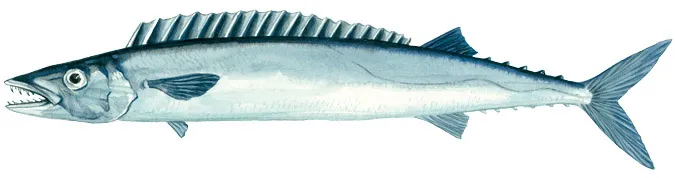
Barracouta (mangā, or couta) is a long, slender, steely-blue schooling fish found around New Zealand, most common around the South Island. Look for the fang-like teeth, the black blotch on the first dorsal fin and a single lateral line that curves sharply down. Anglers often catch it while targeting other fish, and most keep it for bait.
How to identify barracouta
A long, slender, strongly flattened fish with a steely blue back fading to silver below. The front of the first dorsal fin has a black blotch. A single lateral line runs high along the back under the first dorsal fin, then curves sharply down towards the belly. The lower jaw sticks out and the upper jaw has several pairs of long, fang-like teeth. A row of 5 to 7 small finlets sits behind both the second dorsal and anal fins.
Size and daily limits
Daily limitNo species limitExcept Fiordland: 20 a day. Elsewhere it counts towards the combined finfish limit (20–30 a day).Limits for each area
| Area | Min. size | Daily limit |
|---|---|---|
| Auckland and Kermadec area | None | No species limit (combined 20 a day) |
| Central area | None | No species limit (combined 20 a day) |
| Challenger area | None | No species limit (combined 20 a day) |
| Kaikōura area | None | No species limit (combined 30 a day) |
| South-East area | None | No species limit (combined 30 a day) |
| Fiordland area (Fiordland Marine Area) | None | 20 Inside the Fiords: 3 per day. |
| Southland area | None | No species limit (combined 30 a day) |
Within combined finfish daily limit.
Checked 22 October 2026 · Source: MPI. Rules change, so check the NZ Fishing Rules app before you keep a fish.
Where it lives in New Zealand
Found right around mainland New Zealand, the Snares and the Chatham Islands, and most common around the South Island. Barracouta form large schools in coastal and offshore waters, often near the surface, and adults range down to about 400 m. Young fish live inshore in less than 100 m. Tagging showed that mature fish from the east coast of the South Island move north after June to spawn off the east coast of the North Island in August and September.
How to catch it
Barracouta are often caught while fishing for other species, especially in the southern half of the South Island. Almost all recreational catch is taken on rod and reel from boats. Most are kept as bait rather than eaten. Handle them carefully: the long, fang-like teeth cut easily.
Eating
Soft white flesh with a rich, distinctive flavour. The raw flesh is darker and whitens when cooked. Barracouta is not widely eaten in New Zealand today, but it smokes very well and can also be grilled, fried, baked or barbecued. Bold seasonings and marinades suit it.
Recipes
- Green fish curry (Seafood New Zealand)
Good to know
Barracouta grow quickly, mature at about 50 to 60 cm at 2 to 3 years old and rarely live past 10 years. They are managed under the Quota Management System.
Questions
Is barracouta good to eat?
It is edible but not widely eaten in New Zealand today. The soft white flesh has a rich, distinctive flavour and whitens when cooked. It smokes very well and can be grilled, fried, baked or barbecued, and bold seasonings and marinades suit it. Most recreational catch is kept as bait.
What is the difference between barracouta and gemfish?
Check the lateral line. Barracouta have a single lateral line that runs high under the first dorsal fin, then curves sharply down towards the belly. Gemfish have a forked lateral line, with a second, wavy branch along the middle of the side. Both have a black blotch on the first dorsal fin.
Do barracouta have sharp teeth?
Yes. The upper jaw has several pairs of long, fang-like teeth and the lower jaw sticks out. The teeth cut easily, so handle barracouta carefully when unhooking them and keep your fingers clear of the mouth.
Is barracouta the same as barracuda?
No. Barracouta (Thyrsites atun) is a cool-water fish common around southern New Zealand. Barracuda are tropical fish in a different family. Barracouta often carry worms in the flesh, which is the main reason many anglers use them as bait, though some rate them highly smoked.
Related species
 Saltwater
 Saltwater
 Saltwater
 EndemicSaltwater
More guides
All guides- ArticlesHow to bleed and ice your catch (and why it matters)Iki jime, bleeding and an ice slurry make your catch taste better and keep longer. How to do each, with diagrams and notes for kahawai, kingfish and snapper.
- ArticlesNZ fishing rigs and knots: diagrams and when to use eachClear diagrams of the main NZ fishing rigs (ledger, running sinker, strayline, surfcasting, live bait) and the knots to tie them, with which fish each catches.
- ArticlesHow to fillet a fish: snapper, gurnard, kahawai and moreStep-by-step filleting for NZ fish, with photos: the basic method, skinning and pin bones, and what is different about snapper, gurnard, kahawai and blue cod.