
Red Gurnard
Kumukumu, Pūwhaiau
Chelidonichthys kumuAlso known as Gurnard, Bluefin gurnard, grunter
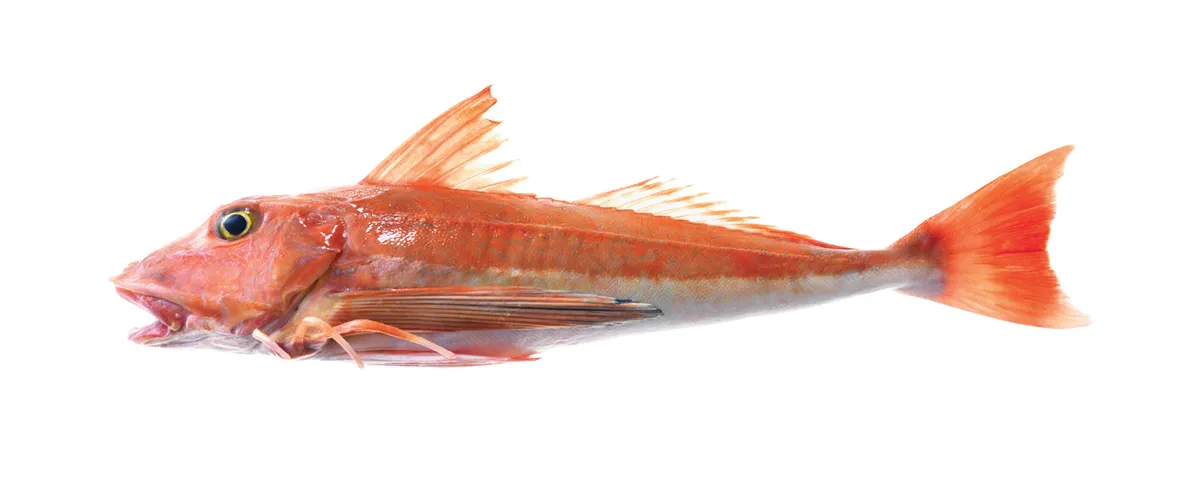
Red gurnard (kumukumu, Chelidonichthys kumu) is a bottom-feeding fish found all around New Zealand on sand and mud, mostly in water shallower than 75 m. Look for a bony, armoured head, a red back and huge wing-like pectoral fins with blue spots and a black blotch. It is the fourth most kept recreational fish and excellent eating.
How to identify red gurnard
- Reddish pink, red or reddish-brown on the back and upper sides, fading to white or silvery white on the belly.
- A large, hard, bony head, armoured with plates and spines.
- Very large pectoral fins that spread like wings. The inside is olive-green to purplish with scattered blue spots, and there is a large black blotch, speckled with white, near the base.
- Three separate finger-like rays under each pectoral fin, used to feel along the seabed.
- A row of small thorn-like bony plates along the base of both dorsal fins.
Red gurnard have a long, tapering body and a big, bony, armoured head. The back and upper sides are reddish pink to red, sometimes brownish, and the belly is white. The tail fin has a concave edge.
The giveaway is the pectoral fins. They are very large and open and close like a bird's wings. Spread one out and the inner surface is olive-green, grey or purplish, scattered with blue spots, with one large black blotch near the base that often carries small white or bluish speckles. Under each pectoral fin are three free, finger-like rays that the fish rests on and uses to feel for food in the sand.
The head is covered in hard plates with sharp spines, including on the gill covers, so hold them firmly behind the head. Red gurnard often grunt when they are landed.
The red gurnard caught in New Zealand is not the European fish of the same name (Chelidonichthys cuculus), which lives in the north-east Atlantic and Mediterranean. In Australia, Chelidonichthys kumu is often called bluefin gurnard.
Often confused with
- Spotted gurnard
Spotted gurnard (Pterygotrigla andertoni) are pink to pinkish-orange with small dark spots on the head and upper body. They live much deeper, usually 100–500 m, so recreational anglers rarely see them.
- Scaly gurnard
Scaly gurnard (Lepidotrigla brachyoptera) are a small New Zealand species that only grow to about 14 cm. Any gurnard big enough to keep is almost certainly a red gurnard.
- European red gurnard
Chelidonichthys cuculus is a different Atlantic species and isn't found in New Zealand. It is red with pinkish-silver mottling, and overseas photos, sizes and descriptions of it won't match the fish caught here.
Size and daily limits
Minimum size25 cmDaily limitNo species limitExcept Fiordland: 5 a day. Elsewhere it counts towards the combined finfish limit (20–30 a day).Limits for each area
| Area | Min. size | Daily limit |
|---|---|---|
| Auckland and Kermadec area | 25 cm | No species limit (combined 20 a day) |
| Central area | 25 cm | No species limit (combined 20 a day) |
| Challenger area | 25 cm | No species limit (combined 20 a day) |
| Kaikōura area | 25 cm | No species limit (combined 30 a day) |
| South-East area | 25 cm | No species limit (combined 30 a day) |
| Fiordland area (Fiordland Marine Area) | 25 cm | 5 Inside the Fiords: 2 per day. |
| Southland area | 25 cm | No species limit (combined 30 a day) |
Within combined finfish daily limit.
Checked 22 October 2026 · Source: MPI. Rules change, so check the NZ Fishing Rules app before you keep a fish.
Where it lives in New Zealand
Red gurnard are found all around New Zealand on sand, mud and shelly seabed, from shallow harbours down to about 180 m. Most live in fairly shallow water. Trawl surveys off the east coast of the South Island find them mainly at 10–75 m, with many of the biggest catches in less than 30 m, and almost none deeper than 100 m.
They are common in harbours and shallow coastal water, which is what makes them such a popular recreational fish. Nearly three-quarters of the recreational catch comes from the north and east of the North Island (the GUR 1 and GUR 2 stocks). The Kaipara and Manukau harbours, Hawke's Bay, Taranaki, the Manawatū and Wellington coasts, Tasman Bay and Golden Bay are all well known for them.
Young fish grow up in shallow water. Juveniles under 15 cm are often found in harbours, and fish of 1–4 years old are most common in sheltered places like Tasman Bay and Golden Bay. As they grow older, gurnard move further offshore.
Spawning runs through spring and summer, peaking in early summer, and in the Hauraki Gulf ripe adults turn up all year. Eggs and larvae drift in the surface waters.
- Jan: quieter
- Feb: quieter
- Mar: good
- Apr: good
- May: good
- Jun: good
- Jul: quieter
- Aug: quieter
- Sep: quieter
- Oct: good
- Nov: good
- Dec: quieter
How to catch it
Bait on the bottom: gurnard feed on the seabed, mostly on crabs and other animals living on or in the sand, so your bait needs to sit right on the bottom. Fish over open sand or mud rather than reef, usually at 15–30 m, or a little deeper (around 40–50 m) during the summer spawning season. A ledger or paternoster rig does the job, with a light leader and fairly small hooks (around 2/0 to 4/0), which hook more gurnard than big snapper hooks. Small, tough baits work best: squid, pilchard, bonito or cut fish. Gurnard feed in daylight, most actively around the middle of the day, and stop feeding in darkness, so they're a good daytime target when the snapper go quiet.
Soft baits and slow jigs: small soft baits on a jig head, or slow jigs, catch plenty of gurnard. Choose a jig head heavy enough to keep the lure on or very near the bottom, and work it slowly with small lifts. Big, high hops are more likely to bring kahawai than gurnard. Drifting over sand lets you cover ground and find where the fish are sitting. Flasher rigs fished on the bottom are another popular choice.
From the shore: most gurnard are caught from boats, and only about 8% of the national recreational harvest is taken from land. Surfcasters on sandy beaches and in harbours still catch them, usually on a surfcasting rig baited for snapper. Gurnard are a common bycatch for anyone fishing the bottom for snapper or tarakihi. Watch the spines on the head when you unhook them, and bleed and ice the keepers straight away.
Eating
Red gurnard is one of New Zealand's best eating fish, and some anglers rate it above snapper. The flesh is pink-white with a sweet, distinctive flavour, and the fillets are firm and hold their shape when cooked.
It suits almost any cooking method: pan-frying, steaming, poaching, baking, barbecuing and casseroles, and very fresh fish can be eaten raw. Small fish are very good cooked whole, which saves filleting the bony head. Each fillet has a row of small pin bones to pull or cut out before cooking. See how to fillet a fish for the gurnard steps, and bleed and ice your catch as soon as it is landed for the best flavour.
Don't skin your gurnard. The scales are tiny and set into the skin, and the skin keeps the fillet moist, so cook it skin side down first.
Recipes
- BBQ whole gurnard (Seafood New Zealand)
- Spiced gurnard fillets with chermoula yoghurt (Seafood New Zealand)
Good to know
Red gurnard is New Zealand's fourth most kept recreational fish. In the National Panel Survey for the year to September 2023, recreational fishers kept an estimated 201,100 gurnard, weighing about 115 tonnes, with an average weight of 0.57 kg. About 93% were caught on rod and line, and a bag of just one gurnard was the most common.
Gurnard have been fished commercially since the 1930s. Today they are a major bycatch of inshore trawling around the country, and are targeted in some areas, such as the east coast of the North Island. They were brought into the Quota Management System in 1986. In the latest Fisheries New Zealand assessments (2022–2024), the east and west coast South Island stocks were well above their targets, while the North Island stocks were about as likely as not to be at target, or of unknown status. None was assessed as likely to be below its soft limit.
Gurnard grow quickly and live to about 16 years. Females grow faster than males and are usually bigger at the same age. They mature at 2–3 years old and about 23 cm, after which growth slows.
The grunt is real. Research at the University of Auckland's Leigh Marine Laboratory found red gurnard make at least four kinds of sound, grunts and growls, by contracting muscles on the swim bladder. They call day and night, most often at dawn and dusk.
Kumukumu was a seasonal catch for Māori, taken in August, September and October alongside tarakihi and pōrae. Charles Darwin collected a red gurnard in the Bay of Islands when the Beagle visited in December 1835.
Questions
Is gurnard good eating?
Yes. Red gurnard is one of the best eating fish in New Zealand, with firm, pink-white fillets and a sweet flavour. The fillets hold together well, so it suits pan-frying, baking, barbecuing, steaming and casseroles, and smaller fish are excellent cooked whole. Bleed and ice it as soon as it is caught.
How do you fillet gurnard?
Hold the fish firmly behind the head, away from the spines, and expect the first cut behind the hard head plate to take some force. A heavy knife or kitchen shears helps. Run a flexible blade along the backbone as usual, then pull or cut out the row of pin bones in each fillet. Our filleting guide has the full steps.
What is the Māori name for gurnard?
Red gurnard is kumukumu in te reo Māori. Te Aka Māori Dictionary also records pūwhaiau as a name for the same fish.
How big do gurnard get, and what size can I keep?
Most gurnard caught are 30–40 cm long, and the biggest reach about 60 cm and 2 kg. Using the Fisheries New Zealand length-to-weight formula, a 30 cm gurnard weighs about 0.3 kg, a 40 cm fish about 0.7 kg and a 50 cm fish about 1.3 kg. The minimum size and daily limit are in the rules table on this page, which shows each fishing area and when we last checked it against MPI.
What do gurnard eat?
Mostly crabs, along with shrimps and other small animals that live on or in the seabed. Gurnard rest on their pectoral fins and use the finger-like rays to feel for food in the sand. They feed in daylight, most of all around midday, which is why baits on the bottom such as squid, pilchard and crab catch them well.
Is New Zealand red gurnard the same as European red gurnard?
No. New Zealand's red gurnard is Chelidonichthys kumu, also found in Australia, where it is called bluefin gurnard. The European red gurnard is a different Atlantic species, Chelidonichthys cuculus, so overseas photos, sizes and recipes may not match the fish caught here.
Related species
 Saltwater
 Saltwater
 EndemicSaltwater
 Saltwater
More guides
All guides- ArticlesSurfcasting in NZ: gear, rigs, bait and how to read a beachHow to surfcast in NZ: the rod, reel and rig to start with, the best baits, how to read a beach for gutters and holes, and when the fish come in.
- PlacesLand-based fishing spots in Auckland: wharves, rocks and beachesWhere to fish in Auckland without a boat: the main wharves, rocks and beaches by area, what you will catch, best tides, local rules and rock fishing safety.
- ArticlesNZ fishing rigs and knots: diagrams and when to use eachClear diagrams of the main NZ fishing rigs (ledger, running sinker, strayline, surfcasting, live bait) and the knots to tie them, with which fish each catches.