Manta Ray
Te Whai Rahi (oceanic manta ray)
Mobula birostris, Mobula mobular formerly Manta birostris, Mobula japanicaAlso known as Oceanic manta ray, Giant manta ray, Giant oceanic manta ray, Spinetail devil ray, Spine-tailed devil ray, Giant devil ray, Japanese devil ray, Devil ray, Devilfish

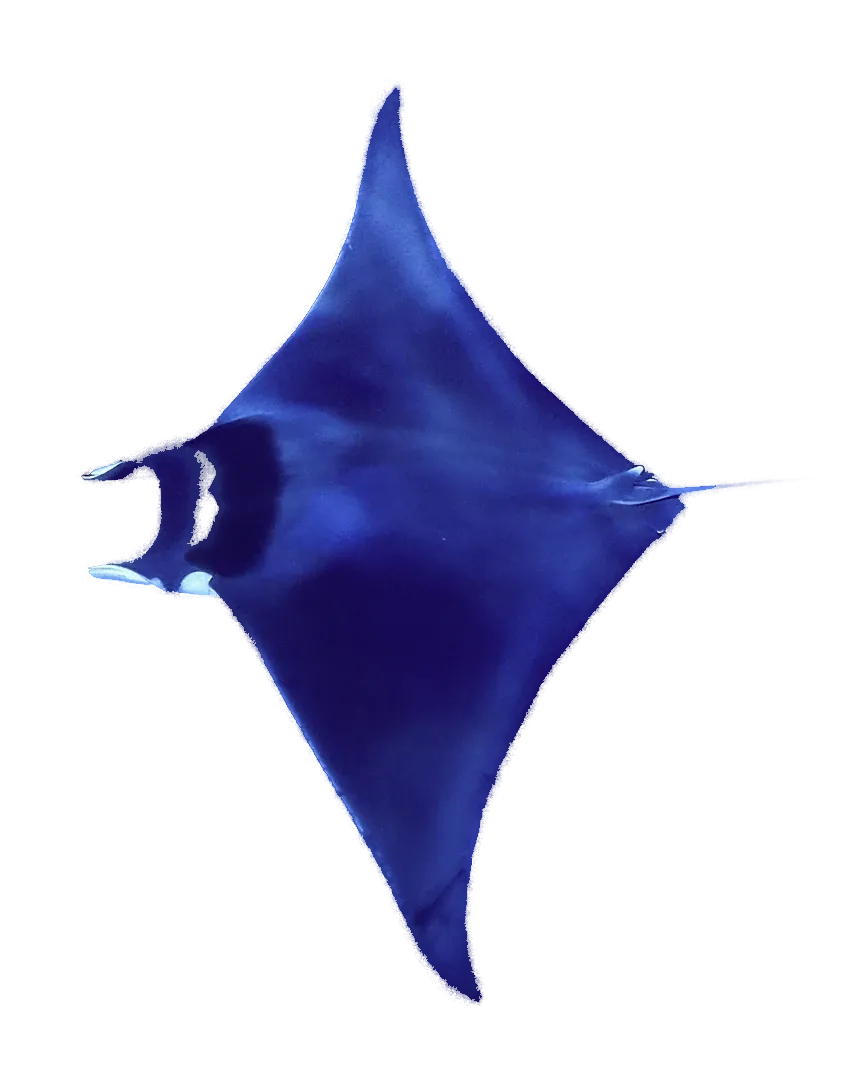
Two giant, plankton-eating rays visit northern New Zealand each spring and summer: the oceanic manta ray (Te Whai Rahi), which can grow to about 7 m across, and the smaller spinetail devil ray. Both have horn-like fins on the head and often feed at the surface. Mantas are harmless to people, and both species have been fully protected here since 2010.
How to identify manta ray
- Oceanic manta ray: very large (often 4 to 5 m across), with a broad head, the mouth at the front of the head, and pale T-shaped shoulder patches on a black back.
- Spinetail devil ray: smaller (mostly under 2.5 m across in New Zealand), with a narrower head, the mouth underneath, a white tip on the dorsal fin and a small spine at the base of the tail.
- Both have horn-like head fins and swim in open water, often at the surface. Eagle rays and stingrays have no head fins and live mainly in harbours, bays and on reefs.
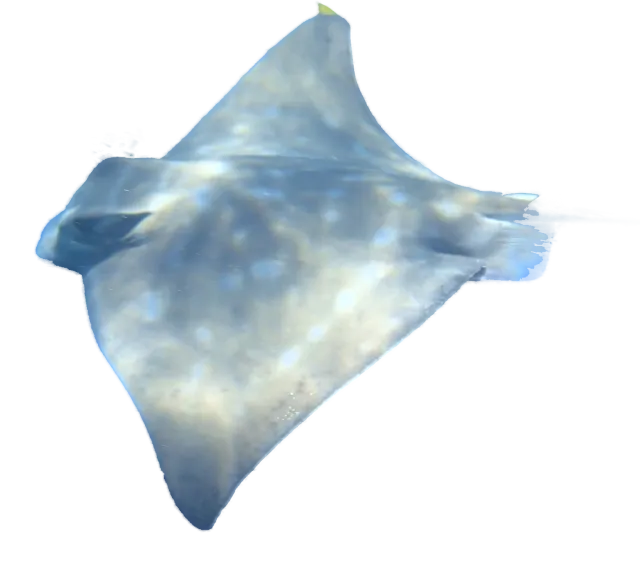
Manta and devil rays are huge, diamond-shaped rays that swim in open water by beating their long, pointed wings. Both have a pair of large fins that stick forward from the head on either side of the mouth, called cephalic fins. They use these to funnel food into the mouth, and roll them up like horns when they are not feeding.
The oceanic manta ray is the bigger of the two, often 4 to 5 m across. It has a very broad head with the mouth right at the front. It is black above with pale shoulder patches that form a T shape, and white below with a grey edge to the disc. Every manta has its own pattern of spots on the belly. There is a swelling at the base of the tail with a buried sting that no longer works.
The spinetail devil ray is smaller: most seen in New Zealand are less than 2.5 m across. It has a narrower head and body, and its mouth sits underneath the head rather than at the front. It has a small working spine at the base of the tail, a white tip on the dorsal fin, and a purple sheen on its back while alive. The underside of the wings is pure white.
The oceanic manta is the only manta recorded in New Zealand, and the spinetail is the only devil ray. They are often mistaken for each other.
Often confused with
 Eagle RayMyliobatis tenuicaudatusEagle rays are much smaller, about 1.5 m across the wings, and have a thick head that sticks out in front but no horn-like head fins. They live in harbours, estuaries, bays and on reefs. Mantas and devil rays have a pair of head fins either side of the mouth and are usually seen in open water near the surface.
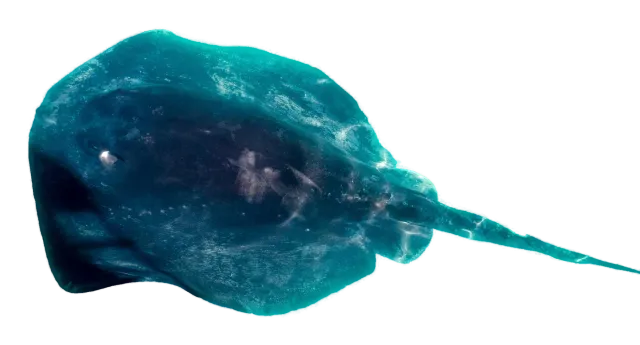
 StingraysBathytoshia brevicaudataStingrays have broad, rounded discs that ripple as they swim, no head fins, and a tail with one or more venomous barbs. They rest on sand and mud in bays and harbours. Mantas and devil rays have long, pointed wings that they beat up and down, and swim in open water.
- Reef manta ray
Not yet recorded in New Zealand. Reef mantas have dark spots between the gill slits on the belly, pale shoulder patches that angle back into a V shape, and no buried sting at the base of the tail. Oceanic mantas have T-shaped shoulder patches.
Protection
Protected: no take anywhere in New Zealand. The oceanic manta ray and spinetail devil ray have both been absolutely protected since 8 July 2010. Killing, harming or keeping one, or any part of one, is an offence; if you catch one by accident, release it in the water and report it to DOC on 0800 DOC HOT (0800 362 468) or sharks@doc.govt.nz.
Checked 22 October 2026 · Source: Wildlife Act 1953, Schedule 7A
Where it lives in New Zealand
The oceanic manta ray lives in open water in tropical and warm temperate seas around the world, and New Zealand is the southern edge of its range. Here it is seen off the east and west coasts of the upper North Island, mainly from spring to early autumn. Sightings off the north-east coast closely follow the path of the East Auckland Current. From December 2021 to January 2022, Manta Watch NZ received 99 sightings, mostly from the Bay of Islands, the Hauraki Gulf, Mercury Island, the Alderman Islands and the Bay of Plenty. In 2024 the IUCN Shark Specialist Group recognised the Hauraki Gulf as an important area for oceanic mantas.
DOC's species page says mantas spend about six months here, from October to March, before moving north towards Tonga and Fiji. DOC has also said that research on other populations suggests the mantas seen here each year may be resident in this part of the south-west Pacific. Courtship and heavily pregnant females have been seen in New Zealand, but no births have been confirmed. In 2019 DOC, Conservation International and the Tindale Marine Research Charitable Trust ran the first field study of mantas in New Zealand. Searching between the Bay of Islands and Doubtless Bay over four days, they saw 7 oceanic mantas and 26 devil rays, and fitted the first satellite tags to two mantas.
The spinetail devil ray comes to northern New Zealand each spring and summer and has been recorded as far south as about 38° S on both coasts of the North Island. It is usually seen at or near the surface in open water beyond the edge of the continental shelf, deeper than 200 m. Tuna spotter pilots say it is one of the most common large animals they see offshore in summer, often with schools of skipjack tuna. Devil rays are usually in small groups, but aggregations of several hundred are sometimes reported off Northland.
NIWA and DOC fitted pop-up satellite tags to nine devil rays caught in tuna purse seine nets between Great Barrier Island and the Bay of Islands. Two of the survivors swam north to Vanuatu (about 1800 km) and south of Fiji (about 1400 km), which suggests devil rays migrate each year between the South Pacific islands and northern New Zealand. They spent most of their time in the top 50 m but dived as deep as 1112 m, probably to feed.
- Jan: more often seen
- Feb: more often seen
- Mar: more often seen
- Apr: less often seen
- May: less often seen
- Jun: less often seen
- Jul: less often seen
- Aug: less often seen
- Sep: less often seen
- Oct: more often seen
- Nov: more often seen
- Dec: more often seen
If you hook one
Manta and devil rays are absolutely protected, so it is illegal to target, kill, harm or keep one, or any part of one. Catching one by accident is not an offence as long as you release it and report it to DOC.
DOC's handling guide says to release protected rays while they are still in the water, still in the net or on the line, where possible. If one comes aboard, return it to the sea head first with as little stress as possible: lower a small ray gently into the water, and slide a large one along the deck or lower it on a piece of net, plastic or canvas. Don't use a gaff, don't kick, hit or throw it, don't carry it by the tail or the gill slits, and don't leave it lying in the sun. Never cut off the tail or spine, or cut holes in the wings to pass a rope through. Watch the tail, as rays can strike in any direction. If you can't remove the hook or gear, cut the line so that no more than 1 m is left trailing.
Then report it to DOC as soon as possible: call 0800 DOC HOT (0800 362 468), email sharks@doc.govt.nz, or use the Protected Species Catch app. Note where it was caught and the water depth. If the ray dies, DOC may ask you to bring it ashore, as dead specimens are valuable for research.
If you meet a manta or devil ray while boating, slow down, keep quiet and don't cut through a group or get in their way. When diving or snorkelling, watch from a respectful distance and don't touch or ride them: it is illegal, and it strips the protective mucus from their skin, which can lead to infection. Mantas can't swim backwards and can tangle in ropes and float lines, so keep lines tidy around them.
Report any sighting to DOC at sharks@doc.govt.nz. Photos and video help, especially of a manta's belly, because the spot pattern identifies each animal. Note the date, time and GPS position. Manta Watch NZ also collects sightings through its app and online form.
Good to know
Mantas and devil rays are filter feeders. They funnel water into the mouth with their head fins and trap tiny animals on filter plates attached to the gill arches. In New Zealand mantas are often seen feeding on dense patches of zooplankton, sometimes swimming in repeated backward somersaults to stay in a patch. Spinetail devil rays feed mainly on krill, as well as copepods, small crustaceans and small fish. Both species leap clear of the water, and mantas visit cleaning stations where small fish pick parasites off them.
Both breed very slowly. A female manta has a single pup about every other year, 122 to 190 cm across at birth, after a pregnancy thought to last more than a year, and mantas don't mature until their teens. Devil rays also have a single pup, 92 to 99 cm across at birth. Males mature at about 2 m across. Late-term embryos found in purse seine catches suggest pregnant devil rays are fairly common in New Zealand waters. Orca and large open-ocean sharks probably prey on devil rays.
DOC classes the oceanic manta as Threatened (Nationally Vulnerable) in New Zealand and the spinetail devil ray as Data Deficient. The IUCN lists both as Endangered worldwide. Overseas, both are caught for their gill plates, used in traditional Chinese medicine, and for their meat and skin. There is no reported bycatch of oceanic mantas in New Zealand. Devil rays were mostly caught in the skipjack tuna purse seine fishery around the northern North Island; that fishery has almost stopped, and they are now an occasional bycatch on tuna longlines and in purse seines, and a rare one in albacore trolling. In NIWA's tagging study, four of the seven devil rays whose tags reported died within four days of release, even though all swam off strongly. Plastic, fishing line and other rubbish at sea are also a risk.
Both rays were added to Schedule 7A of the Wildlife Act 1953 by the Wildlife Order 2010, which came into force on 8 July 2010. The schedule still lists them under their older names, Manta birostris and Mobula japanica. Hunting, killing, possessing, buying or selling one, or any part of one, carries up to 2 years in prison, a fine of up to $250,000, or both. They are protected under the Wildlife Act only, which covers New Zealand fisheries waters out to 200 nautical miles.
Questions
Are there manta rays in New Zealand?
Yes. The oceanic (giant) manta ray is the only manta recorded here, and it is common off the north-east and west coasts of the upper North Island from spring to early autumn. Its smaller relative, the spinetail devil ray, also visits northern waters each summer.
Where and when can you see manta rays in New Zealand?
Most sightings come from the Bay of Islands, the Hauraki Gulf, the Mercury and Alderman Islands and the Bay of Plenty, between about October and March. December to February is the best time, when mantas feed on krill at the surface. Devil rays are usually further offshore, beyond the continental shelf off Northland.
Are manta rays dangerous?
No. DOC considers mantas harmless. They eat plankton and have no working sting. Divers have occasionally been towed at speed when a manta got tangled in their float line, so keep lines clear and watch from a distance. Devil rays have a small spine at the base of the tail, so take care if you have to release one.
What's the difference between a manta ray and a devil ray?
Size, head and tail. Oceanic mantas grow much larger, have a broad head with the mouth at the front, T-shaped pale patches on the shoulders and no working spine. Spinetail devil rays are mostly under 2.5 m across here, with a narrower head, the mouth underneath, a white tip on the dorsal fin and a small spine at the base of the tail.
How big do manta rays get?
The largest accurately measured oceanic manta was 6.7 m across, and DOC says they can reach about 7 m and 2000 kg. Mantas estimated at 2 to 7.9 m across have been reported in New Zealand. Spinetail devil rays are smaller, with the largest reported here 3.1 m across.
Are manta rays protected in New Zealand?
Yes. Oceanic mantas and spinetail devil rays have been absolutely protected under the Wildlife Act 1953 since 8 July 2010. It is illegal to hunt, kill, harm or possess one, or trade in any part of one. The penalty is up to 2 years in prison, a fine of up to $250,000, or both.
What should I do if I see a manta ray?
Enjoy it from a distance, don't touch it, and report it to DOC at sharks@doc.govt.nz or on 0800 DOC HOT (0800 362 468). A photo of the belly helps researchers identify the individual. You can also report sightings to Manta Watch NZ.