Eagle Ray
Whai keo, Whai repo (also used for the short-tail and long-tail stingrays)
Myliobatis tenuicaudatus
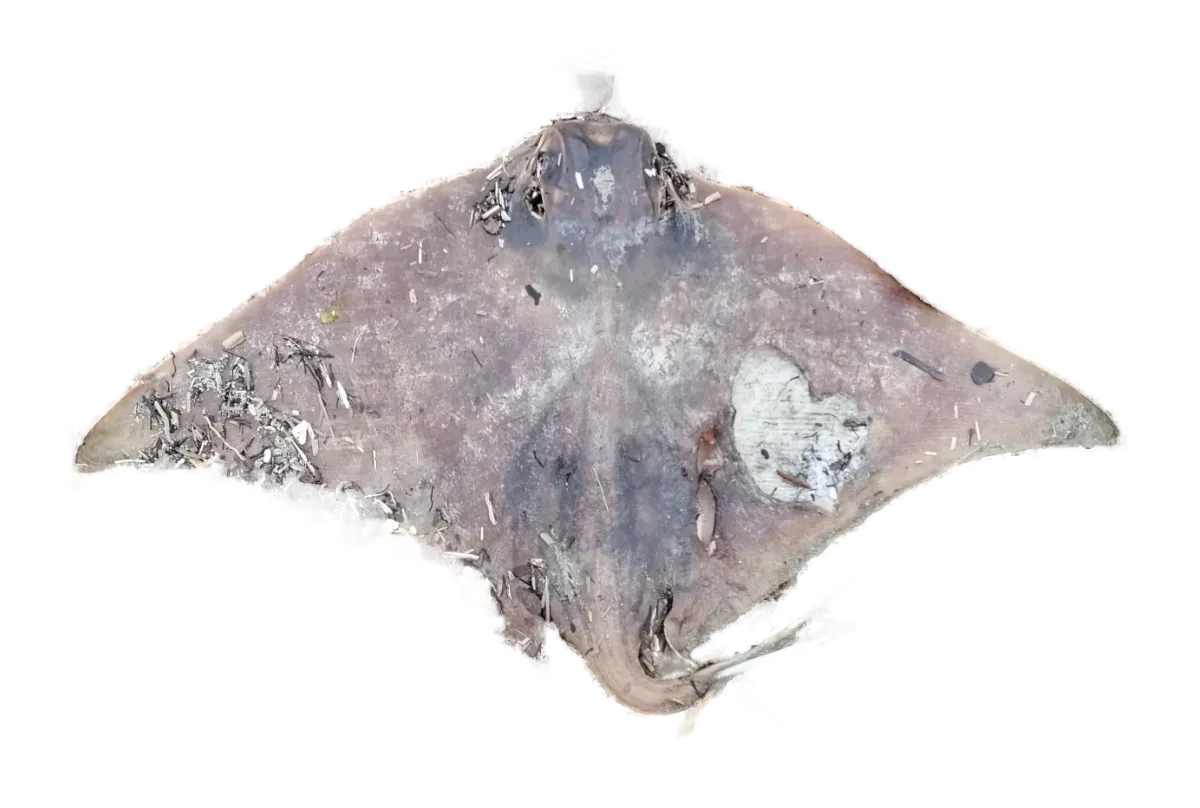
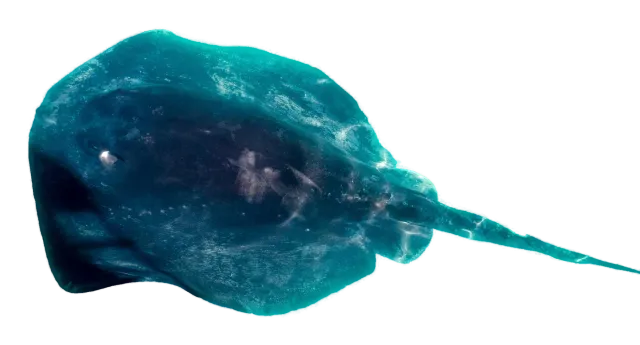
The eagle ray (whai keo) is a common New Zealand ray with pointed wings that it flaps like a bird, a thick head that sticks out in front, and a thin whip tail with a venomous spine. It is olive-green, grey or yellow-brown above with pale blue or grey markings, and lives in harbours, estuaries, bays and on reefs, mostly from Cook Strait north.
How to identify eagle ray
A diamond-shaped ray with long, pointed wings, which it flaps up and down like a bird as it swims. The head is thick and sticks out in front of the wings, with the eyes on the sides. The tail is thin and whip-like, with a small fin at its base and one or more small spines. There is no tail fin.
The upper side is olive-green, greenish-grey, yellow or dark brown, with pale blue or grey markings; the underside is pale yellow-white. Colour varies a lot, and the eagle rays in Wellington's Whairepo Lagoon range from grey to yellow and brown. A large eagle ray is about 1.5 m across the wings.
Often confused with

- Spinetail devil ray
Devil rays are open-ocean rays, dark blue to black above, up to about 3 m across, usually seen at the surface beyond the continental shelf and often leaping clear of the water. They strain plankton from the water, and they are protected. Eagle rays live on or near the bottom in harbours, bays and reefs.
Where it lives in New Zealand
Eagle rays live around New Zealand, the Kermadec Islands and Norfolk Island, from the shallows to about 160 m, and are most abundant from Cook Strait north. They are found over sand and mud and on rocky reefs, in bays, estuaries and harbours, and are usually alone.
They follow the tide. Tracking in small Northland harbours showed eagle rays orient to the water flow, coming into estuaries on the incoming tide and leaving on the outgoing tide. On northern sand flats you can see their feeding pits at low tide, about 30 cm across.
Eagle rays are a common summer sight on the Wellington waterfront. Up to a dozen gather in Whairepo Lagoon (by Frank Kitts Park) from about October or November until the water cools in April, where they have been seen feeding and mating. Where they go in winter is not known.
They are often recorded at Goat Island (Cape Rodney–Okakari Point Marine Reserve): iNaturalist users had logged 87 eagle ray observations inside the reserve by 24 October 2026, far more than of either stingray.
- Jan: more often seen
- Feb: more often seen
- Mar: more often seen
- Apr: more often seen
- May: less often seen
- Jun: less often seen
- Jul: less often seen
- Aug: less often seen
- Sep: less often seen
- Oct: more often seen
- Nov: more often seen
- Dec: more often seen
Good to know
Eagle rays feed on shellfish, crabs and worms. They dig prey out of the sand by taking water in through spiracles behind the eyes and jetting it out through the gills, which blasts away the sediment. Their teeth work like nutcrackers. MPI marine biologist Tim Riding says they also scavenge dead fish such as kahawai. Around reefs they eat Cook's turban shells, which they carry to a gravel patch to crack open.
Like stingrays, eagle rays give birth to live young, born at less than 50 cm. Orca, dolphins and hammerhead sharks hunt rays, and great white sharks in New Zealand have been found with eagle rays in their stomachs.
The IUCN lists the eagle ray as Least Concern (2015). It is not protected in New Zealand.
Questions
Are eagle rays dangerous?
Not usually. The spine on the tail is venomous and can give a painful wound, but eagle rays are not aggressive and, unlike stingrays, can't swing the spine around. Leave them be in the water, and if you're stung, soak the wound in hot water and see a doctor.
What's the difference between an eagle ray and a stingray?
Eagle rays have pointed wings that they flap like a bird, and a thick head that sticks out in front. Stingrays have broad, rounded wings that ripple as they swim, and no protruding head.
Where can I see eagle rays in New Zealand?
In shallow northern harbours, estuaries and bays, and on reefs. Whairepo Lagoon on the Wellington waterfront has up to a dozen from about October to April, and they are often recorded at Goat Island marine reserve.
What is the Māori name for eagle ray?
Whai keo. Te Aka Māori Dictionary also lists whai repo, which is used for the stingrays too.
What do eagle rays eat?
Shellfish, crabs and worms, which they dig out of the sand by jetting water through their gills, leaving pits about 30 cm across. They also scavenge dead fish.