Great White Shark
Mangō taniwha, Mangō ururoa, Tupa (Ngāi Tahu name)
Carcharodon carchariasAlso known as White pointer, White pointer shark, White shark

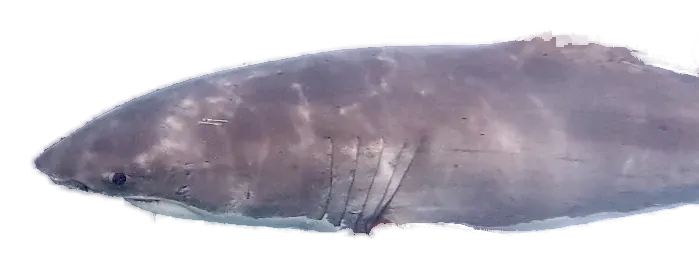
The great white shark, or white pointer, is a large, heavy-bodied shark with a blunt conical snout, black eyes and big triangular, saw-edged teeth. It is grey to almost black above and abruptly white below. New Zealand is one of the world's hotspots for the species, and it has been fully protected here since 2007.
How to identify great white shark
A huge, spindle-shaped shark with a blunt, conical snout, conspicuous black eyes and large, triangular teeth with saw edges. The back is lead-grey to brown or black, and the colour changes sharply to white on the belly. There is a black spot where the rear of the pectoral fin meets the body. The first dorsal fin is large and the second is very small. The tail is crescent-shaped, with the two lobes almost the same size.
Females grow larger than males. Females reach about 7 m and males about 5.5 m, but the largest reliably measured was 6.4 m. Reports of 9–11 m sharks have never been verified.
Often confused with
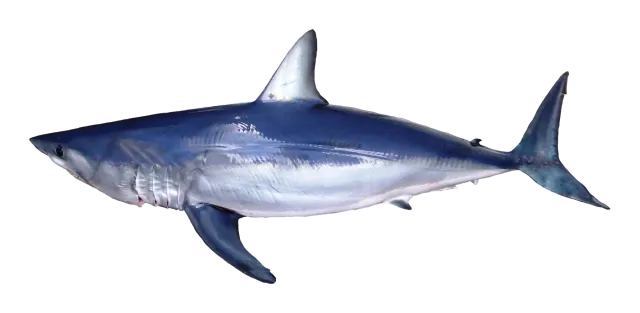
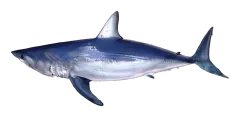 Mako SharkIsurus oxyrinchusMako are slimmer and deep indigo-blue above, with a sharp, pointed snout and long, narrow, hooked teeth with smooth edges. Great whites are bulkier and grey to black above, with a blunt snout and broad triangular teeth with saw edges.
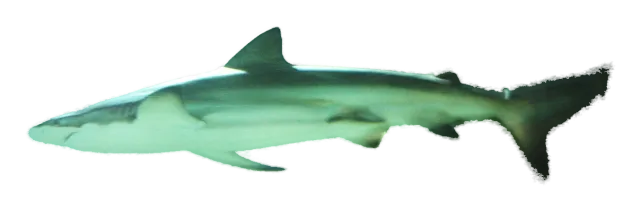
 Bronze WhalerCarcharhinus brachyurusBronze whalers are bronze or grey above with a cream belly, grow to about 3 m, and have dusky to black tips on the pectoral fins and narrow, bent upper teeth. Great whites are grey to black, much heavier, with broad saw-edged teeth and a black spot at the base of the pectoral fin.
- Porbeagle shark
Porbeagles are smaller (to about 3.5 m), with small, smooth-edged teeth that have tiny side points, and a bright white patch on the rear tip of the first dorsal fin. Great whites have large triangular saw-edged teeth and no white patch on the fin.
Protection
Protected: no take anywhere in New Zealand. Great white sharks are absolutely protected under the Wildlife Act 1953. Killing or keeping one, or any part of one, is an offence. If you hook one, release it in the water and report it to DOC.
Checked 22 October 2026 · Source: Wildlife Act 1953, Schedule 7A
Where it lives in New Zealand
Great whites live all around New Zealand, throughout the Exclusive Economic Zone north of about 53° S (Campbell Island). They are most often seen near large seal colonies. Juveniles and adults use shallow coastal waters, including large harbours and estuaries, and sub-adults and adults also range into the open ocean and around offshore islands and banks. Most records of pregnant, newborn and 1 to 2-year-old white sharks come from shallow coastal waters around the top half of the North Island.
Stewart Island and the Chatham Islands are the best-known gathering places. Satellite tags show that juveniles and adults leave these sites between March and September and travel to the tropical and subtropical Pacific, to Queensland and northern New South Wales, the Coral Sea, Norfolk Island, New Caledonia, Vanuatu, Fiji and Tonga. They spend at least 5 to 7 months north of New Zealand before coming back, often to the exact place they were tagged. No movement has been recorded between the Stewart Island and Chatham Islands groups.
Like other large sharks, great whites are encountered in coastal waters mostly in spring and summer.
- Jan: more often seen
- Feb: more often seen
- Mar: less often seen
- Apr: less often seen
- May: less often seen
- Jun: less often seen
- Jul: less often seen
- Aug: less often seen
- Sep: more often seen
- Oct: more often seen
- Nov: more often seen
- Dec: more often seen
If you hook one
You can't. Great whites are absolutely protected under the Wildlife Act 1953, so it is illegal to target, kill, harm or keep one, or any part of one, anywhere in New Zealand waters. New Zealand-flagged boats can't take them on the high seas either.
If you hook one by accident, it is not an offence as long as you release it and report it. DOC's handling guide says to release a shark without bringing it on board where you can, and to leave it in the water. If you can't remove the hook safely, cut the line as close to the hook as you can, keeping a safe distance. Don't gaff it, don't lift it by the tail, head or gill slits, and never cut off fins to free it. Circle hooks tend to hook sharks in the corner of the mouth, which makes a clean release more likely.
Then report it to DOC as soon as possible: call 0800 DOC HOT (0800 362 468), email sharks@doc.govt.nz, or use the Protected Species Catch app. Note where and how deep it was caught. If a great white dies, or you find one washed up, DOC may ask for it to be brought ashore for research.
Good to know
Great whites have been fully protected in New Zealand since April 2007. They are listed in Schedule 7A of the Wildlife Act 1953 ("white pointer shark"). Hunting, killing or possessing one is an offence carrying up to 2 years in prison, a fine of up to $250,000, or both. They are also listed on Appendix II of CITES, so exports need a permit, and on Appendices I and II of the Convention on Migratory Species. DOC rates them Nationally Endangered in New Zealand; the IUCN lists them as Vulnerable worldwide.
In 2018 the east Australasian population, which includes the sharks that move between New Zealand and eastern Australia, was estimated at about 5,500, with fewer than 1,000 in New Zealand waters and about 750 of breeding age.
Males mature at 3.5–4.1 m and about 7 to 9 years old; females at 4.2–5.2 m and about 15 years old. Pups are 109–165 cm long and 20–30 kg at birth, in litters of 3 to 14. Pregnancy is thought to last about 18 months, and great whites probably live 30 to 40 years.
In New Zealand they have been found to eat bony fish, other sharks, stingrays, eagle rays, little blue penguins, fur seals, sea lions, elephant and leopard seals, common and Hector's dolphins, and whale blubber scavenged from carcasses.
The main threats are bycatch in commercial and recreational fishing and, overseas, trophy fishing. Their habit of returning to the same places makes them vulnerable.
Questions
Are great white sharks protected in New Zealand?
Yes. Great whites have been fully protected since April 2007 under the Wildlife Act 1953. It is illegal to hunt, kill, harm or possess one, or any part of one, in New Zealand waters, and New Zealand boats can't take them on the high seas. The penalty is up to 2 years in prison, a fine of up to $250,000, or both.
What should I do if I catch a great white shark?
Release it as quickly as you can, ideally without bringing it aboard. If you can't remove the hook safely, cut the line close to the hook. Then report the catch to DOC on 0800 DOC HOT (0800 362 468), at sharks@doc.govt.nz or through the Protected Species Catch app. Catching one by accident is not an offence if you release and report it.
Where are great white sharks found in New Zealand?
All around the country, mostly near seal colonies. Stewart Island and the Chatham Islands are the best-known gathering places, and young sharks are found in shallow coastal waters around the top half of the North Island. Many leave for the tropical Pacific between March and September.
How many great white sharks are in New Zealand?
Nobody knows exactly. A 2018 estimate put the east Australasian population at about 5,500 sharks, with fewer than 1,000 in New Zealand waters and about 750 of breeding age across the population.
Are great white sharks dangerous in New Zealand?
Attacks are rare. DOC records three fatal great white attacks in New Zealand between 2013 and 2024, and 15 fatal shark attacks of any kind in the 180 years before 2020. Te Ara notes great whites caused most of the fatal attacks where the shark was identified. The risk is highest near seal colonies, where great whites feed.
How big do great white sharks get?
Females reach about 7 m and males about 5.5 m, but the largest reliably measured was 6.4 m and the heaviest accurately weighed was 2500 kg. A 4.7 m female caught off Port Waikato in 2005 weighed 1628 kg.
What's the difference between a great white and a mako?
Mako are slimmer and deep indigo-blue, with a sharp snout and long, smooth-edged, hooked teeth. Great whites are bulkier and grey to black, with a blunt snout and broad triangular teeth with saw edges. Great whites are protected; mako are not.