Basking Shark
Mangō reremai, Reremai
Cetorhinus maximus
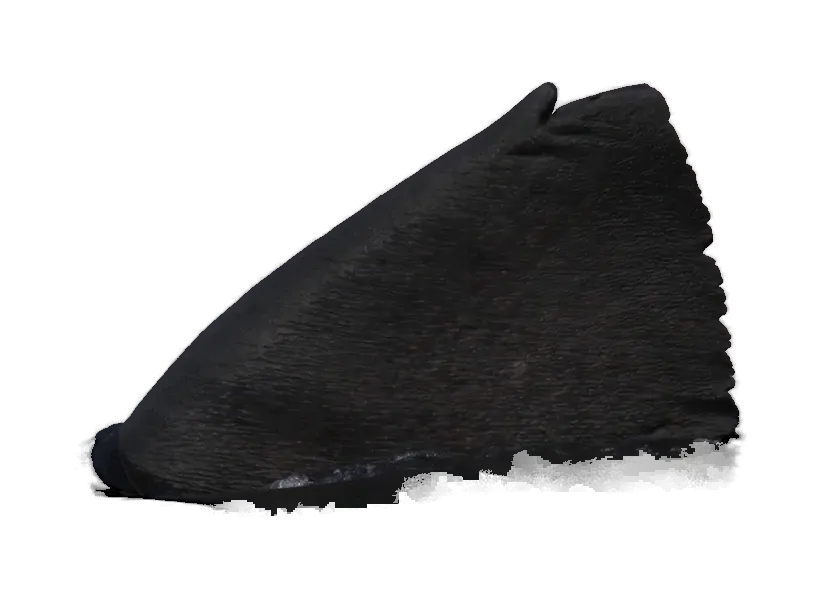
The basking shark is the second-largest fish in the world, a slow, harmless filter-feeder that grows to around 10 m and sieves plankton through gill slits that almost circle its head. New Zealand was once the Southern Hemisphere hotspot for the species, with schools of hundreds off Kaikōura and Banks Peninsula, but it has been rarely seen since the mid-1990s. It has been protected since 2010 and is rated Nationally Critical.
How to identify basking shark
A huge shark with a pointed snout and enormous gill slits that almost circle the head. When it feeds, the mouth gapes wide open and you can see the gill rakers inside, which sieve plankton from the water. The teeth are tiny and hooked. The body is blackish to grey-brown, grey or blue-grey, often with irregular white blotches under the head and belly. There are strong keels on each side of the tail stock, and the tail is crescent-shaped.
At the surface, the large, triangular first dorsal fin is often the first thing you see as the shark cruises slowly along.
Basking sharks reported in New Zealand waters have been 3.5 to 10.4 m long, but most are under 8 m.
Often confused with
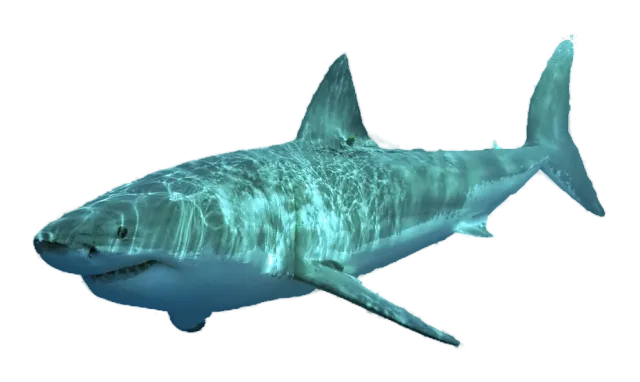
 Great White SharkCarcharodon carchariasBoth show a big triangular dorsal fin at the surface. A basking shark moves slowly, often with its mouth gaping open, and has huge gill slits that almost circle the head. A great white has a blunt, conical snout, black eyes, a closed mouth with large triangular teeth, and a sharp line between its grey back and white belly. Both are protected.
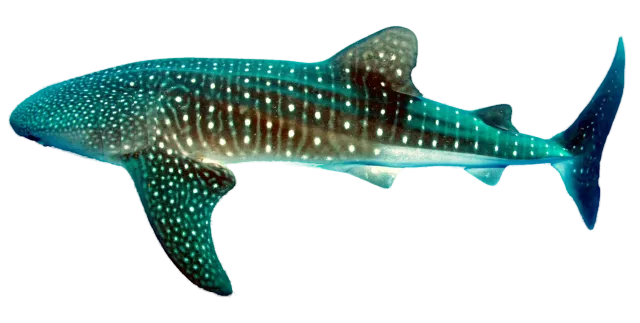
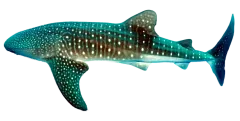 Whale SharkRhincodon typusWhale sharks have a broad, flat head with the mouth right at the front, and a checkerboard of pale spots and stripes on a dark back. Basking sharks have a pointed snout, no spots, and gill slits that almost circle the head. In New Zealand, whale sharks are seen in warm northern waters; basking sharks are most common south of about 39° S.
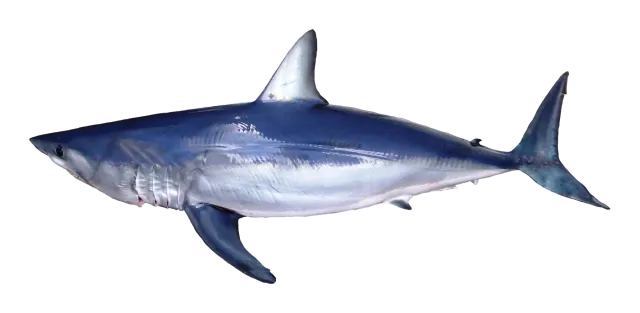
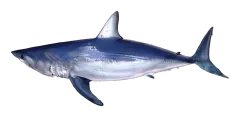 Mako SharkIsurus oxyrinchusMako are slim, fast and deep indigo-blue above with a sharp snout and long, hooked teeth. A basking shark is far bigger and bulkier, grey-brown, slow-moving, and has tiny teeth and huge gill slits.
Protection
Protected: no take anywhere in New Zealand. Basking sharks have been absolutely protected since 16 December 2010. Hunting, killing, harming or keeping one, or any part of one, is an offence (up to 2 years in prison, a fine of up to $250,000, or both), and New Zealand boats can't take them on the high seas either. If you catch one by accident, release it and report it to DOC on 0800 DOC HOT (0800 362 468) or sharks@doc.govt.nz.
Checked 22 October 2026 · Source: Wildlife Act 1953, Schedule 7A
Where it lives in New Zealand
Basking sharks live in cool temperate seas around the world. In New Zealand they range from the Kermadec Islands to the Auckland Islands, but are most abundant south of about 39° S.
In spring and summer they come inshore to the surface, sometimes right up to the surf zone, and have even entered brackish coastal lagoons such as Lake Ellesmere (Te Waihora). Large seasonal schools were once reported off Kaikōura and Canterbury (Pegasus Bay and Canterbury Bight). They favour coastal waters rich in plankton. The rest of the year they move offshore into deep water over the upper continental slope and oceanic banks.
Bycatch in trawl fisheries has been highest off Banks Peninsula, north-west of the Auckland Islands and in the Hokitika Canyon. Satellite tags suggest they prefer water of about 15–17.5 °C. Tagged basking sharks in the North-west Atlantic have travelled to the tropics at depths of 300–1000 m, below the warm surface water, and may even cross the equator.
- Jan: more often seen
- Feb: more often seen
- Mar: less often seen
- Apr: less often seen
- May: less often seen
- Jun: less often seen
- Jul: less often seen
- Aug: less often seen
- Sep: more often seen
- Oct: more often seen
- Nov: more often seen
- Dec: more often seen
If you hook one
Basking sharks are absolutely protected under the Wildlife Act 1953. It is illegal to hunt, kill, harm or keep one, or any part of one, anywhere in New Zealand waters, and New Zealand boats can't take them on the high seas either.
If you hook or net one by accident, it is not an offence as long as you release it and report it. Release it alive with as little harm as you can. DOC's handling guide says to leave a shark in the water where possible, and if you can't remove the hook safely, cut the line as close to the hook as you can, keeping a safe distance. Don't gaff it, don't lift it by the tail, head or gill slits, and never cut off fins to free it. Remove any trailing line or gear if you can.
Then report it to DOC as soon as possible: call 0800 DOC HOT (0800 362 468), email sharks@doc.govt.nz, or use the Protected Species Catch app. Note where it was and how deep. Very little is known about basking sharks, so a dead one is valuable to science. If one dies, DOC may ask you to bring it ashore.
If you see one while boating, slow down and keep noise down. Don't cut through a group or get in their way, and avoid sudden movements that might startle them. If you are in the water, swim slowly and quietly, don't swim straight at the shark, and never touch or try to ride one.
Please report every sighting or stranding to DOC on the same number or email. Photos help: full-length shots, the fins and any marks or scars, plus the exact location. Individual basking sharks can often be recognised from their markings.
Good to know
Basking sharks have been absolutely protected in New Zealand since 16 December 2010, when they were added to Schedule 7A of the Wildlife Act 1953. Hunting, killing or possessing one is an offence carrying up to 2 years in prison, a fine of up to $250,000, or both. The Fisheries Act 1996 also protects them from New Zealand boats fishing on the high seas. They are on Appendix II of CITES, so all trade in basking shark products within New Zealand is illegal, and on Appendices I and II of the Convention on Migratory Species.
DOC rates the basking shark Nationally Critical, the highest threat ranking for a species still found here, in the 2024 assessment of New Zealand sharks and rays (Duffy et al. 2025). It was Nationally Vulnerable in the 2016 assessment. The IUCN lists it as Endangered worldwide.
New Zealand was once the Southern Hemisphere hotspot for this species. Schools of 50 to 300 were regularly seen along the coast. Since the mid-1990s sightings have been rare, and inshore sightings have dropped by more than 90%. The last confirmed surface school was three sharks in Pegasus Bay in 2007. Aerial surveys around Banks Peninsula from 1990 to 1997 never went two years in a row without seeing one, but surveys in the summers of 2009/10 and 2010/11 found none. Nobody knows why they disappeared from coastal waters, or whether they have simply moved to different habitat.
A rare recent record: a 3.45 m (fork length) juvenile washed up on Gillespies Beach, near Franz Josef, in August 2024. The specimen went to Auckland Museum for necropsy (iNaturalist record, photo credited to DOC).
Basking sharks feed on zooplankton, mainly small crustaceans called copepods. They swim slowly through dense patches with the mouth wide open, and the gill rakers strain out the food. A 7 m shark swimming at 2 knots is estimated to filter about 1484 cubic metres of seawater an hour.
Little is known about their life history. Males are thought to mature at 5–7 m and 12 to 16 years old, females at 8.1–9 m and about 20 years. Pups are about 1.5–2 m at birth, and pregnancy may last up to 3.5 years. They probably live 30 to 60 years. Killer whales and great white sharks may prey on them.
Despite the size and the shared fin shape, they are related to the great white and mako (order Lamniformes), not to the whale shark.
The main threat here is bycatch: basking sharks are caught in set nets for rig and school shark, and in middle-depth and deepwater trawl fisheries for barracouta, squid and hoki. An estimated 922 were caught in the three trawl fisheries with the most bycatch between 1994–95 and 2007–08. Catches peaked in 1997–98 and then fell, though that may reflect less fishing rather than fewer sharks. Small numbers are still caught each year. Overseas, they were hunted for liver oil, and every directed fishery has followed the same pattern of high early catches, collapse and very slow or no recovery.
On 25 April 1977, Japanese fishermen hauled a rotting carcass aboard about 500 km east of Christchurch. Talk that it was a plesiosaur sparked "monster fever" in Japan, but it was later decided to be a basking shark.
Questions
Are there basking sharks in New Zealand?
Yes, from the Kermadec Islands to the Auckland Islands, but mostly south of about 39° S. Big schools were once seen off Kaikōura and Banks Peninsula, but sightings have been rare since the mid-1990s. Small numbers are still caught as bycatch in trawl fisheries around the south of the country.
Are basking sharks dangerous?
Not to people who leave them alone. They feed on plankton and have tiny teeth. FishBase describes them as ordinarily harmless, though potentially dangerous if attacked. They are very large, so keep a boat well clear and don't touch or try to ride one.
How big do basking sharks get?
Basking sharks are the second-largest fish in the world. Most seen in New Zealand are under 8 m, and the largest measured here was 10.43 m. An 8.8 m shark was estimated to weigh about 4.5 tonnes.
What do basking sharks eat?
Zooplankton, mainly tiny crustaceans called copepods. A basking shark swims slowly with its mouth wide open and sieves the plankton out with its gill rakers. A 7 m shark can filter around 1500 cubic metres of water an hour.
Are basking sharks protected in New Zealand?
Yes. They have been absolutely protected under the Wildlife Act 1953 since 16 December 2010, and New Zealand boats can't take them on the high seas. Killing or keeping one, or any part of one, can mean up to 2 years in prison, a fine of up to $250,000, or both. If you catch one by accident, release it and report it to DOC.
Is that a basking shark or a great white?
Both show a big triangular fin at the surface. A basking shark cruises slowly, often with its mouth gaping open, and has enormous gill slits that almost circle its head. A great white has a closed mouth, black eyes, a conical snout and a sharp grey-to-white colour line. Either way, keep your distance and report the sighting to DOC.
Where can I see a basking shark in New Zealand?
There is no reliable place any more. They used to gather off Kaikōura, in Pegasus Bay and the Canterbury Bight in spring and summer. DOC would like to hear about any sighting, with photos and the exact location, on 0800 DOC HOT (0800 362 468) or sharks@doc.govt.nz.