Hammerhead Shark
Mangōpare (also the name of a kōwhaiwhai pattern that symbolises the hammerhead), Kakere
Sphyrna zygaenaAlso known as Smooth hammerhead, Smooth hammerhead shark, Hammerhead

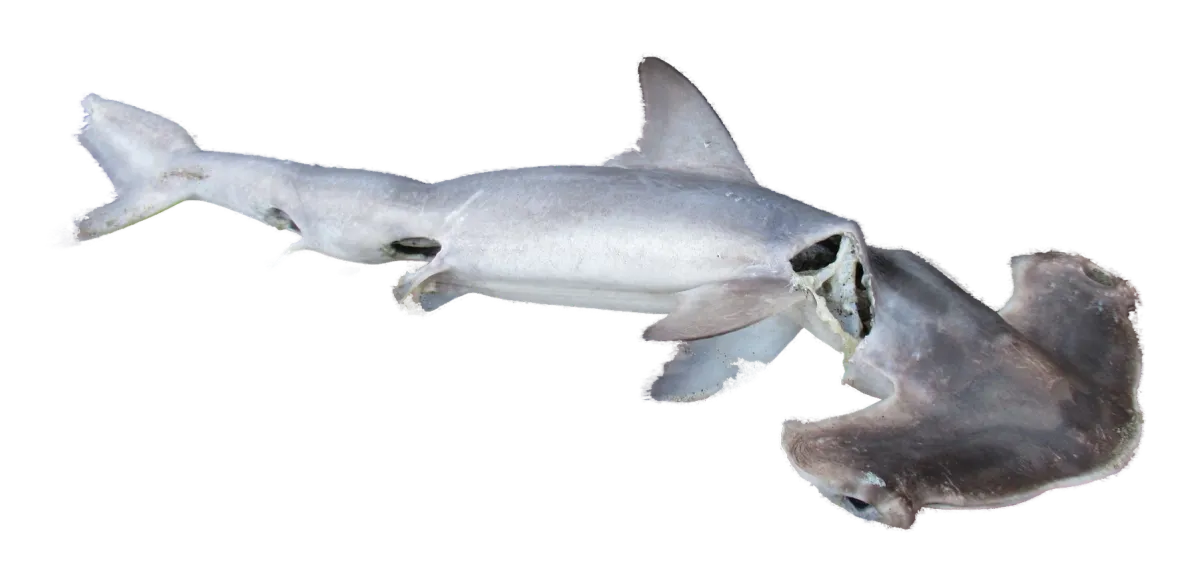
The smooth hammerhead is the only hammerhead shark recorded in New Zealand. Its flattened, hammer-shaped head has the eyes at the outer ends and a smooth, unnotched front edge. Young hammerheads are common in summer in shallow harbours and bays of the northern North Island, which are important nursery grounds.
How to identify hammerhead shark
The head is flattened and stretched out sideways into a broad hammer, with an eye and nostril at each end. The front edge of the hammer is evenly curved and has no notch in the middle. The body is olive to dark grey above and white below, and the undersides of the pectoral fin tips are dusky. The first dorsal fin is tall; the second dorsal and pelvic fins are low. Most hammerheads seen in New Zealand harbours are juveniles of 60 cm to 2 m.
Often confused with
- Scalloped hammerhead
Not recorded from New Zealand, but tropical hammerheads may visit occasionally. The scalloped hammerhead has a clear notch in the middle of the front edge of its head. The smooth hammerhead's head has no centre notch.
Where it lives in New Zealand
Found in temperate and tropical seas worldwide, from the coast out over the continental shelf to about 200 m. In New Zealand hammerheads are regular summer visitors to North Island waters and reach as far south as Cook Strait.
Juveniles are common in shallow coastal waters of the northern North Island and rare further south. The Firth of Thames, Hauraki Gulf, eastern Bay of Plenty and Ninety Mile Beach hold the highest numbers, and the Kaipara and Manukau Harbours are probably important too. Pups are born in summer at about 60 cm and use harbours, estuaries and shallow bays as nurseries until they are about two years old and 1.5 m long. Juveniles of 1.5 to 2 m are common off the west coast of the North Island, and young hammerheads sometimes gather in groups of 100 or more.
Little is known about adults in New Zealand. One shark tagged in the outer Hauraki Gulf in 2011 was caught near Tonga, about 2225 km away.
- Jan: more often seen
- Feb: more often seen
- Mar: more often seen
- Apr: less often seen
- May: less often seen
- Jun: less often seen
- Jul: less often seen
- Aug: less often seen
- Sep: less often seen
- Oct: less often seen
- Nov: less often seen
- Dec: more often seen
Good to know
The hammer-shaped head is thought to give lift as the shark swims, like a hydrofoil. Spreading the eyes and nostrils wide apart helps it find prey, and pores across the head sense the weak electrical fields of fish, squid and crabs buried in the sand. Smooth hammerheads eat mainly squid and bony fish.
Females carry their young inside them and feed them through a placenta. Litters are about 20 to 50 pups, born after 10 to 11 months. Smooth hammerheads mature at about 2.5 to 3 m and may live 20 to 25 years.
Hammerheads are not in the Quota Management System and are not protected in New Zealand. They are listed on Appendix II of CITES and as Vulnerable on the IUCN Red List (assessed 2018). Their stock status in New Zealand is unknown. Since 1 October 2014 commercial fishers must not fin sharks and must land shark fins naturally attached to the body.
Te Ara notes that large hammerheads can be dangerous to people, though FishBase says only a few attacks anywhere can be tentatively put down to this species. Te Ara names great white, mako and bronze whaler sharks as the species known to have caused fatal attacks in New Zealand.
Questions
Are there hammerhead sharks in New Zealand?
Yes. The smooth hammerhead is the only hammerhead recorded here. It visits North Island waters in summer, reaching as far south as Cook Strait, and juveniles are common in northern harbours and bays.
Are hammerhead sharks dangerous?
Very rarely. Te Ara says large hammerheads can be dangerous, but few attacks anywhere have been tied to this species. Most hammerheads seen in New Zealand are juveniles under 2 m. The sharks known to have caused fatal attacks in New Zealand are great whites, mako and bronze whalers.
Why are there baby hammerheads in the Hauraki Gulf?
The Firth of Thames and Hauraki Gulf are among the biggest hammerhead nursery grounds in New Zealand. Pups are born there in summer at about 60 cm and stay in sheltered, shallow water until they are about 1.5 m long and two years old.
What is the Māori name for hammerhead shark?
Mangōpare, also kakere. Mangōpare is also the name of a kōwhaiwhai pattern that represents the hammerhead.
Why do hammerheads have a hammer-shaped head?
The wide head is thought to give lift like a hydrofoil, and spreading the eyes and nostrils apart helps the shark find prey. Pores across the head detect the weak electrical signals of fish and crabs buried in the sand.