Whitebait
Īnanga (the fish and its whitebait)
Galaxias maculatus, Galaxias brevipinnis, Galaxias fasciatus, Galaxias argenteus, Galaxias postvectisAlso known as Īnanga, Inanga, White bait
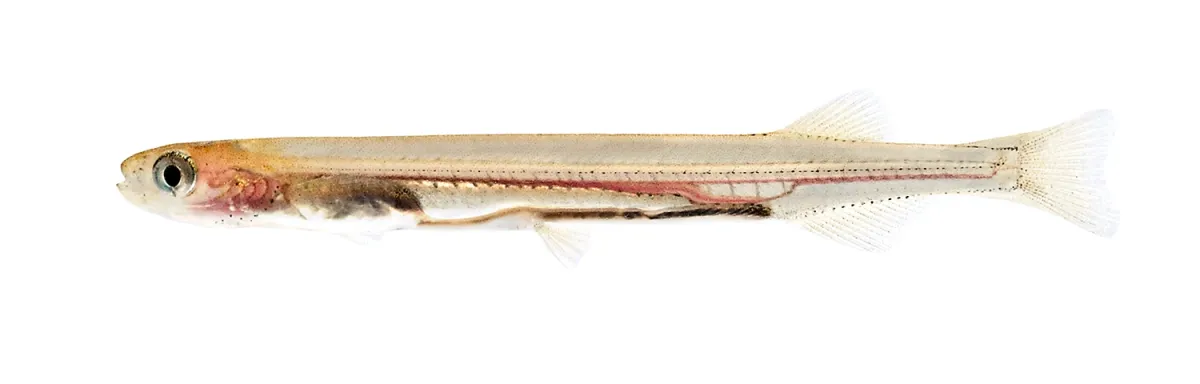
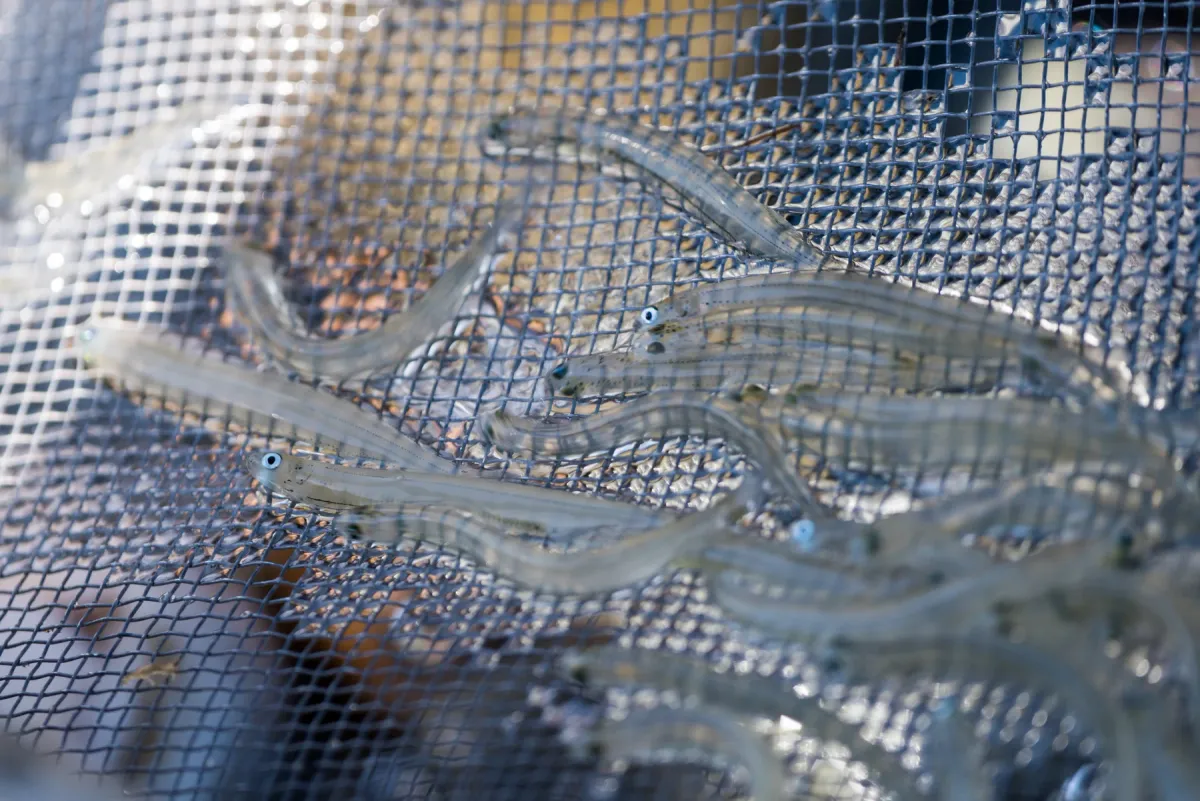
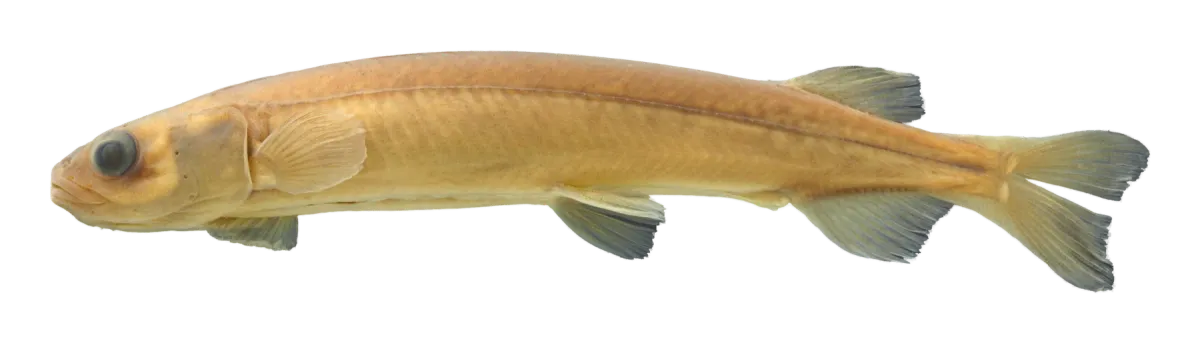
Whitebait are the see-through juveniles of five native galaxiid fish, caught in spring as they swim from the sea into rivers. Most of the catch is īnanga, a small silver-bellied fish found in coastal streams and wetlands. All five species are now classed as Threatened or At Risk.
How to identify whitebait
- Whitebait are slender and almost transparent, about 50–60 mm long, and are caught moving upstream from the sea in spring.
- Juvenile īnanga, the bulk of the catch, have distinctive black mouths.
- Adult īnanga are small and scaleless, with a speckled olive back, a bright silver belly and a slightly forked tail.
- Adult īnanga swim in shoals in open water during the day. The other whitebait species are mostly solitary and active at night.
- Banded kōkopu are among the smallest whitebait and often golden.
Whitebait is not one species. It is the juvenile, upstream-migrating stage of five native fish in the family Galaxiidae: īnanga, kōaro, banded kōkopu, giant kōkopu and shortjaw kōkopu. The legal definition in the Whitebait Fishing Regulations 2021 also includes the young of common smelt. As whitebait they look alike: slender, scaleless and nearly transparent, about 50–60 mm long.
Īnanga make up most of what is caught. NIWA puts it at usually about 95% of a whitebait fritter, with the rest mostly kōaro and banded kōkopu. A DOC ranger quoted in 2024 gave a figure of about 90%, depending on the river. Giant and shortjaw kōkopu turn up rarely and are very hard to pick from the others at the whitebait stage.
Juvenile īnanga have distinctive black mouths. Banded kōkopu whitebait are among the smallest and often golden. Shortjaw kōkopu whitebait have broad, dark vertical bands and are hard to tell from kōaro of the same size.
The adults are much easier to tell apart. Adult īnanga are small, usually 80–110 mm, with a speckled olive back, a bright silver belly and a slightly forked tail, and they are the only migratory galaxiid that swims in shoals. The other four grow larger, live longer, and are mostly found alone in forested or rocky streams.
Every whitebait species is now classed as Threatened or At Risk under the New Zealand Threat Classification System. The 2023 freshwater fish assessment, published by DOC in November 2025, moved īnanga from At Risk – Declining to Threatened – Nationally Vulnerable. The panel said this was due to a change in how the criteria are applied (based on the small area of īnanga spawning habitat), not a newly measured fall in numbers. Banded kōkopu moved from Not Threatened to At Risk – Naturally Uncommon for the same kind of reason.
Often confused with
- Kōaro (Galaxias brevipinnis), At Risk – Declining
Adults have a long, tube-shaped body with light patches and bands and broad, ribbed pectoral fins they use to climb waterfalls. They usually reach 160–180 mm and live in fast, cool forest or tussock streams, often far inland. As whitebait they are hard to tell from shortjaw kōkopu.
- Banded kōkopu (Galaxias fasciatus), At Risk – Naturally Uncommon
Adults are brown-red with thin pale bands that cross the back and join over the top, easiest to see near the tail. They grow to about 200 mm and live in small forested streams near the coast. The whitebait are among the smallest in the catch and often golden.
- Giant kōkopu (Galaxias argenteus), At Risk – Declining
The largest galaxiid, usually 200–300 mm, with golden spots and squiggles that give the family its name. Adults live under cover in wetlands, lakes and slow lowland streams and can live more than 20 years. DOC says their whitebait usually run later in the season.
- Shortjaw kōkopu (Galaxias postvectis), Threatened – Nationally Vulnerable
Adults have a lower jaw shorter than the upper, a blue-black patch behind each gill and marbled brown to olive colouring, and usually reach 150–200 mm. The rarest whitebait species, found mainly in rocky forest streams in the west. Whitebait carry broad dark vertical bands.
- Common smelt (Retropinna retropinna), At Risk – Declining
Not a galaxiid at all but a member of a separate family, Retropinnidae. Its young are still included in the legal definition of whitebait, so they can be taken in a whitebait net.
Season and rules
Season (most of NZ)1 September to 30 OctoberDates and gear rules
| Area | Season opens | Season closes |
|---|---|---|
| Most of New Zealand All of mainland New Zealand and Stewart Island, including the West Coast. You also can't possess whitebait taken from these waters outside the season. | 1 September | 30 October |
| West Coast of the South Island Same season as the rest of New Zealand since 2022. Extra gear and stand rules apply (see rules marked West Coast). | 1 September | 30 October |
| Chatham Islands Runs from 1 December to the last day of February the following year (29 February in a leap year). | 1 December | 28 February |
Gear and fishing rules
- Hours
- Fish only between 5 am and 8 pm, or between 6 am and 9 pm during New Zealand daylight time.
- Removing gear
- Take all your gear out of the water when you finish fishing, and in any case by 8 pm (9 pm during daylight time). DOC also says gear must come out whenever you move more than 10 m from your net.
- Number of nets
- Use only one whitebait net at a time, and stay within 10 m of it.
- Net size
- A whitebait net can be no more than 3.5 m long overall, with a mouth no more than 4.5 m around the inside of the frame. Framing material can be no more than 120 mm wide.
- Drag netsAll areas except the West Coast
- Drag net netting can be no more than 3.5 m long and 1 m high, must lie flat with no pockets, bags, funnels or traps, and the whole drag net can be no more than 6 m long laid out.
- Drag netsWest Coast
- Drag nets are banned. You can't use, set or possess one in or beside any river, stream, estuary or channel on the West Coast.
- Total gear length
- All your fishing gear together can be no more than 6 m long, including when you fish from a stand. Gear includes nets, screens, stakes, ropes and spotter boards.
- Width of the waterway
- Your gear, alone or together with gear already set by others, can't take up more than a quarter of the width of the river, stream, estuary or channel at that place and time.
- Screens
- Screens are the only thing you can use to steer whitebait into a net. They can total no more than 3 m unless you fish from a licensed stand, and one net can't be placed to divert whitebait into another.
- ScreensWest Coast
- Screens must be set from the water's edge and only on the bank side of the net, never on the side furthest from the bank. From a stand, screens can't extend beyond its outer edges.
- Spacing between set gear
- Fixed (set) gear must be at least 20 m from any other fixed gear already set, except when fishing from a licensed stand. There is no minimum distance between scoop or drag nets.
- Distance from structures
- Don't fish within 20 m of a confluence, culvert, floodgate, groyne, outfall structure, tide gate or weir, or any unlawful diversion.
- Stands
- Only one whitebait net can be used from a licensed stand at a time, by anyone. Stands are licensed under the Resource Management Act by regional councils.
- StandsWest Coast
- Don't fish from an unlicensed structure. A net used from a licensed stand must be in a straight line from its upstream or downstream edge.
- Distance from standsWest Coast (Schedule 3 rivers)
- On the 21 rivers listed in Schedule 3, don't fish within 40 m of a licensed stand someone else is already fishing from, on either bank. On the Mokihinui River this doesn't apply if you are fishing from another licensed stand.
- Bycatch
- Return any other fish species to the water straight away, taking care that they survive. Don't dump them on shore.
- Riverbed and banks
- Don't alter the bed or banks of the waterway or build any diversion.
- Unlawful nets
- Don't have whitebait in your possession together with a net you aren't allowed to use, even if it isn't being fished.
- Licence and catch limit
- The regulations don't require a licence and set no daily catch limit. DOC says they don't prohibit selling your catch.
- Penalties
- Most breaches carry a $400 infringement fee or a court fine of up to $800. Prosecution can bring a fine of up to $5,000, and DOC can seize gear.
Where you can't whitebait
- Non-tidal water: you can only fish where the water level rises and falls with the tide. Where DOC has placed a back-peg, don't fish upstream of it.
- Whitebait refuges listed in Schedule 2: all rivers and streams in Fiordland from Yates Point to the Waitutu River, rivers in and leaving Abel Tasman National Park from Taupō Point to Tinline Stream, and named rivers, creeks and lagoons on the West Coast. You can't possess whitebait or gear in a refuge.
- National parks and public reserves under the Reserves Act 1977, anywhere in New Zealand.
- From a bridge.
- From a boat or any other vessel, including rafts. People with a disability who can't fish any other way can apply to DOC for an exemption.
Checked 23 October 2026 · Source: Whitebait Fishing Regulations 2021 (LI 2021/180), as at 23 December 2023. Check DOC's whitebaiting page before you go.
Where it lives in New Zealand
Īnanga live in coastal creeks, streams, rivers, lagoons, lakes, estuaries and wetlands. They are weak swimmers and can't climb past waterfalls or fast rapids, so most stay in lowland water close to the sea. The species is not endemic. DOC describes it as the most widely distributed native freshwater fish in the world, also found in Australia, Chile, Argentina and the Falkland Islands.
Īnanga spawn in late summer and autumn. From about February to May, a few days before a full or new moon, adults move downstream to where fresh water meets the salt water pushing up on the tide. On a high spring tide they push into flooded vegetation at the very edge of the water and lay their eggs at the base of tall, dense grasses. A female can release up to 13,000 eggs.
When the tide drops, the eggs are left out of the water in the grass for 2–4 weeks. The next spring tide makes them hatch, and the larvae are carried out to sea. They feed on plankton in coastal waters for about six months, then return to rivers and streams in spring at about 55 mm long. This upstream run is the whitebait. Juveniles spend the summer in backwaters and slow reaches and are mature by late summer. Most īnanga live only about a year, and many die after spawning.
The other four species spawn differently. Kōaro and the kōkopu lay their eggs in streamside vegetation, leaf litter or gravel when rain raises the water, and the eggs hatch when the next flood covers them. Their larvae also go to sea and come back as whitebait. Some populations of kōaro and the kōkopu are landlocked and rear their young in lakes instead.
How to catch it
Whitebait are caught as they move upstream from the sea, using hand-held scoop nets, set nets fished from the bank with screens to guide the fish in, or from licensed stands on some rivers. When you can fish, where, and with what gear are all set by the Whitebait Fishing Regulations 2021. See the whitebait season guide for the current dates and gear rules.
Any other fish caught while whitebaiting must go straight back into the water alive.
Eating
The classic New Zealand way to eat whitebait is the whitebait fritter. Because the catch is a mix of species, a fritter can contain the young of all five galaxiids, though mostly īnanga.
Buying: selling whitebait is legal. DOC says the regulations don't prohibit whitebaiters selling their catch, and it doesn't regulate the sale. Prices vary from season to season and we haven't yet found a reliable, dated source for them, so they aren't listed here.
Good to know
Whitebait is a taonga species and an important mahinga kai for Māori. Māori fishing rights exercised by tangata whenua sit outside the Whitebait Fishing Regulations 2021 and are managed by local rūnanga, iwi and hapū under tikanga, which can include rāhui.
Fishing is only one pressure on these fish. The 2023 threat assessment lists the main threats to īnanga as barriers to fish passage, such as flap gates, pump stations, weirs and culverts, and the loss of habitat through drainage and channel straightening. Its spawning grounds, in the lower reaches of rivers and the top of estuaries, are small and prone to being smothered by sediment. For the kōkopu and kōaro, sedimentation, loss of streamside forest and introduced trout add to the pressure.
Because īnanga return to the same spawning sites year after year, those sites can be protected. NIWA's advice is to protect and restore streamside vegetation where eggs are laid, fix barriers so whitebait can move upstream, keep waterways clean and remove pest fish and plants. Community projects that fence and plant local streams help with all of these. Whitebaiters can help by sticking to the rules and respecting refuges and rāhui, and by checking, cleaning and drying gear between waterways so they don't spread didymo and other pests.
Questions
What fish is whitebait?
Whitebait is the juvenile stage of five native galaxiid fish, caught as they return from the sea to rivers in spring. About 90–95% of the catch is īnanga (Galaxias maculatus). The rest is mostly kōaro and banded kōkopu, with the occasional giant or shortjaw kōkopu.
Is whitebait endangered?
All five whitebait species are classed as Threatened or At Risk. Under the 2023 assessment, īnanga and shortjaw kōkopu are Threatened – Nationally Vulnerable, kōaro and giant kōkopu are At Risk – Declining, and banded kōkopu are At Risk – Naturally Uncommon.
What does adult whitebait look like?
It depends on the species. Most whitebait grow into īnanga, a small fish of about 80–110 mm with a speckled olive back, a silver belly and a slightly forked tail. The kōkopu and kōaro grow larger and have bands, spots or blotches.
When is whitebait season?
The season dates are set by the Whitebait Fishing Regulations 2021, with one season for most of New Zealand including the West Coast and a separate one for the Chatham Islands. See our whitebait season guide for the current dates and rules.