
Pacific Bluefin Tuna
Thunnus orientalis formerly Thunnus thynnus orientalisAlso known as Northern bluefin tuna, bluefin, blue fin tuna
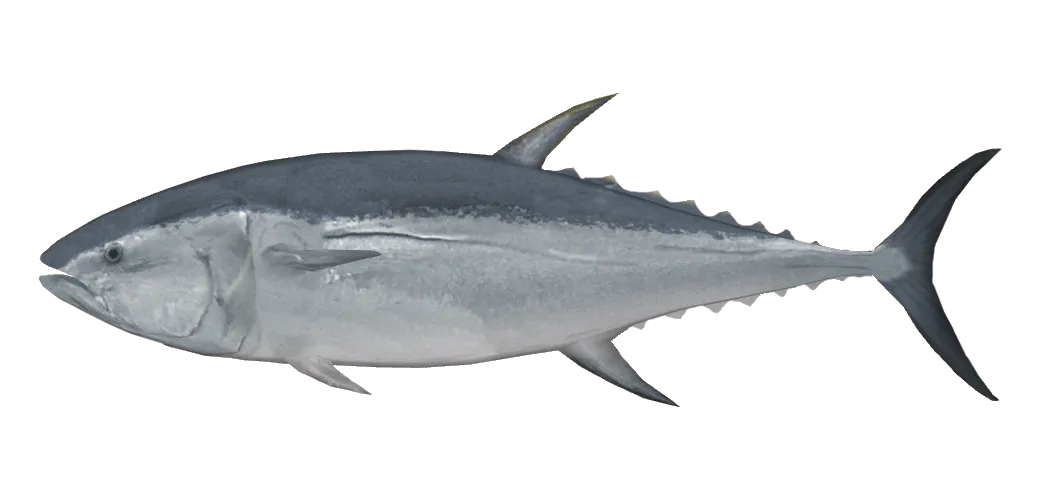
Pacific bluefin tuna is a very large ocean tuna that visits New Zealand from its North Pacific spawning grounds. Look for a black or dark blue back, short pectoral fins and dark tail keels. Big fish are targeted in winter off the West Coast of the South Island, and the deep red, fatty flesh is prized for sashimi.
How to identify pacific bluefin tuna
A very large, heavy-bodied tuna. The back is black or dark blue with a grey-green sheen, and the belly is silver or grey with spots or bands. A row of small yellow finlets edged in black runs to the tail. The pectoral fins are short and do not reach the second dorsal fin. The keels at the base of the tail are dark. In New Zealand, Pacific bluefin are usually larger than southern bluefin, though no single external feature is reliable on its own.
Often confused with
- Southern Bluefin Tuna
Southern bluefin have yellow tail keels, while Pacific bluefin have dark ones, but keel colour can be unreliable in large fish.
Size and daily limits
Daily limitNo species limitCounts towards the combined finfish limit (20–30 a day). A shared limit applies in Fiordland.Limits for each area
| Area | Min. size | Daily limit |
|---|---|---|
| Auckland and Kermadec area | None | No species limit (combined 20 a day) |
| Central area | None | No species limit (combined 20 a day) |
| Challenger area | None | No species limit (combined 20 a day) |
| Kaikōura area | None | No species limit (combined 30 a day) |
| South-East area | None | No species limit (combined 30 a day) |
| Fiordland area (Fiordland Marine Area) | None | Varies, see note No species limit: counts towards Fiordland's 'any other finfish' limit of 10 a day, or 4 inside the Fiords. |
| Southland area | None | No species limit (combined 30 a day) |
Not named on any regional page. NOTE: every region lists 'Southern bluefin tuna' at 1 per day; that is a different species (Thunnus maccoyii) and is not applied here.
Checked 22 October 2026 · Source: MPI. Rules change, so check the NZ Fishing Rules app before you keep a fish.
Where it lives in New Zealand
Pacific bluefin are one Pacific-wide stock that lives mainly in the North Pacific and spawns between Japan and the Philippines. Adults visit New Zealand and are found throughout the EEZ, with commercial catch rates highest off the east coasts of both islands from April to July. Since 2004 a recreational fishery has targeted large fish off the West Coast of the South Island, where they feed on spawning hoki in winter. Tagged fish have stayed in New Zealand and Australian waters for several months.
- Jan: quieter
- Feb: quieter
- Mar: quieter
- Apr: quieter
- May: quieter
- Jun: good
- Jul: good
- Aug: good
- Sep: good
- Oct: quieter
- Nov: quieter
- Dec: quieter
How to catch it
Most commercial catch is bycatch on tuna longlines. Recreational catches are occasional, apart from the West Coast fishery where charter and private boats target big fish feeding near hoki trawlers. Charter boats must register and report their catch. Keep well clear of trawlers and their nets. Many fish are tagged and released.
Eating
Raw flesh is deep red, firm and rich in fat. It is mostly eaten raw as sushi and sashimi. Cooking is generally not recommended because it brings out a strong fishy taste and smell. Higher fat content is treated as a sign of better quality.
Good to know
Pacific bluefin entered the Quota Management System in 2004 as a single stock, TOR 1. They mature at 3 to 5 years and live 15 years or more. DNA testing has found no evidence that Atlantic bluefin are caught in New Zealand waters.
Questions
What's the difference between Pacific and southern bluefin tuna?
Mainly the tail keels and size. Southern bluefin have yellow tail keels and Pacific bluefin have dark ones, though keel colour can be unreliable in large fish. In New Zealand, Pacific bluefin are usually larger, but no single external feature is reliable on its own.
When is bluefin tuna season in NZ?
Winter. The West Coast recreational fishery for Pacific bluefin runs from about June to September, when big fish feed near hoki trawlers off the South Island. Commercial catch rates are highest off the east coasts of both islands from April to July.
How big do Pacific bluefin tuna get?
Adults reach about 3 m long and 550 kg. Fish seen in New Zealand are usually 1.5 to 2 m long. They mature at 3 to 5 years and live 15 years or more.
Related species
 Saltwater
 Saltwater
 EndemicSaltwater
 Saltwater
More guides
All guides- ArticlesNZ fishing rigs and knots: diagrams and when to use eachClear diagrams of the main NZ fishing rigs (ledger, running sinker, strayline, surfcasting, live bait) and the knots to tie them, with which fish each catches.
- ArticlesHow to fillet a fish: snapper, gurnard, kahawai and moreStep-by-step filleting for NZ fish, with photos: the basic method, skinning and pin bones, and what is different about snapper, gurnard, kahawai and blue cod.
- ArticlesBest time to fish in New ZealandWhen to catch snapper, kingfish, kahawai, tuna, trout and salmon in New Zealand, with a month-by-month calendar and what bites in each season.