
Leatherjacket
Kōkiri
Meuschenia scaber formerly Parika scaberAlso known as Creamfish, smooth leatherjacket, velvet leatherjacket, leather jacket
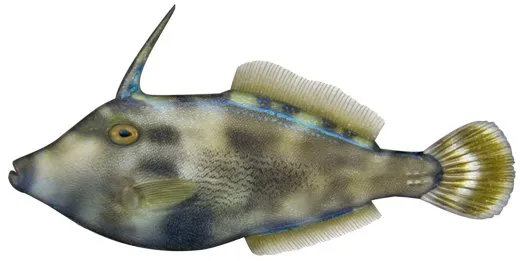
Leatherjacket (kōkiri) is a small, oval reef fish found around much of New Zealand, most commonly in the north. Tough, sandpaper-like skin and a single strong spine above the eye make it easy to identify. It is rarely caught on a line, but has firm, very white flesh and is sold skinned as creamfish.
How to identify leatherjacket
A deep, oval, side-flattened fish with tough leathery skin covered in tiny spines that feel like velvet or sandpaper. A single strong spine sits above the eye and folds down into a groove, giving a horned look when raised. The body is greenish-grey, plain or mottled, often with dark blotches and bars running down from the eye, and the fins are orange. Males are more uniform and have a yellow tail with a thin dark bar near its edge; females and young fish are more mottled. The mouth is small, with strong teeth.
Size and daily limits
Daily limitNo species limitCounts towards the combined finfish limit (20–30 a day). A shared limit applies in Fiordland.Limits for each area
| Area | Min. size | Daily limit |
|---|---|---|
| Auckland and Kermadec area | None | No species limit (combined 20 a day) |
| Central area | None | No species limit (combined 20 a day) |
| Challenger area | None | No species limit (combined 20 a day) |
| Kaikōura area | None | No species limit (combined 30 a day) |
| South-East area | None | No species limit (combined 30 a day) |
| Fiordland area (Fiordland Marine Area) | None | Varies, see note No species limit: counts towards Fiordland's 'any other finfish' limit of 10 a day, or 4 inside the Fiords. |
| Southland area | None | No species limit (combined 30 a day) |
Not named on any regional page; combined finfish limit only.
Checked 22 October 2026 · Source: MPI. Rules change, so check the NZ Fishing Rules app before you keep a fish.
Where it lives in New Zealand
Leatherjackets are found around much of New Zealand but are most common in the north. They live near rocky reefs, weed beds and rough seafloor, sometimes over sand or in midwater, from the shallows to beyond 100 m, and are most abundant at 40 to 60 m. They do not school but often move in small groups. Males defend territories, and eggs are laid in nests on the seafloor in spring and summer.
How to catch it
Leatherjackets are seldom caught on rod and line. Their small mouths let them strip bait from hooks without being hooked, which made them unpopular with early fishers. Most recreational catch comes from spearfishing, craypots and set nets. Anglers who target them use small hooks and baits fished close to weedy reef.
Eating
Leatherjacket has firm, very white flesh that suits most cooking methods. The tough skin is removed before cooking, and fish are usually sold headed and skinned. That processed product is sold as creamfish, a trade name adopted to help sales.
Good to know
Managed under the Quota Management System since 2003. Leatherjackets live to at least 7 years and mature at about two years and 19 to 22 cm. Rough and smooth leatherjackets were once thought to be separate species but are now treated as one species with variable colouring. They also occur in southern Australia.
Questions
Is leatherjacket good eating?
Yes. Leatherjacket has firm, very white flesh that suits most cooking methods. Remove the tough skin before cooking. Commercially the fish is usually sold headed and skinned, under the trade name creamfish.
What is creamfish?
Creamfish is the trade name for leatherjacket that has been headed and skinned. The name was adopted to help sales. Under the tough skin the flesh is firm and very white, and it can be cooked most ways.
Why are leatherjackets hard to catch?
Their small mouths let them strip bait from a hook without getting hooked. Anglers who target them use small hooks and small baits fished close to weedy reef. Most recreational catch comes from spearfishing, craypots and set nets.
Related species
 Saltwater
 Saltwater
 EndemicSaltwater
 Saltwater
More guides
All guides- ArticlesHow to fillet a fish: snapper, gurnard, kahawai and moreStep-by-step filleting for NZ fish, with photos: the basic method, skinning and pin bones, and what is different about snapper, gurnard, kahawai and blue cod.
- ArticlesBest time to fish in New ZealandWhen to catch snapper, kingfish, kahawai, tuna, trout and salmon in New Zealand, with a month-by-month calendar and what bites in each season.