
Kahawai
Kōhere (young kahawai), Kōwaitau (young kahawai), Koria (kahawai fry)
Arripis truttaAlso known as Australian salmon, Eastern Australian salmon, Sea trout, Sea salmon, KY
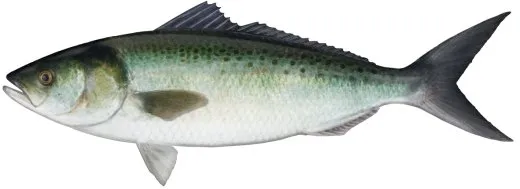
Kahawai is New Zealand's second most caught recreational fish after snapper. It is a fast, schooling coastal fish with a torpedo-shaped body, a dark blue-green back marked with rows of dark spots, silver sides and a large forked tail. Found all around the coast, it is a hard fighter on lures and very good smoked.
How to identify kahawai
- A streamlined, torpedo-shaped body, only slightly flattened from side to side.
- Dark blue-green to grey-green back and silvery white sides and belly, with irregular dark spots on the upper sides in loose rows.
- Yellowish pectoral fins with a dark spot at the base.
- A large, deeply forked tail with a blackish edge, and a dark edge on the spiny front part of the dorsal fin.
- Young fish have golden bars along the upper sides, which break up into spots as they grow.
Kahawai are built for speed: a long, torpedo-shaped body, a spiny dorsal fin running into a soft one, and a big, deeply forked tail. The back is dark blue-green to grey-green and the sides and belly silvery white. The upper sides carry irregular dark spots, arranged in rough rows along the body.
Look at the pectoral fins, just behind the gill cover. On kahawai they are yellowish, with a dark spot where they join the body. The tail and the front of the dorsal fin have a blackish edge. Young kahawai have golden bars along the upper sides instead of spots, and these break up into spots as the fish grow.
A second, larger species, the Kermadec or northern kahawai (Arripis xylabion), lives around the Kermadec Islands and turns up seasonally around Northland. It is a deeper blue, with faint grey spots and grey rather than yellow pectoral fins, and an even bigger tail. Fisheries New Zealand manages the two together.
Often confused with
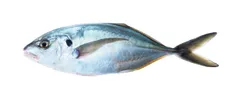 TrevallyPseudocaranx georgianusTrevally have a deeper, flatter body, a small dark spot on the upper gill cover and a row of hard scutes near the tail. Kahawai are slimmer, with dark spots along the back and no scutes.
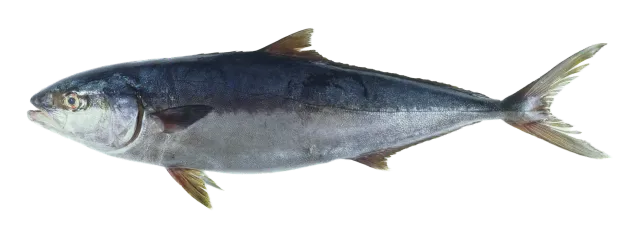
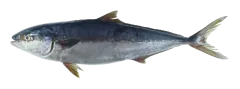 KingfishSeriola lalandiKingfish have a yellow stripe along each side and a yellow tail, no spots on the back, and grow far larger.
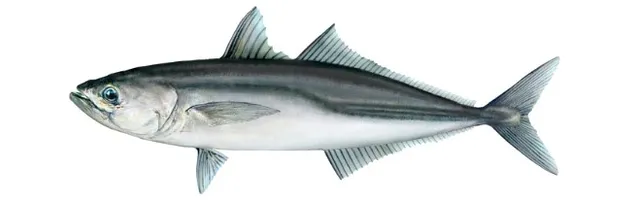
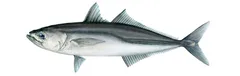 Jack MackerelTrachurus novaezelandiaeJack mackerel are much smaller and have a row of hard, scute-like scales along the whole lateral line, plus a black spot on the gill cover.
- Kermadec kahawai
A larger northern relative. It is a deeper blue with faint grey spots, has grey pectoral fins rather than yellowish ones, and has an even bigger forked tail.
Size and daily limits
Daily limit5–15 a dayNo species limit in Auckland and Kermadec, Central, and Challenger.Limits for each area
| Area | Min. size | Daily limit |
|---|---|---|
| Auckland and Kermadec area | None | No species limit (combined 20 a day) |
| Central area | None | No species limit (combined 20 a day) |
| Challenger area | None | No species limit (combined 20 a day) |
| Kaikōura area | None | 10 |
| South-East area | None | 15 Lyttelton Harbour/Whakaraupō: 5 per day. Rāpaki mātaitai: no take. |
| Fiordland area (Fiordland Marine Area) | None | 5 Inside the Fiords: 1 per day. |
| Southland area | None | 15 |
Within combined finfish daily limit.
Checked 22 October 2026 · Source: MPI. Rules change, so check the NZ Fishing Rules app before you keep a fish.
Where it lives in New Zealand
Kahawai are found right around New Zealand, including the Chatham and Kermadec Islands, but are more common around the North Island. They live mainly in open coastal water, harbours and estuaries, and seldom go more than about 20 km offshore. They will also move into the brackish lower reaches of rivers, which is why river mouths are classic kahawai spots.
They school by size and travel along the coast, driving baitfish to the surface. The churning water draws terns and shearwaters, and diving birds are the easiest way to find a school. Tagging shows most kahawai stay in the same area for several years, though some travel widely. The main concentrations are around the Bay of Plenty and the top of the South Island.
Young kahawai grow up in shallow water over eelgrass meadows and in estuaries. Spawning grounds are poorly known, but are thought to be near the seabed offshore: schools of ripe females have been trawled at 60–100 m in Hawke Bay, and eggs have been found in the outer Hauraki Gulf in February.
- Jan: good
- Feb: good
- Mar: good
- Apr: good
- May: good
- Jun: good
- Jul: good
- Aug: good
- Sep: good
- Oct: good
- Nov: good
- Dec: good
How to catch it
Lures: kahawai hit most small, shiny lures, and spinning is the classic method. Metal slices, spoons, small spinners and soft baits all work, as do small poppers when fish are feeding on top. Find a school by the birds working over it, cast ahead of or into the edge of the school, and retrieve fast with a few sudden stops, so the lure looks like an injured baitfish. Silver lures that flash are a good start, but carry a few sizes and colours, as kahawai can be choosy on the day. In deeper water, small metal jigs often get hit on the drop or on the first few turns of the reel. Trolling a small lure or feather around headlands and current lines also picks up fish.
Bait: from beaches, rocks, river mouths and wharves, kahawai take pilchards, pipi, cockles, squid and strips of fresh fish. On the beach, fish the gutters (deeper channels running along the shore) with a two-hook surfcasting or ledger rig, and skin-on cut baits stay on the hook better than soft pilchards. In harbours and off wharves a lightly weighted strayline works well, and berley brings fish up and keeps them close. See our rig guide for how to tie each one and the bait guide for what to use where.
Once it's landed: a kahawai's dark, oily flesh goes downhill fast if the fish is left to thrash and warm up on deck. Kill it straight away, cut the throat or gills to bleed it, and put it in an ice slurry. Our bleed-and-ice guide covers each step. Then fillet it like any round fish, or keep the fillets skin-on for the smoker. Kahawai is also one of the best baits there is, live or as cut strips, for snapper and kingfish.
Eating
Kahawai has a mixed reputation, and handling explains most of it. A 1966 encyclopaedia called the flesh "rather dry and tasteless" fresh, but Te Ara now notes that kahawai that are bled and kept cool give good-quality fillets. The flesh is darker than snapper or tarakihi, oily, with medium to thick flakes.
Bleed it and get it into an ice slurry as soon as it's caught. This matters more for kahawai than for most fish: MPI lists kahawai among the fish that can form histamine if they aren't chilled properly, which can make people sick. Trim out the dark strip of blood muscle along the centre of each fillet if you want a milder flavour.
Smoked kahawai is the classic, and it's the dish most people search for. Hot smoke skin-on fillets after a short brine; our smoking guide has a step-by-step smoked kahawai recipe. Fresh kahawai also suits baking, barbecuing, frying, curries and marinades, and very fresh, well-bled fish is excellent raw, as sashimi or in raw fish salad. Eat it within a few days; it doesn't keep well in the freezer.
Treat a kahawai like you'd treat a snapper: kill it, bleed it and get it on ice straight away. Then trim out the dark meat and eat it within a day or two. Handled right, it's an underrated fish.
Recipes
- Smoked kahawai (RNZ)
- Beetroot-cured kahawai gravlax bagels (Seafood New Zealand)
- Kahawai fish tacos (RNZ)
Good to know
Kahawai is New Zealand's second biggest recreational fishery. Recreational fishers kept an estimated 513,980 kahawai (about 810 tonnes) in the year to September 2023, second only to snapper. Almost half came from the northeast of the North Island (the KAH 1 stock). More than 9 in 10 were caught on rod and line, about half from trailer boats and over a third from the shore. The estimate was roughly half the 2017–18 figure, though harvest estimates for most finfish fell over the same period.
Kahawai and Kermadec kahawai entered the Quota Management System together on 1 October 2004, under the single code KAH. Commercial fishers catch most of their kahawai by purse seine, often while targeting jack mackerels and trevally, which school with kahawai. The only stock with an accepted assessment is KAH 1, assessed in 2021. It was about as likely as not to be at or above its target level, and overfishing was very unlikely to be occurring. The status of the other stocks is unknown.
Kahawai grow fast, reaching about 15 cm by the end of their first year, and mature at 3–5 years old and 35–40 cm long, after which growth slows. The oldest recorded fish was 26 years old. The longest was 79 cm (fork length), caught by a recreational fisher in the Waitangi Estuary, Hawke Bay, in 1997. Adults feed mainly on small fish and on krill and other swimming crustaceans, and are in turn eaten by orca, bottlenose dolphins, kingfish and bronze whaler sharks.
Kahawai is an important traditional food fish for Māori, and Te Aka lists several names for the young fish and fry, as well as koko kahawai, a large spoon-shaped landing net used to catch them. Don't confuse it with kāhawai, with a long a, which is the Caspian tern.
Questions
Is kahawai good eating?
Yes, if it's handled well. Kill it quickly, bleed it and put it straight into an ice slurry, and the dark, oily flesh is very good smoked, raw or cooked. Left to warm up on deck, it turns soft and strong-tasting, which is where its old reputation as a poor eating fish comes from.
How do you bleed a kahawai?
Kill the fish as soon as it's landed, cut across the gills on both sides or cut the throat, and let it bleed out in a bucket of seawater or an ice slurry. Then keep it in the slurry until you fillet it. Our bleed-and-ice guide has the full method.
What are the best lures for kahawai?
Small, flashy lures that look like baitfish. Metal slices, spoons, spinners, soft baits and small poppers all catch kahawai. Cast into or ahead of a feeding school and retrieve quickly with a few sudden stops. Silver is a good start, but carry a few colours and sizes.
When do kahawai run?
Kahawai are caught all year, wherever they live. They are in best condition in spring, when they chase whitebait. They school and move along the coast, so look for diving birds over surface schools, and fish river mouths, where kahawai often gather.
How many kahawai can I keep?
It depends where you fish. The daily limit is different in each MPI fishing area, some harbours have their own rules, and kahawai also count toward the combined daily limit for finfish. Check the table on this page, which shows the current rules for every area and when we last checked them against MPI.
How big do kahawai get?
Most kahawai caught are 40–50 cm long, and the average kahawai kept by recreational fishers in 2022–23 weighed about 1.6 kg. The longest on record was 79 cm (fork length), and the New Zealand all-tackle record listed by the NZ Sport Fishing Council is 9.75 kg, caught off the North Shore in 1981.
Related species
 Saltwater
 Saltwater
 Saltwater
 Saltwater
More guides
All guides- ArticlesFishing knots: how to tie the six knots NZ anglers useHow to tie the uni, snell, palomar, uni-to-uni, dropper loop and improved clinch knots, with step-by-step animated diagrams and when to use each one.
- ArticlesSurfcasting in NZ: gear, rigs, bait and how to read a beachHow to surfcast in NZ: the rod, reel and rig to start with, the best baits, how to read a beach for gutters and holes, and when the fish come in.
- ArticlesHow to bleed and ice your catch (and why it matters)Iki jime, bleeding and an ice slurry make your catch taste better and keep longer. How to do each, with diagrams and notes for kahawai, kingfish and snapper.