
Chinook Salmon
Hāmana
Oncorhynchus tshawytschaAlso known as King salmon, quinnat salmon

Chinook salmon, also called king or quinnat salmon, is an introduced Pacific salmon that runs up South Island east coast rivers such as the Waimakariri, Rakaia, Rangitata and Waitaki from December to April. Black gums on the lower jaw identify it. It is New Zealand's largest salmon or trout and a prized eating fish.
How to identify chinook salmon
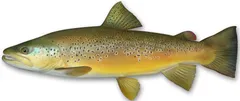
Fresh-run fish from the surf or tidal water are mostly silver with a dark grey-green back. There are many small black spots on the back and on both lobes of the tail. The gums of the lower jaw are black, which separates chinook from other salmon and trout in New Zealand. Fish darken as they move upriver to spawn, and males and females colour differently. Lake-locked fish are smaller than sea-run fish.
Size and daily limits
Fish & Game New Zealand regulates sports fishing (trout, salmon) throughout New Zealand except the Taupō area, where fishing is administered by the Department of Conservation (DOC).
Everyone, of any age, must carry a valid New Zealand Sports Fishing Licence (or be named on a family licence with the primary holder present) when fishing for sports fish. Fish & Game licences (apart from Local Area) are valid anywhere in NZ except the Taupō area. Overseas visitors must buy a Non-Resident Licence. Fishing with the wrong licence is regarded as fishing with no licence. Taupō requires a separate DOC Taupō fishing licence.
Seasons and daily limits are set by region; check the Fish & Game regulations for the water you plan to fish. Fishing in the sea is covered by the MPI rules.
Where it lives in New Zealand
Chinook live mainly on the east coast of the South Island, from the Waiau River south to the Clutha. The main runs are in the large braided rivers: the Waimakariri, Rakaia, Rangitata and Waitaki. Small runs occur in the Paringa, Taramakau and Hokitika rivers on the West Coast, and some landlocked stocks live in lakes. Young fish go to sea and most return to spawn at about three years old. All adults die after spawning in autumn.
- Jan: good
- Feb: good
- Mar: good
- Apr: good
- May: quieter
- Jun: quieter
- Jul: quieter
- Aug: quieter
- Sep: quieter
- Oct: quieter
- Nov: quieter
- Dec: good
How to catch it
A Fish & Game freshwater licence is required. Most fish are taken on heavy spinning gear upriver, or by long-distance surfcasting beside river mouths. Large silver spoons and wobblers are standard.
Eating
Chinook has a rich, full flavour and soft, delicate flesh high in natural oils. It can be served rare or raw, and suits any cooking method. It cooks quickly and is done when the flesh turns opaque and flakes. Fish caught soon after entering fresh water are in the best condition, as they lose condition travelling upstream.
Good to know
Chinook are native to the North Pacific and are the largest salmon or trout in New Zealand. Wild runs are too small for commercial fishing, and Fish & Game says spawning runs are now under 10% of 1990s levels. Salmon sold in supermarkets is farmed.
Questions
Do you need a licence to fish for salmon in NZ?
Yes. You need a Fish & Game freshwater fishing licence to fish for salmon. Fish & Game sets seasons, bag limits and other rules by region, and sea-run salmon have their own rules, so check the current regulations for the river you plan to fish.
Where can you catch salmon in NZ?
Mostly in the large braided rivers of the South Island east coast, from the Waiau south to the Clutha: the Waimakariri, Rakaia, Rangitata and Waitaki hold the main runs. Anglers spin upriver or surfcast beside river mouths. Small runs reach some West Coast rivers, and some lakes hold landlocked salmon.
When is salmon season in NZ?
The sea-run salmon spawning run lasts from December to April and usually peaks around mid-March. Fish are in the best condition soon after they enter fresh water. Fish & Game sets open seasons and limits by region, so check the regulations for your river before you go.
Related species
 Freshwater
 Saltwater
 Saltwater
 EndemicSaltwater
More guides
All guides- ArticlesHow to bleed and ice your catch (and why it matters)Iki jime, bleeding and an ice slurry make your catch taste better and keep longer. How to do each, with diagrams and notes for kahawai, kingfish and snapper.
- ArticlesNZ fishing rigs and knots: diagrams and when to use eachClear diagrams of the main NZ fishing rigs (ledger, running sinker, strayline, surfcasting, live bait) and the knots to tie them, with which fish each catches.
- ArticlesHow to fillet a fish: snapper, gurnard, kahawai and moreStep-by-step filleting for NZ fish, with photos: the basic method, skinning and pin bones, and what is different about snapper, gurnard, kahawai and blue cod.